Yes, a Democrat won Kentucky in 2019. Here’s why it’s more difficult for McGrath.
Heading into 2019, it was unclear if a Democrat could still win a statewide election in Kentucky.
Republicans held super majorities in the state House and state Senate. Despite becoming a magnet for political donors, former Marine Corps pilot Amy McGrath came up short in 2018 in a congressional district that contains Kentucky’s second largest city. Eastern Kentucky — once a Democratic stronghold — rapidly turned red on the heels of President Donald Trump’s election.
Andy Beshear, though, was able to stitch together enough votes to prove doubters wrong by juxtaposing his calm and disciplined message against former Gov. Matt Bevin’s brash, shoot-from-the-hip persona.
The open question of 2020 is whether Beshear’s strategy can be replicated as Democrats head into November with their eyes set on taking down U.S. Sen. Mitch McConnell.
“There is no statewide race in Kentucky where we can sit back, put our feet up and win the race,” said Marisa McNee, spokeswoman for the Kentucky Democratic Party. “But what we saw in 2019 is that it can be done.”
Republicans contend Beshear only won because he was running against the enormously unpopular Bevin, but Democrats see the path Beshear took as a model for how to win statewide in Kentucky, providing a potential glimmer of hope in a state that has otherwise been voting overwhelmingly conservative.
In the past five years, Democrats have gone from controlling five of the six independently elected state constitutional offices to just one. And there hasn’t been a Democratic U.S. Senator from Kentucky since Wendell Ford retired 22 years ago.
McGrath — who has raised millions in her effort to unseat McConnell and has brought in field staff from around the country — gave a vague answer when asked if she would attempt to replicate Beshear’s path to victory.
“I’m going to talk to all Kentuckians, urban and rural,” McGrath said.
While it seems possible to replicate on paper, Beshear’s path may be more of a mirage.
“Anybody trying to read tea leaves from that election into future results is on a fools errand,” said Tres Watson, a Republican campaign consultant.
After a McGrath campaign event at the Fuzzy Duck in Morehead, where Beshear campaigned a little more than a year before, Vaughn Carter, 78, of Menifee County said she was still holding out hope for McGrath.
“Because we elected Beshear, I’m going to say she’s got a shot,” Carter said. “Otherwise, I couldn’t get up in the morning.”
An unpopular incumbent
Not many people liked Matt Bevin. The former governor appeared to relish confrontation.
Most famously, he picked a fight with teachers when he tried to reform the state’s pension system, at one point going so far as to suggest that children may have been sexually abused because teachers were protesting in Frankfort.
But there were other, smaller things. He held up road funds, he wasn’t always receptive to the needs of county judge-executives. He expressed support for tolls in Northern Kentucky less than a month before the election.
“Matt Bevin was so disliked by even Republicans that the path is a once in a lifetime thing that happened,” Watson said. “You just had this compendium of issues that doesn’t exist for any other candidate.”
Democrats are quick to point out that McConnell is unpopular, too. He consistently ranks among the least popular senators in the country, but creating juxtaposition between McConnell and a Democratic candidate is more difficult.
The McGrath campaign has focused on an obvious line of attack — the 35 years McConnell has spent in Congress — to both rally her Democratic base while appealing to people who voted for Trump so he could “drain the swamp.”
In her stump speech, McGrath says McConnell has done little for Kentucky during his tenure in the Senate — citing Kentucky’s poor rankings for wages, employment, cancer rates, diabetes and heart disease. She asserts McConnell cares more about power than helping Kentuckians. (He points out he is the only leader in Congress that’s not from New York or California).
McGrath’s approach appears to have had limited success. A recent poll by Quinnipiac University found that more people view McGrath unfavorably than McConnell, despite saying they believe McGrath is more honest and more likely to care about Kentuckians.
McGrath’s campaign has also tried to raise the profile of Libertarian candidate Brad Barron, only agreeing to debates where Barron was invited, in an attempt to highlight a conservative alternative for those who don’t like McConnell.
Still, it is unclear if McGrath’s attempt to drive a wedge between McConnell and Trump will have much of an effect, especially as the Senate Majority Leader has positioned himself as a key defender of Trump in Washington D.C.
“I think there’s not the same level of distrust or dislike for McConnell as there was for Matt Bevin,” Watson said.
A federal race
It’s different running for governor as a Democrat in Kentucky than running for federal office.
“In federal elections, people in this state appear pretty set in their ways,” said Matt Erwin, a Democratic political consultant.
Gubernatorial elections take place in a year when there are no federal elections on the ballot, making it more difficult to tie candidates to the national Democratic Party. It allowed Beshear to avoid taking firm stances on Trump.
Instead, Beshear focused on the “kitchen table issues” of education, health care and jobs. That was McGrath’s takeaway from Beshear’s 2019 campaign.
“He focused on the bread and butter issues,” McGrath said. “So if you’re referring to a focus on bread and butter issues, that’s what I’ve been doing all along.”
Still, McGrath has struggled with how to handle Trump’s popularity in the state, saying she would have voted to impeach him while also not mentioning the president’s name when criticizing “the leadership” in Washington D.C. The stance has alienated both Democrats and Republicans alike.
McNee, the communications director for the state Democratic Party, said COVID-19 has made health care and the economy more urgent than ever, forcing McConnell to focus on the issues McGrath wants to talk about.
“In this election he’s having to address more readily the issues that are usually in-state issues,” McNee said.
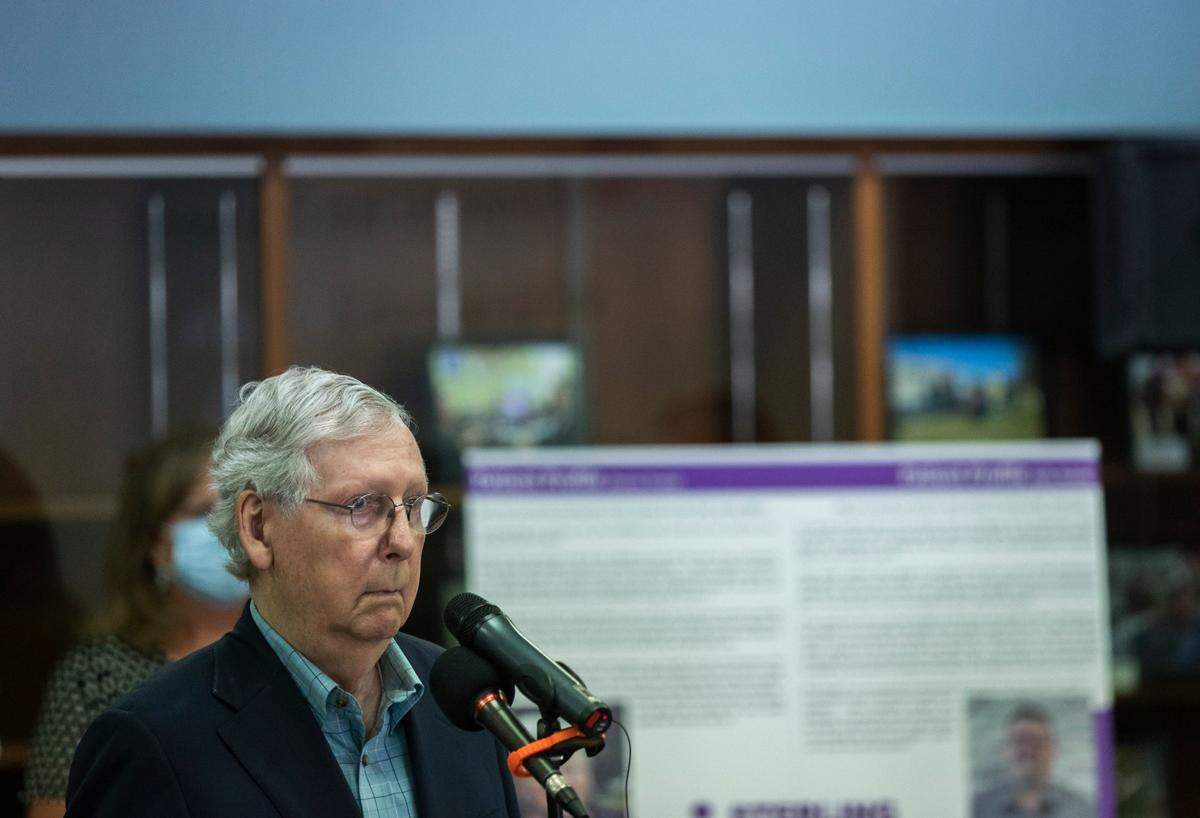
McConnell, though, has happily toured the state touting money the federal government provided to keep businesses and hospitals afloat, even as McNee said he’s “fumbled repeatedly” in his role negotiating relief packages.
McConnell has said it is unlikely Congress will pass another relief package until after the November election, as Democrats and Republicans couldn’t find common ground on the next phase.
Despite that lack of action, a September Quinnipiac poll found that 55 percent of likely Kentucky voters approve of how McConnell has handled the coronavirus pandemic.
The math
Increased voter turnout in a presidential year means McGrath would have to take “the Beshear path on steroids,” according to Erwin. In 2019, 1.44 million Kentuckians voted for governor, nearly 500,000 fewer people than voted in the 2016 presidential race.
“If McGrath is going to follow the 2019 Beshear path, the same path has to be followed but the number has to be cranked up,” Erwin said. “It can’t just be winning the suburbs of Lexington and Louisville. It has to be knocking the door off the hinges.”
Her support appears strong in Lexington and Louisville, but the state’s two largest cities don’t have the ability to singlehandedly shape elections. Beshear won Fayette County and Jefferson County by a combined 135,254 votes, including Fayette County by 32.5 percentage points, a much larger margin than McGrath’s 20.3 percentage points the year before.
That lead quickly shrunk as votes were tallied in Kentucky’s rural counties. By the end of the night, Beshear only beat Bevin by about 5,000 votes.
While the cities can give Democratic candidates a buffer, they still must win over voters in at least some of the state’s more populated rural counties.
For years, Eastern Kentucky was the stronghold that helped boost Democrats into statewide office. In 2019, Beshear leaned on former House Minority Leader Rocky Adkins to whip up support in Eastern Kentucky (Adkins has not hit the campaign trail for McGrath so far and McGrath has not asked Adkins to campaign for her).
Eastern Kentucky voters have rapidly shifted to the right in the past decade, so much so that districts once held by Adkins and former Senate minority leader Ray Jones are now controlled by Republicans.
“Especially when you’re talking about federal races, it’s going to be a while before they get the east back,” Watson said.
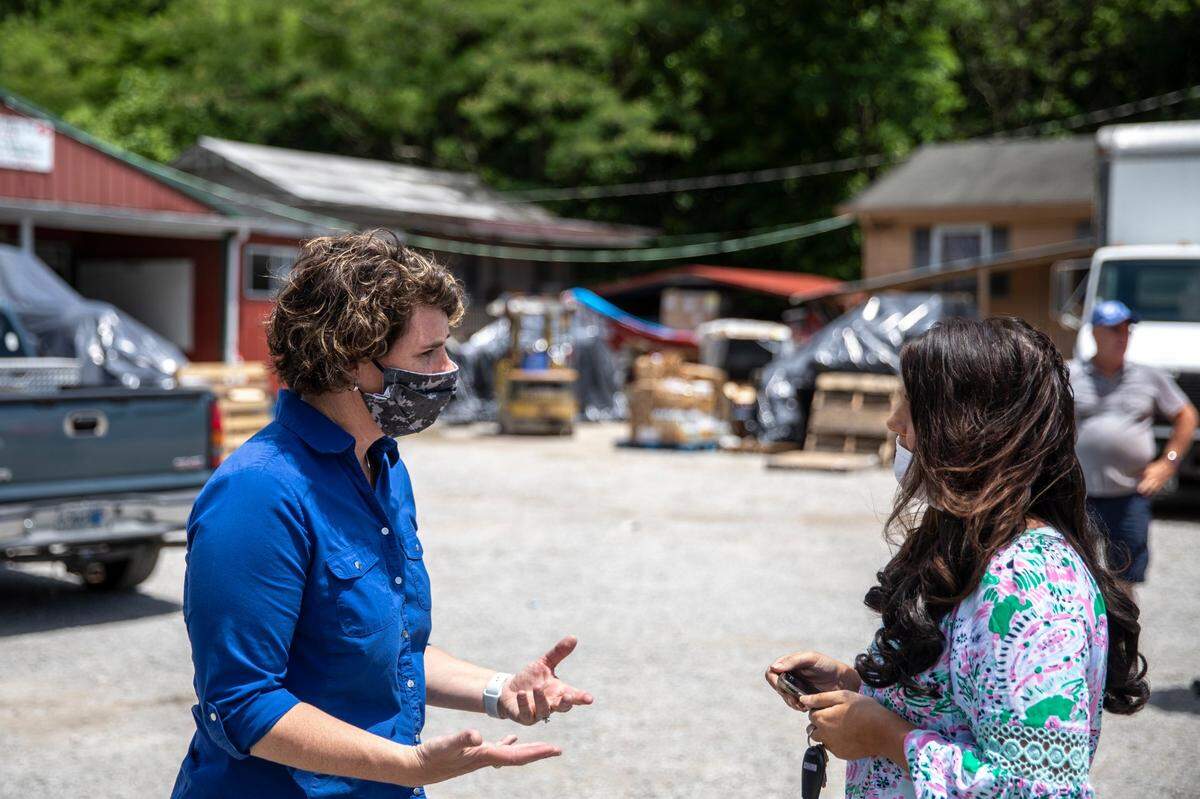
To make up for that loss, Democrats have placed their hopes in the suburbs, particularly the Cincinnati suburbs of Northern Kentucky. Beshear won Kenton and Campbell counties by a combined 2,308 votes, a margin McGrath needs to increase significantly.
Her campaign hopes her Northern Kentucky roots (she went to Notre Dame Academy in Covington and now lives in Scott County) will help boost her support in the region. It has focused field staff on getting out the vote in places like Covington.
“Eastern Kentucky is still very important to Democrats,” McNee said. “But Northern Kentucky is very ripe for her to increase that margin. They have a huge team up here doing outreach.”
Correction: An earlier version of this article incorrectly stated which party controls the seat of former House Speaker Greg Stumbo. It is the Democratic Party.
This story was originally published September 25, 2020 at 11:28 AM.