Andy Barr, seeking a 5th term in Congress, protests ‘socialist policies’ of Democrats
U.S. Rep. Andy Barr, R-Lexington, is running for a fifth term representing Central Kentucky in Congress, but this is the first time he’s campaigned as a member of his chamber’s minority.
It makes a big difference.
Democrats control the House, so little of Barr’s legislation stood any chance of becoming law. Instead, Barr spent much of the last two years protesting while Democrats advanced legislation on climate change, voting rights, consumer protection and other subjects — which usually went on to die in the Republican-led Senate — and loyally defending GOP President Donald Trump from criticism and impeachment.
In a lengthy House floor speech blasting the Democrats’ agenda last December, Barr warned of “socialism” no less than 39 times.
“The socialist policies of today, with popular names like Medicare for All, the Green New Deal, the Lower Drug Costs Now Act, the Wall Street Tax Act, the Stop Wall Street Looting Act — these pieces of legislation are all a danger to a free society,” Barr said.
“They are nothing more than central planning schemes that accumulate power in the government at the expense of the people,” Barr continued, “and in ways that rely on administrative coercion, force and discrimination, and through measures which are entirely incompatible with a free society.”
Shortly after taking over last year, House Democrats passed their top priority, H.R. 1, the For the People Act. It was a collection of measures including stronger campaign-finance transparency laws, automatic voter registration and a requirement that presidential candidates share their income tax returns with the public, something Trump has refused to do.
Barr said he was appalled by it.
“H.R. 1 is the single worst, most unsound, unconstitutional legislation that I have seen in my six and a half years in Congress,” Barr told the House chamber.
Adopting a similarly sharp tone, Barr quickly went on the attack in his re-election campaign this year. He’s airing a series of scathing television ads against his Democratic challenger, Lexington lawyer Josh Hicks.
In one ad called “The Choice,” the Barr campaign says Hicks supports “unlimited abortion paid for by taxpayers up until the very moment a child is born.” On the screen, a newborn baby peers up at the camera.
But in his own campaign, Hicks says he agrees with “reasonable restrictions on abortion in late-term pregnancies that do not threaten the life of the mother.” And Congress several decades ago blocked federal funds from paying for abortion except for pregnancies involving rape, incest or serious health risks.
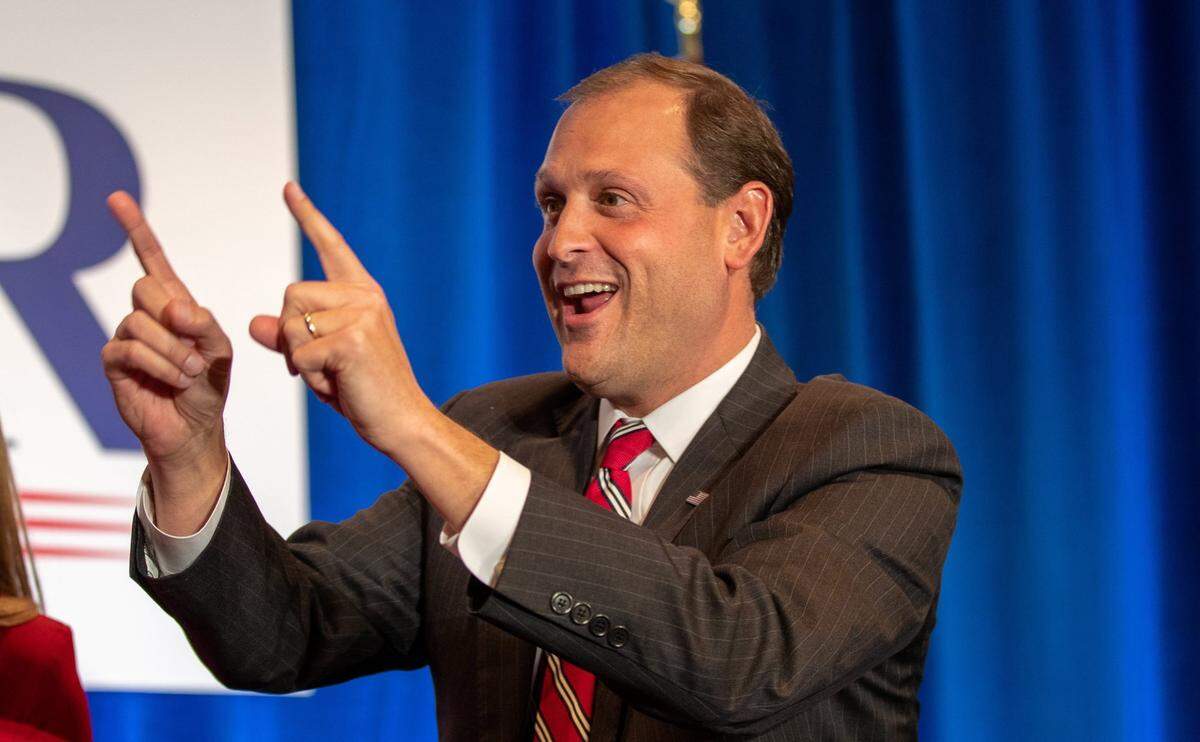
Barr, 47, did not respond to a request for comment for this story.
The election is Nov. 3, although mail-in absentee balloting already has begun. Aside from Barr and Hicks, the Libertarian Party’s Frank Harris also is a candidate. Harris won just 0.7 percent of the vote when he ran in 2018 against Barr and Democrat Amy McGrath.
The Heritage Foundation, a conservative think tank in Washington, rates members of Congress based on how closely their votes match the foundation’s own priorities. The average Republican congressman scores 87 percent, the foundation says. Barr scores at a nearly perfect 94 percent.
Barr is the scion of an old, successful Lexington family. Barr Street downtown reportedly is named for an ancestor who owned land there. He graduated from Henry Clay High School and earned degrees at the University of Virginia and University of Kentucky College of Law. Before law school, he spent two years on Capitol Hill as a legislative assistant to then-U.S. Rep. Jim Talent, R-Mo.
The father of two young girls, Barr was widowed in June after his wife, Carol, died unexpectedly of a heart condition known as mitral valve prolapse, or floppy valve syndrome.
COVID-19 response
Barr has found ways to keep busy during the 116th Congress.
Possibly his highest-profile work has been on H.R. 1754, the Horseracing Integrity and Safety Act, for which he is a co-sponsor behind Democratic Rep. Paul Tonko of New York. The bill — which the House recently passed — would set national standards for racetrack safety and horse racing medication, in response to a controversial spate of racehorse deaths. A Senate version is being sponsored by Senate Majority Leader Mitch McConnell, R-Ky.
Widely respected for his constituent service, Barr also made himself useful after the COVID-19 pandemic struck in March. He helped state health officials secure two truckloads of masks, gowns and other personal protective equipment from the Strategic National Stockpile.
And he lobbied the U.S. Treasury Department for local businesses having a hard time winning loans from the Paycheck Protection Program.
David Nisbet of Lexington employs roughly a dozen people at four oil and lube stores where “our revenue just stopped (after the pandemic hit), like someone turned off a faucet,” he said in an interview. Nisbet applied for a PPP loan to stay open. But after approving his application, the bank told him the federal program had run out of funds.
Someone recommended Nisbet call Barr’s office. He was skeptical, not having experience with politics, but Barr’s office gave him an aide’s cell phone number. The aide answered directly.
“Lo and behold — and this is what really impressed me — nobody asked me what political party I was or who I voted for. They just wanted to know where my stores were and how many employees I had, and then I was hearing back from them once or twice every day until they got me through the process,” Nisbet said.
“I was just totally blown away by his office’s reaction. They could not have been more helpful,” he said.
In Congress, Barr supported the first pandemic relief package in March, the $2.2 trillion CARES Act. But he opposed the second, the $3 trillion HEROES Act, that House Democrats passed in May only to see it stall in the Senate.
Barr called the HEROES Act “reckless” and “outrageous.” He especially objected to more than $1 trillion in aid that he said would “bail out mismanaged state and local governments.” (Before his 2012 House election, Barr served in the administration of Republican Gov. Ernie Fletcher for several years while Kentucky’s state pension debt was exploding.)
“Instead of surrendering our country to socialism, we need to reopen our economy and allow Americans to get safely back to work,” Barr told his colleagues in a May 15 floor speech against the HEROES Act.
A week earlier, at a White House event on COVID-19, Barr offered effusive praise to Trump, whom he credited for “an effective response to this pandemic and this crisis.”
“Mr. President, thank you,” Barr told Trump.
“Thank you,” Trump replied. “Thank you very much.”
Veterans legislation
Barr has sponsored more than two dozen bills during the 116th Congress, most of which never left the House.
He did see a rare success with one bill signed into law, H.R. 2196, which reduced the credit hour requirements for the Edith Nourse Rogers STEM scholarship programs at the U.S. Department of Veterans Affairs. That was Barr’s first triumph as a new member of the House Veterans’ Affairs Committee.
Another veterans-related bill by Barr, the Veterans Benefits Fairness and Transparency Act, went to the Senate on Sept. 23. It would direct the Department of Veterans Affairs to restore public access on its website to questionnaires needed to complete the disability benefits process.
Barr’s other committee assignment, the House Financial Affairs Committee, gives him oversight on banking and insurance.
Not surprisingly, those industries are among the top donors to his re-election campaign committee, where he had raised $2.85 million as of June 30, and his own political action committee, Building America’s Republican Representation, where he has raised $396,561.
Most of Barr’s contributions come from PACs and large donors, usually with a financial interest in his work as a congressman. Guests at Barr’s more upscale fundraisers can pay from $1,000 to $2,500 each for the chance to spend time with him.
Failed welfare state?
Aiming down at the other end of the income scale, Barr recently helped release a House Republican report called Reclaiming the American Dream: Proposals to Empower the Workers of Today and Tomorrow.
Barr was chairman of the minority’s American Worker Task Force that wrote the report. It repeatedly warned against socialism and offered 118 policy recommendations. Among them: drug testing welfare recipients, requiring home visits for families on food stamps, eliminating federal subsidies for student loan forgiveness and tuition tax credits, turning over the student loan program to banks, prohibiting union membership as a condition of employment and establishing vouchers to pay for private school.
None of the proposals are likely to go anywhere unless Republicans retake the House. But GOP lawmakers on the task force said it’s important to show how they would “reimagine welfare” by “empowering individuals” if they get to wield power again.
“By almost any standard of review, the modern welfare state has been an abject failure,” Barr said in a Sept. 22 speech on the House floor introducing the report.
“Because of the blessings of freedom that are given, anyone, regardless of race, color or creed, gender or any station in life, through hard word, persistence and determination, can achieve upward mobility, can achieve his or her god-given potential and realize the American dream,” he said.
This story was originally published October 6, 2020 at 9:10 AM.