Beshear vetoes items in budget restricting his powers, ability to spend relief funds
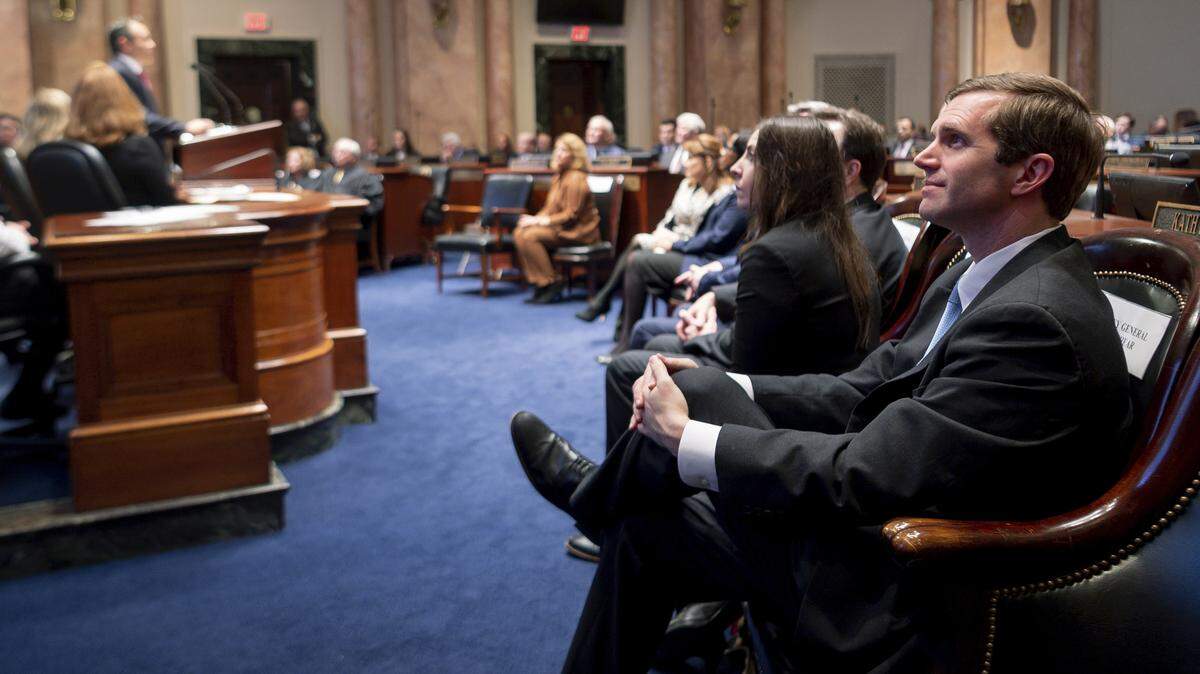
Gov. Andy Beshear late Friday afternoon quietly issued line-item vetoes on the budget and several revenue bills, crossing out provisions that would have handcuffed his ability to spend federal relief money and enforce his COVID-19 orders.
Beshear singled out 20 areas of the 197-page executive branch budget bill, House Bill 192, for specific line-item vetoes, several of which restricted the governor’s powers.
In his veto of language that prohibited him from spending money without the legislature’s permission, Beshear argued the provision violated the Supremacy Clause of the U.S. Constitution (which says federal law takes precedence over state law) and would inhibit the state’s ability to bounce back from the COVID-19 pandemic.
“It is the intent of the American Rescue Plan Act to cycle these funds into the state economy to bridge the economic gap that the pandemic has caused,” Beshear wrote in his veto message. “The sooner we deploy the resources from the American Rescue Plan Act, in combination with our vaccination program, the sooner the economy will recover and create jobs so people can return to work.”
Beshear also vetoed a section of the budget that forbids any state employee from spending time or state money enforcing emergency orders lasting more than 30 days that had not been approved by the General Assembly. The provisions relate directly to an ongoing legal battle over bills passed earlier this session that attempted to limit Beshear’s ability to issue executive orders during an emergency.
It would prevent the administration from enforcing the mask mandate or any capacity limitations on businesses.
In his veto message, Beshear said the provision violates a temporary injunction issued by the Franklin Circuit Court on the General Assembly, which could “subject the body to a contempt of court citation.”
“It would prohibit such employees, like the Commissioner for Public Health, from working on such matters to protect the lives and safety of Kentuckians,” Beshear wrote. “Aside from the constitutional infirmity, this part would create a chaotic, haphazard public health response to the COVID-19 pandemic, resulting in a public health catastrophe.”
Some of the other lines Beshear vetoed dealt with funding for the Kentucky Commission on Women, requiring cabinet secretaries to get approval from the state treasurer to use the state’s plane and having the attorney general, not the judicial branch, get the final say over any legal challenges to the budget bill.
Beshear’s vetoes may last only as long as the weekend, as the Republican-controlled legislature is likely to override many, if not all, of his vetoes when it returns Monday and Tuesday. Since the legislature adjourned nearly two weeks ago, Beshear has vetoed 27 bills.
While the legislature will likely ignore Beshear’s objections over how to spend federal relief money, earlier this week he was optimistic that he and the legislature will be able to come to an agreement on how to spend some of the more than $2.4 billion in federal relief that’s set to be allocated by the state.
Beshear and the legislature have already agreed to spend money on rural broadband access, though he vetoed a line in House Bill 320 that said only $50 million of the $250 million allocated to the issue could be spent before April 1, 2022.
“I strongly support this legislation, but am vetoing these parts because they create a limitation of spending just one-fifth of the $250 million appropriation over the next year, which will put Kentucky at a competitive disadvantage to other states at a time all will be competing to purchase and run fiber,” Beshear wrote.
Beshear also vetoed parts of House Bill 195, the $448 million judicial budget. He said he was making the vetoes at the request of the Administrative Office of the Courts.
.
Beshear vetoed a provision that gave circuit clerks a $200-a-month expense allowance, and he vetoed a pay raise for one employee, saying that other court employees were not given an annual salary increment.
He also deleted in the judicial budget a provision dealing with restructuring of the courts’ budget and language pertaining to employee layoffs, furloughs and reduced hours. He said the court system already has the authority to set its own personnel policies and the language was not necessary.
Other bills vetoed by Beshear were:
▪ House Bill 249, which creates a new and separate account in the Road Fund that can only be spent on projects specified by the General Assembly.
Beshear said the Road Fund already has an account from which specified projects are authorized by the legislature.
He said the new account does not specify that it will be used to fund projects in the two-year highway construction plan, “leaving the possibility that it will fund projects that have not been a part of the Transportation Cabinet’s rigorous planning process.”
“Road Fund resources are too valuable to deploy separately from the Commonwealth’s rational, thorough and accepted planning process,” Beshear said.
▪ House Bill 405, which deals with funds for paying claims against the state.
Beshear vetoed two parts of the bill using money from the federal American Rescue Plan, saying the federal government has not yet provided guidance on how the money should be spent, and spending the dollars now could result in the state’s losing them.
The vetoes affect about $37 million to the Justice Administration to detect COVID-19 in vulnerable population settings like prisons and $2 million to the office of Attorney General Daniel Cameron to investigate crimes related to the coronavirus pandemic such as false unemployment insurance benefits.
▪ House Bill 413, which deals with the unemployment insurance trust fund.
Beshear said he supports a one-year freeze on the fund’s wage and unemployment tax schedule and a one-year suspension of the interest surcharge this fiscal year because of COVID-19 but not for the second year of the budget since the General Assembly believes the state’s financial situation is fluid.
“Given that next year is a budget session, it makes more sense to freeze the wage base and tax schedule and suspend the interest surcharge for only one year, and then revisit those in the 2022 regular session,” Beshear said.
This story was originally published March 26, 2021 at 6:12 PM.