Barely half of KY adults are in the workforce, leaving out 1.5 million, report warns
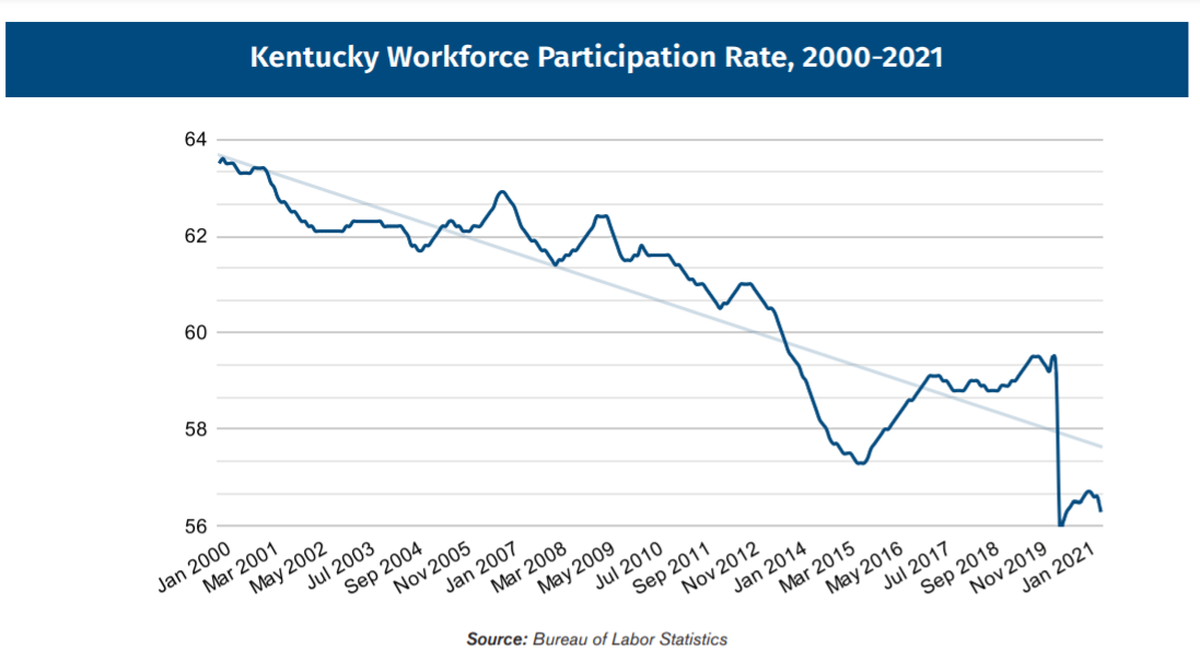
The percentage of Kentucky adults in the workforce steadily dropped from nearly 64 percent in 2000 to 56 percent this summer, according to a report released Friday by the Kentucky Chamber of Commerce.
As of June, more than 1.5 million Kentucky adults were neither employed nor looking for work, according to the report. That’s unhealthy in a state of 4.5 million people, and it ranked Kentucky third-lowest in the nation for workforce participation, ahead of only Mississippi and West Virginia, the report concluded.
“This is part of a national trend, but it is, in fact, worse here in Kentucky,” said Charles Aull, a senior policy analyst for the Kentucky Chamber, at a virtual news conference on Friday.
Generally, residents of metro areas who have college degrees or technical training are doing better, while rural communities and low-skill workers are falling behind in a swiftly developing world, the report said.
In the rural counties of Southeastern and Eastern Kentucky, fewer than half of adults are working or looking for work. In Elliott County, the workforce participation rate is the state’s lowest, at 27 percent. By comparison, in the state’s urban and suburban “Golden Triangle” of Louisville, Lexington and Northern Kentucky, close to two-thirds or more of adults are active in the workforce.
The Chamber released its report, 20 Years in the Making: Kentucky’s Workforce Crisis, to identify reasons for the labor shortage and recommend possible solutions.
While the COVID-19 pandemic led to a temporary surge in unemployment in spring 2020 when businesses briefly closed, the underlying problems are systemic and have festered for years, according to the report. Among them:
▪ An aging population and the ongoing retirement of the Baby Boomers born between 1946 and 1964. On a related note, Kentucky’s population is growing more slowly (3.8 percent between 2010 and 2020) than the United States as a whole ( 7.4 percent). There are fewer young adults coming along to replace seniors exiting the labor pool.
“With the retirement of the Baby Boomer generation well underway and new data from the Census Bureau showing stagnant population growth in Kentucky, policymakers need to think strategically and creatively about how to grow our population,” the report stated. “Public policy should encourage both talent retention and talent attraction.”
▪ A gap between the advanced skills needed in the modern economy and those available in Kentucky. Despite making progress in recent years, Kentuckians still lag behind the national average in post-secondary degrees and STEM training in science, technology, engineering and mathematics.
“In any given month, Kentucky generally has 90,000 to 100,000 open jobs. More and more of these jobs, however, require skills and training beyond a high school degree,” the report stated.
▪ A lack of affordable child care for working parents. This already was a problem before COVID-19, especially in rural Kentucky, but the pandemic has shuttered many child care providers across the state over the last 18 months.
“Close to half of the state’s population reside in ‘child care deserts,’ areas with at least 30 children under the age of 5 with either no or not enough licensed child care providers,” the report stated. “A total of 1.3 million rural Kentuckians reside in child care deserts.’”
▪ Drug addiction and other health problems. By one estimate, as many as 55,200 Kentuckians are missing from the workforce because of opioid addiction, and drug use reduces productivity among people who do work, according to the report. Kentuckians also are plagued with some of the nation’s worst rates for depression, cancer, obesity, diabetes, cardiovascular disease and other serious ailments.
“Some research has estimated that the opioid epidemic alone may have been responsible for 20 percent of the decline in workforce participation in prime working-age men between 1999 and 2015,” the report stated.
▪ Criminal convictions and incarceration. In Kentucky, up to 41,000 people are estimated to be incarcerated in local, state and federal detention facilities, according to the report. Several hundred thousand Kentuckians have a felony conviction on their records that can make it difficult for them to find a job. The unemployment rate for people who have been incarcerated is estimated at 27 percent, according to the report.
Among its proposals for state leaders, the report recommends pro-immigration policies to bring in more workers; lower tax rates to attract more employers; criminal-justice reforms that leave fewer Kentuckians unemployable; greater state investment in roads, child care and public transportation, to help Kentuckians get to jobs; and changes to public benefits programs that encourage unemployed people to take a job faster.
“Legislators and policymakers in our various state agencies, I think they get the problem,” Aull said Friday. “I do think there is sometimes a disconnect between understanding how something such as criminal-justice reform or fighting the opioid epidemic intersects with workforce and how those things tie together. So that’s something we’ve been working really hard to illustrate.”
The report also includes a package of proposals to improve worker skills, such as more closely connecting the more than $250 million in state financial aid awarded each year in higher education to “the projected needs of employers.” For example, it stated, state financial aid should be made accessible at for-profit technical schools that teach high-demand skills such as welding and truck driving.
In order to make Kentucky attractive, state leaders should promote open-mindedness, the report stated.
“Lawmakers in Kentucky should avoid pursuing any legislative measure that could create misperceptions of the commonwealth as unwelcoming or intolerant,” the report stated.
“Instead, it is critical that public policy encourage any individual interested in living and working in Kentucky to follow through on those interests. Ensuring that individuals living outside Kentucky perceive it as a welcoming place is key to talent attraction.”
This story was originally published October 1, 2021 at 3:22 PM.