Knott County already struggled to pay huge debt on Sportsplex. Now it’s crumbling.
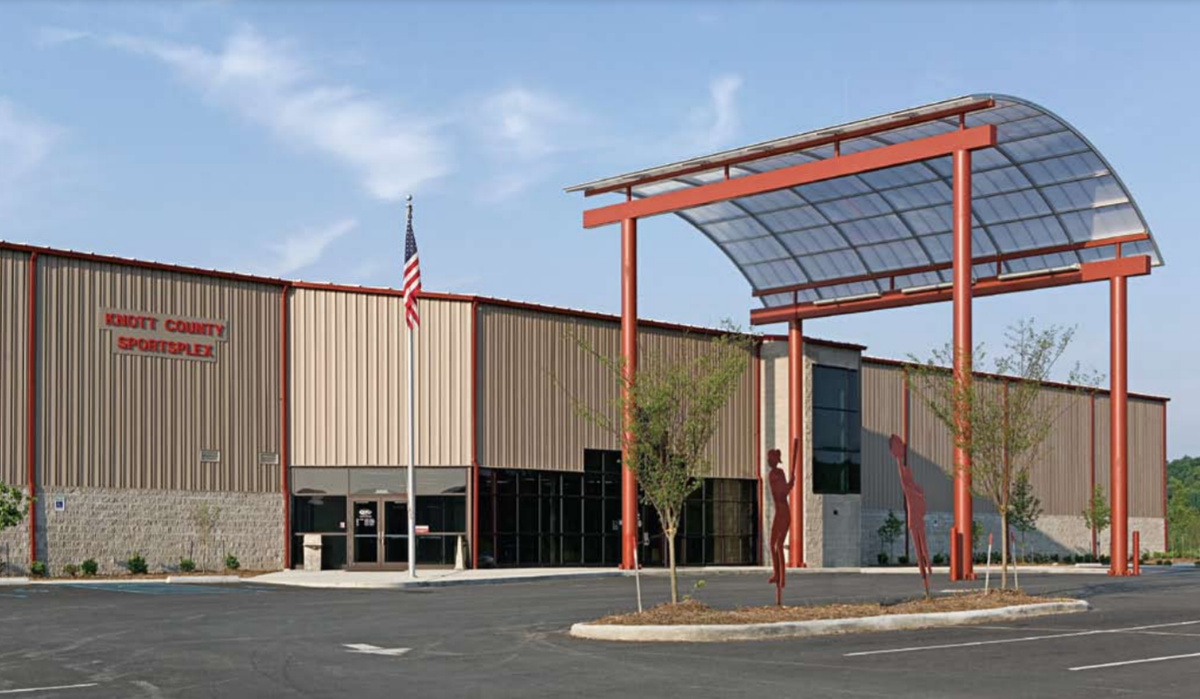
For years, most of Knott County’s coal severance tax money has been committed to paying down $9 million in bond debt for the Sportsplex, a 66,000-square-foot recreation center that opened in 2007. The county spent $590,000 on the debt service just last year.
However, if the Sportsplex’s high price is certain, its future isn’t.
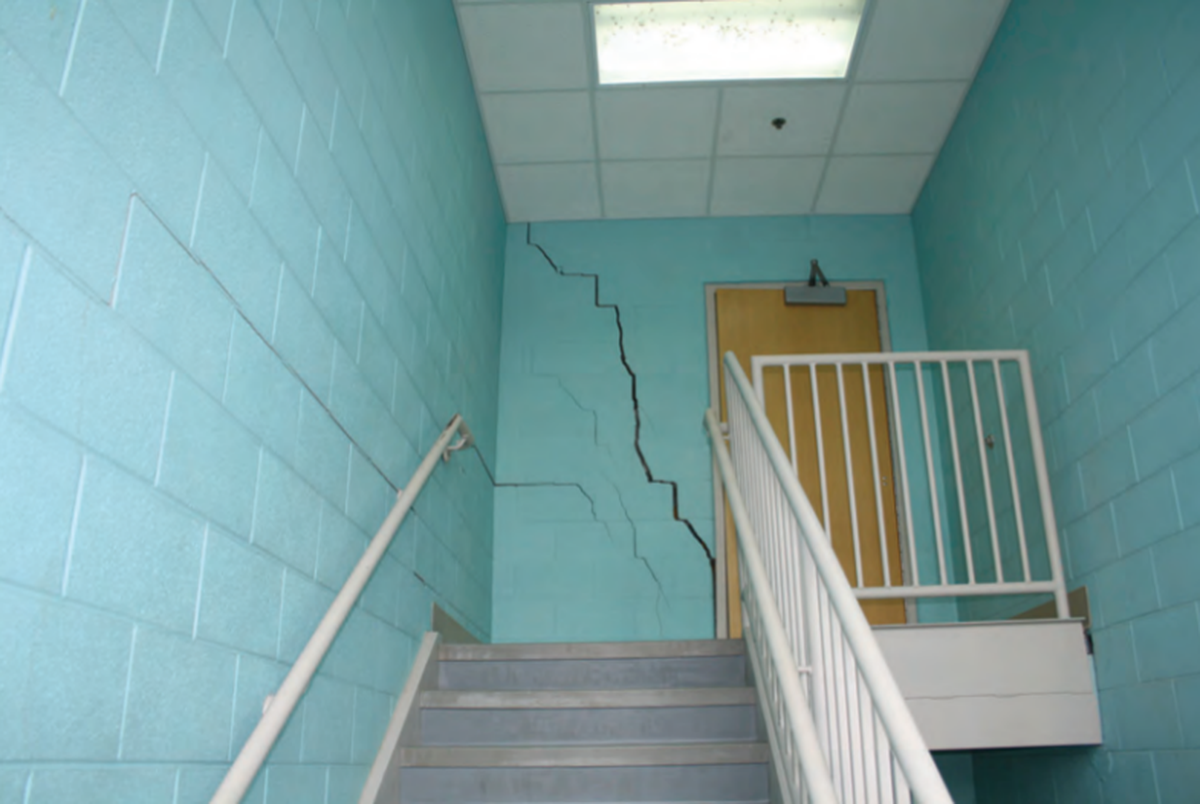
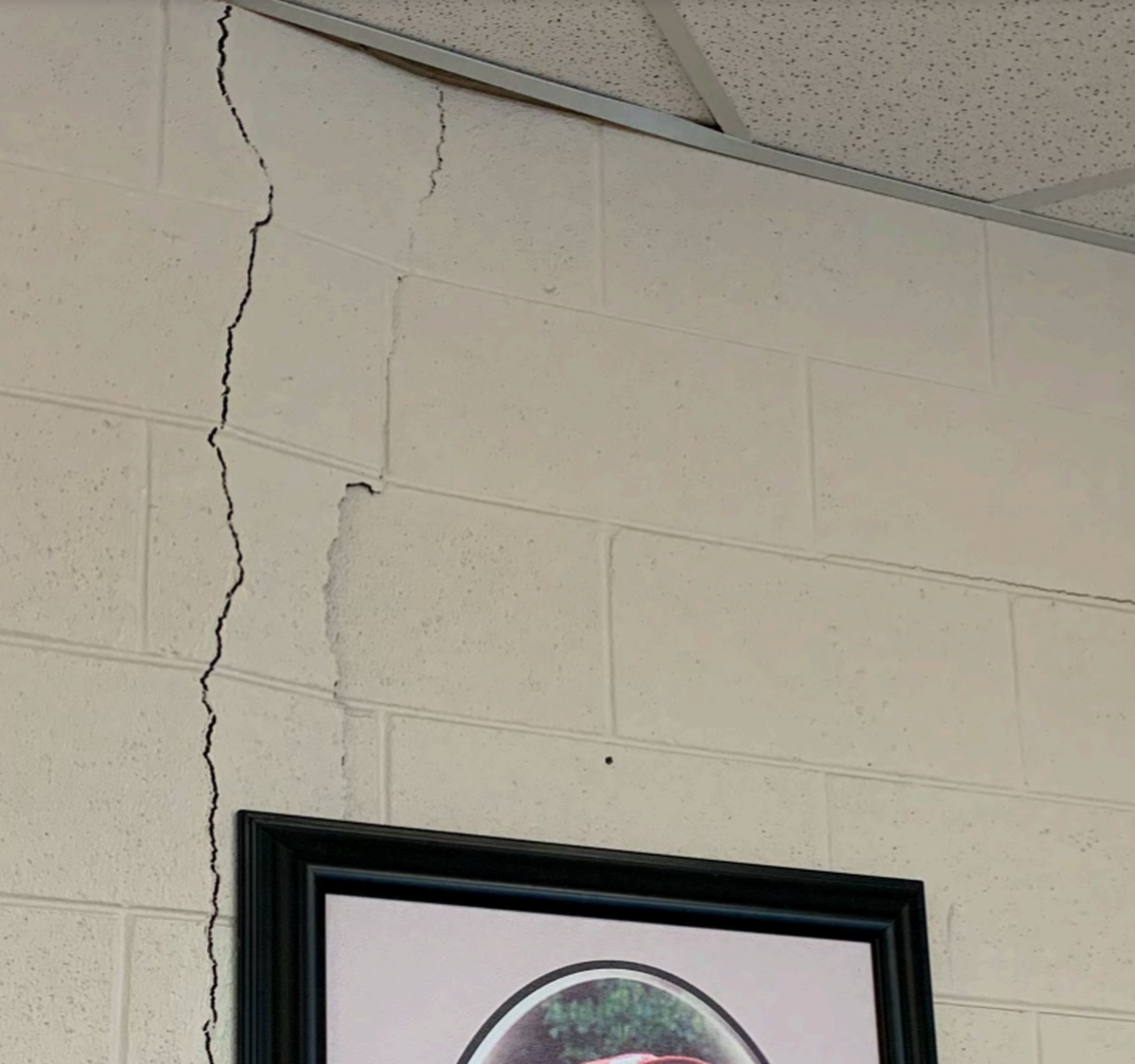
The 14-year-old building is falling apart, with cracked, bowed walls and a shifting foundation that prompted the Kentucky Office of the State Fire Marshal to order it shut for part of last summer. The riskiest sections have been barricaded to keep out the public.
“Extensive repairs” are needed, the county says. Nobody has a cost estimate.
“I’m afraid it’s going to fall down before we finally pay it off,” said Zach Weinberg, who was Knott County judge-executive from 2013 to 2018.
The 4.5 percent state tax on coal extraction and processing has raised billions of dollars since it started in 1972.
Other Eastern Kentucky coalfield counties are free to use their share of coal severance tax money to do productive things like extend water and sewer lines to more homes or establish tourism attractions that create jobs, Weinberg said. But Knott County’s coal severance tax money is tied up in Sportsplex debt, he said.
“That’s one of the things that really keeps this county down, that almost every dollar we’re getting in coal severance money goes to pay off that place,” Weinberg said.
In an attempt to recover some of its losses, Knott County is suing Harold Fletcher Jr., the architect who oversaw the Sportsplex’s construction design, and Kenar Architectural and Engineering, the Frankfort firm that he owned at the time. Also named as a defendant is BFMJ Structural Engineers of Lexington.
The county alleges breach of contract, professional negligence and unjust enrichment.
“Knott County has learned that material defects exist in the design and/or construction of the Sportsplex brought about as a direct and proximate result of Kenar’s and/or Fletcher’s acts and/or omissions,” Knott County says in its 2019 lawsuit, which is in the discovery phase in Knott Circuit Court.
There is where politics enters the picture.
Harold Fletcher is the older brother of former Kentucky Gov. Ernie Fletcher. In 2005, Ernie Fletcher appointed the Knott County judge-executive, Randy Thompson, who hired Harold Fletcher on the Sportsplex project, which was Thompson’s brainchild.
Thompson later went to prison after his conviction for vote-buying in a local corruption scandal.
Asked about it in 2005 by the Herald-Leader, a spokeswoman for Ernie Fletcher denied a connection between his choosing Thompson to run Knott County and his brother getting the Sportsplex contract, with a reported value of $800,000. (County officials say they are now unable to locate a copy of the contract.)
“He knew his brother was doing business in Knott County, but he didn’t know anything specific about the business he was doing,” gubernatorial spokeswoman Jodi Whitaker told the Herald-Leader in 2005.
Neither Harold nor Ernie Fletcher returned calls seeking comment for this story. In his written response to the county’s lawsuit, Harold Fletcher — an unsuccessful Republican state Senate candidate in 2004, when his brother was governor — denied liability for structural problems at the Sportsplex.
Thompson, the former judge-executive, also did not return calls. He was removed from office in 2013 because of his felony conviction but returned to the county after spending 40 months in federal prison.
Controversial from the start
The Sportsplex was controversial from the start. For one thing, it’s more than the community can afford.
Knott County is a rural area of about 15,000 people, nearly one in three of whom live in poverty.
Initial plans two decades ago called for a modest recreation center to serve local youths. Randy Thompson was, and remains, the founder and president of the nonprofit Knott County Youth Foundation, which launched the project.
The recreation center would be built on a reclaimed coal strip mine in Leburn, eight miles northeast of the county seat of Hindman. The land previously was owned by Western Pocahontas Properties, a division of Natural Resource Partners. The company hoped to develop the area, with the recreation center serving as a hub of activity.
“When we were first approached, the idea was to have a small building with a basketball court needing only an acre or two to operate. It was Randy’s idea to think on a larger scale,” Natural Resources President Nick Carter wrote to a federal judge on Thompson’s behalf in 2009 before Thompson was sentenced to prison for vote-buying.
That “acre or two” became 24 acres under Thompson’s stewardship. Plans expanded to include two stories lined with hardwood maple basketball and volleyball courts, a fitness center, locker rooms, a raised walking track, a video game arcade, three lighted baseball fields, a golf driving range, a concession stand and other amenities.
In 2006, Knott County gave $2 million in coal severance tax funds to the Knott County Youth Foundation and $8.45 million in bond proceeds in order to secure the land and build the Sportsplex, according to a later audit. The county followed in 2017 with $627,000 in additional bond debt to pay for improvements.
That left the county swimming in debt. Although the facility charges user fees and sells food and drink, county officials admit it doesn’t pay its own way.
The Sportsplex has provided Knott County residents with a place to exercise indoors as well as a venue for youth athletic teams to compete, said Jeff Dobson, the current Knott County judge-executive.
“We’re really blessed and lucky to have it. But maybe if it was just scaled back some to be just a smidgen of a smaller facility where we would have a somewhat smaller expense,” Dobson said.
“When they built it, you know, coal severance was doing a lot better, so I guess it looked like we could afford more than we can now,” Dobson said.
Outside warnings ignored
Even at the time, the state auditor’s office warned Knott County against assuming so much debt to build the Sportsplex.
And the auditor said it would be unwise to plan on paying the money back using coal severance tax funds. Those can fluctuate based on the health of the coal industry and “cannot be relied upon by the county as a continual revenue source,” the auditor said.
The funding, in fact, has declined ever since.
The county moved ahead, anyway, led by Thompson. In public records, he said he would earmark $500,000 a year in coal severance tax funds to repay the debt, a figure that proved to be too conservative.
Thompson got the county’s top job because the previous judge-executive, Donnie Newsome, was forced out of office in 2005 after his own felony conviction for vote-buying. Ernie Fletcher appointed Thompson, a radio station executive and fellow Republican, to replace Newsome.
At the Knott County Youth Foundation, Thompson selected Harold Fletcher for the Sportsplex project. Harold Fletcher came along with Thompson when he took control of the county courthouse. Another firm — Trace Creek Construction — sued the county, alleging that Newsome hired it to oversee the Sportsplex, a deal it lost when Thompson allegedly pushed it aside. The county settled that lawsuit in 2009.
The Sportsplex opened in 2007.
State officials in Frankfort raised more concerns before long. The state auditor said Sportsplex jobs went to two of Thompson’s relatives, while thousands of dollars in Sportsplex contracts went to a business owned by his sister. The Kentucky Department for Local Government warned that the Sportsplex was running a worrisome deficit.
Meanwhile, inside the Sportsplex, employees noticed the masonry walls and concrete floor were starting to crack within a year of its completion.
Cracked walls, shifting floor
A half-dozen structural engineering inspections of the Sportsplex over the years came to the same conclusion: Much of it is falling apart, particularly in the entrance vestibule and front stairwell and on the first and second floors at the concession stand and near the edge of the basketball courts and walking track.
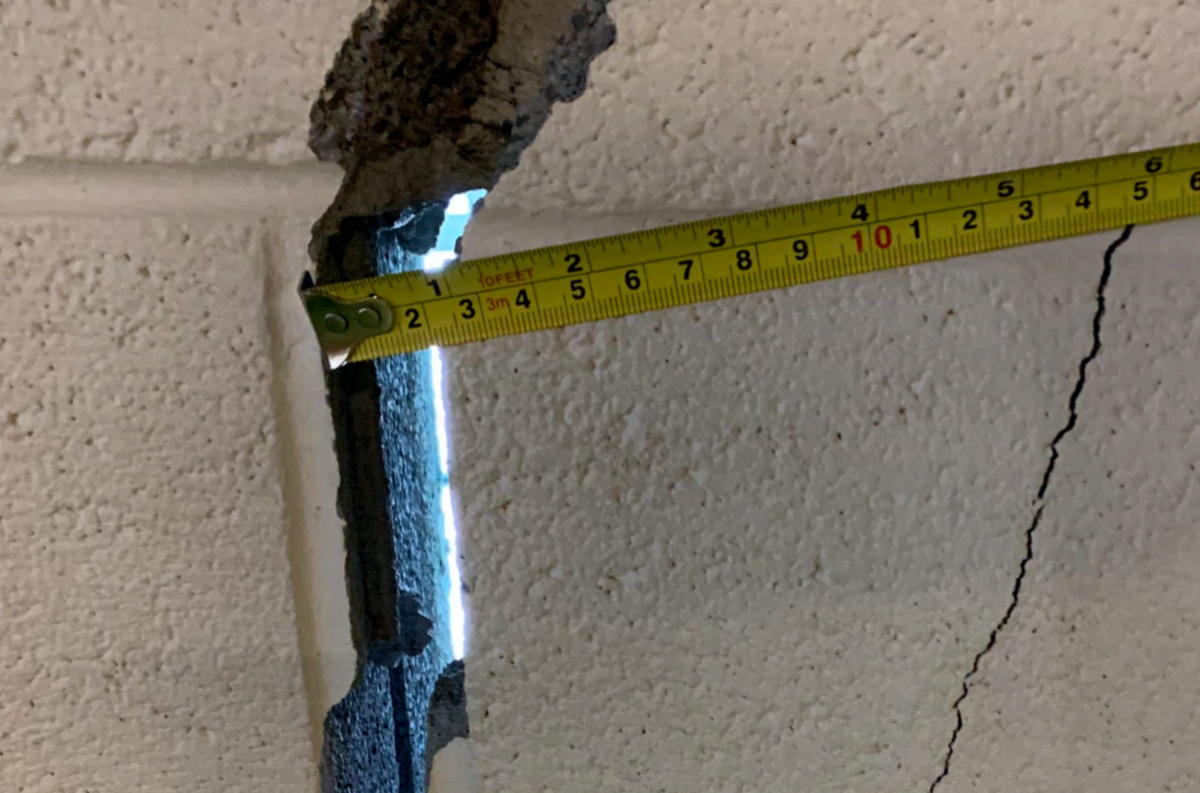
Cracks — a few wide enough to show daylight — have zigzagged across walls. Some walls buckled or separated eastward as much as one inch in width for every 10 feet in height. The building’s foundation shifted in places so that flooring has torn and doors no longer can open or close as intended because doorways are skewed.
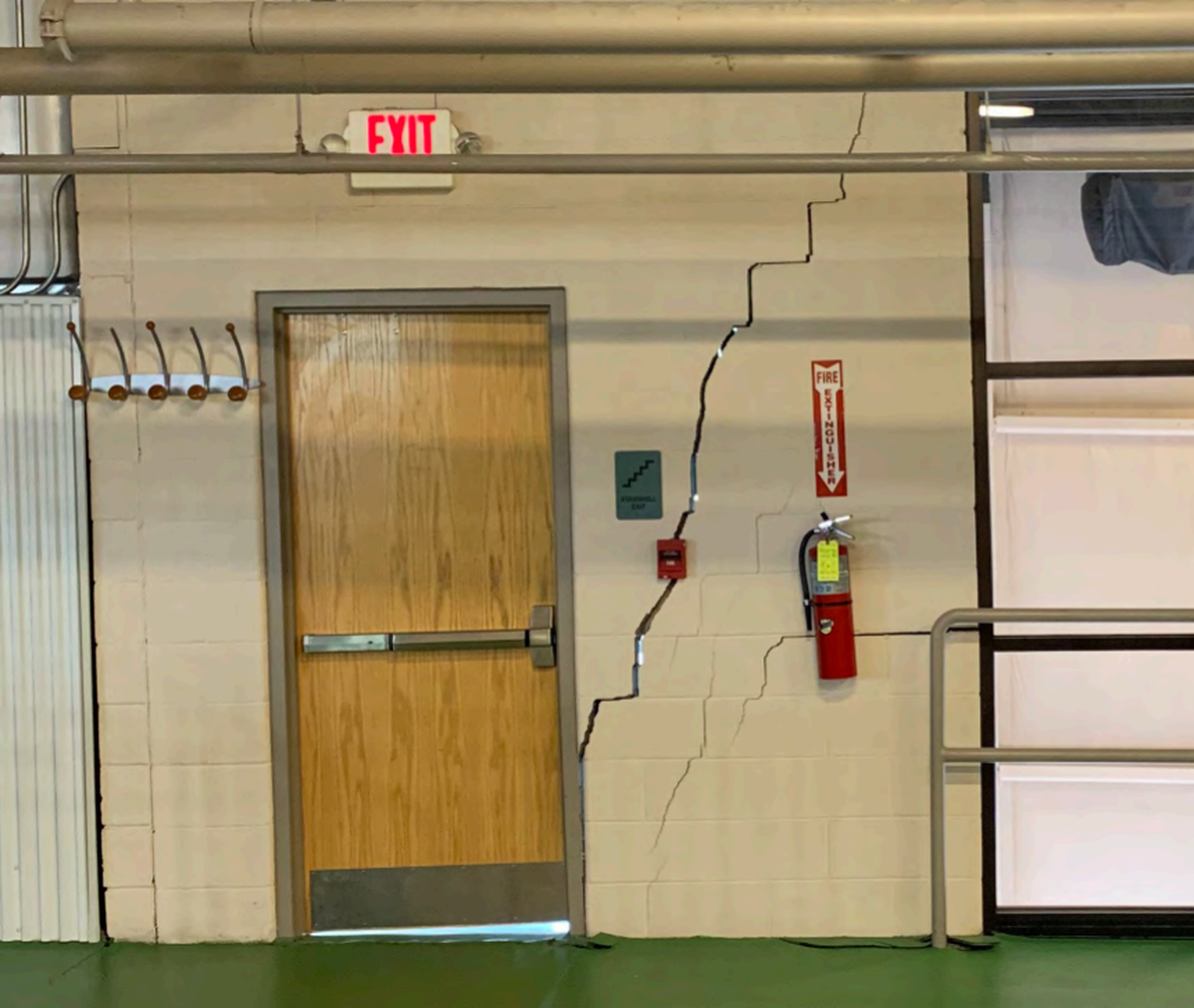
The state fire marshal’s office finally ordered the building closed for most of July and August to protect the public until Knott County better understood the safety risk.
“The magnitude and nature of the cracking has compromised the structural integrity of the (front) stairwell and is threatening the integrity of several of the interior non-load-bearing block masonry walls,” according to a report that Tony Huff & Associates Engineering Solutions presented to the Knott County Fiscal Court on July 28.
“Access to the area around these cracks should be restricted until the potential risk associated with the cracked walls can be appropriately addressed or repairs can be made to the structure,” the report stated.
The fire marshal allowed Knott County to reopen the building only after barricades were installed to close the hazardous areas and reduce occupancy. Also, the Tony Huff report suggested bracing to support the walls and minimize risk of collapse and other measures to deflect pieces of debris that might crash to the floor.
In its litigation, the county says “extensive repairs will need to take place at the Sportsplex so as to prevent an unsafe and/or unstable building.”
Different insproectors have suggested different possible causes for the damage, including design flaws that did not allow for necessary flexibility between the building’s structural steel skeleton and masonry walls; explosive blasting in the area from coal mining; and a 4.2 magnitude earthquake in 2012 with an epicenter 20 miles away.
Also, inspectors say, the Sportsplex is built atop 90 feet of “spoil fill” from a reclaimed strip mine that could have continued to settle underneath the building’s concrete slab foundation. The thickness and composition of the spoil were never defined, making it impossible to determine its stability, inspectors say.
On the bright side, said Dobson, the current judge-executive, Knott County recently took advantage of low interest rates to refinance the Sportsplex, shrinking payments to $400,000 a year.
Unfortunately, he added, that’s still more than the cash-strapped county can afford with the steady decline in its share of coal severance funds.
“About all of our coal severance goes to the debt service on that,” Dobson said. “It’s a problem.”