Ky. House GOP beats Gov. Beshear to the punch by releasing its state budget plan first
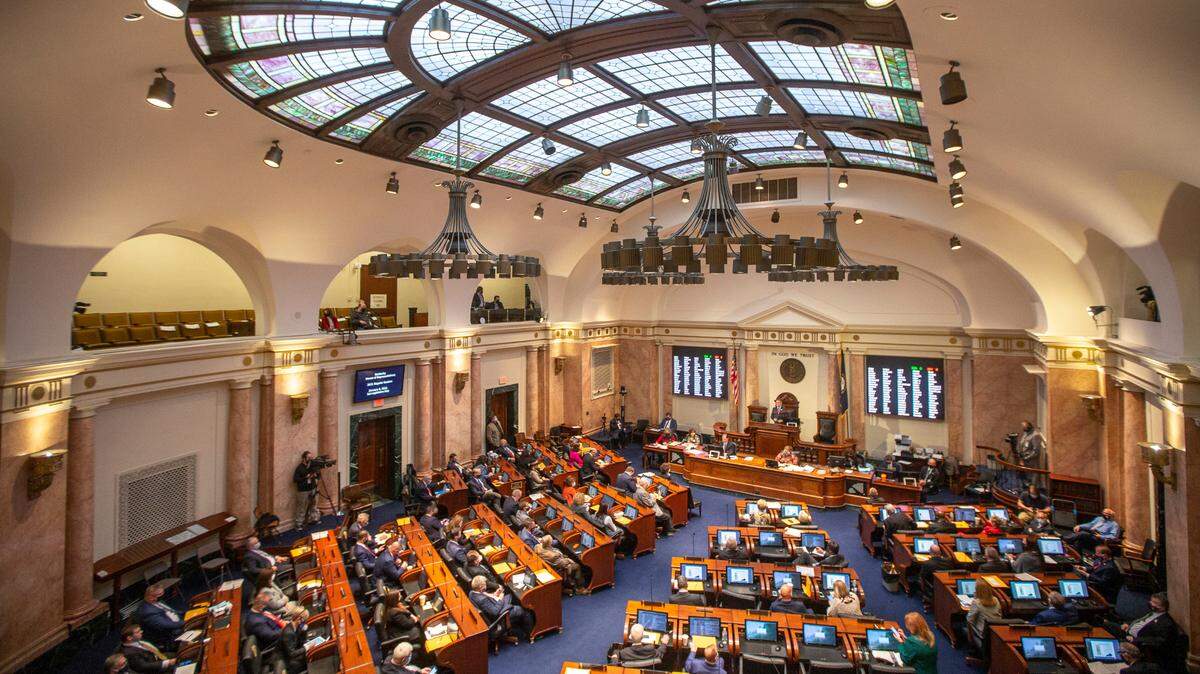
Kentucky House Republicans on Friday filed a two-year state budget bill that includes long-sought pay raises for state employees, enough state funding to cover the cost of full-day kindergarten for school districts and the more than $4.2 billion required for pension contributions to the funds for state workers and school teachers.
By filing House Bill 1 on the fourth day of the 2022 legislative session, the House GOP majority got an unexpected jump on Democratic Gov. Andy Beshear, who is not scheduled to present his own state spending plan to lawmakers until his formal budget address next Thursday.
House Speaker David Osborne, R-Prospect, has said his goal is for the House quickly to pass a budget so it next can address the complicated issue of changes to the tax code, which could adjust how much revenue the state collects in coming years. Some Republican lawmakers want to shift away from the income tax and toward the sales tax.
The governor’s office did not seem to appreciate the House cutting ahead in line.
“Today’s actions are concerning as they violate both longstanding practice and state law. Neither the executive branch nor the governor were alerted or consulted,” Beshear spokeswoman Crystal Staley said Friday.
“Of more concern is that the House’s budget fails to make the game-changing investments that Kentuckians will see in the governor’s recommended budget,” Staley said. “For example, the governor’s budget will fund universal pre-K for all 4-year-olds.”
House Republican leaders announced their budget bill in an unanticipated news release after adjourning for the day Friday. They later posted the 213-page bill online for public review.
Based on overall numbers in the bill, the House seems to be taking a conservative approach in some ways.
State economists last month estimated that Kentucky could collect enough revenue for a $14 billion General Fund in Fiscal Year 2023 and a $14.6 billion General Fund in Fiscal Year 2024, with several billion more available in surplus state revenue and federal aid from a COVID-19 pandemic stimulus package and an infrastructure bill.
However, the news release says the House budget plan would rely on a smaller $13.9 billion General Fund each year, with “a continued commitment” toward saving available money in the state’s “rainy day” budget reserve trust fund.
Federal money provided for pandemic response and transportation infrastructure would be targeted toward those specific spending needs, House leaders said.
“For far too long, Kentucky state government has looked at the budget as an opportunity to win votes and curry favor. That hasn’t been our approach and it certainly is not with this budget,” said Rep. Brandon Reed, R-Hodgenville, sponsor of HB 1 and vice chairman of the House budget committee.

“While some would ask that we use one-time federal funds to make recurring commitments, we would be paying for long after the federal funding to pay for them has ended,” Reed said. “We’re committed to continuing work to provide clean drinking water, internet access, and meeting our pension obligations,” Reed added. “These are basic and fundamental concerns.”
An analysis of the House budget bill by the Kentucky Center for Economic Policy in Berea suggested that GOP leaders left several billion dollars in funds “on the table unspent.” If all that money goes into the state’s rainy day fund, it would represent 28 percent of the General Fund, the center said.
“That is far more money than the state needs to prepare for the next recession, and sidelining too much money will make our recovery from the pandemic weaker than it can and should be,” the center said.
Among the specific items identified in the House budget, there would be money for:
▪ Pay raises for the state government workforce, which is struggling with poor morale and under-staffing across many different agencies.
There would be raises and $4,800 annual retention payments for social workers totaling $25.6 million the first year and $61.7 million the second; a $15,000 raise for Kentucky State Police troopers and motor vehicle inspectors; an $8,000 raise for state police telecommunications staff; and more than $7 million a year to boost the pay of public defenders, who currently start at $45,000 a year..
For the rest of the state workforce, there would be a 6 percent raise in Fiscal Year 2023. No raise is identified for the next year, but the state’s personnel secretary would be instructed to issue a report to lawmakers on salary structure for different job classifications.
▪ One hundred additional social worker positions in each year of the budget, for a total of 200. There also would be funding to provide an unspecified number of “additional personnel” at the Office of the Attorney General and in the local offices of commonwealth’s attorneys and county attorneys.
▪ An increase in the guaranteed per-pupil SEEK funding for school districts to “a record-high dollar amount,” from $4,000 this year to $4,100 in Fiscal Year 2023 and $4,200 in Fiscal Year 2024.
However, in its analysis of the House budget, the Kentucky Center for Economic Policy said those numbers are not as generous as they appear. Base SEEK funding is a mixture of money from the state and school districts, the center said, and in the House bill, the state’s allocation would drop from $2.081 billion in this fiscal year to $2.044 billion in the next two fiscal years.
▪ Twice as much state funding for full-day kindergarten in both fiscal years, to cover the entire cost for school districts. Full-day kindergarten was one of the priorities of a school funding task force that met throughout the legislative interim last year.
▪ A boost in state funding for school districts’ student transportation costs, going from the current $214 million to $274 million. While this would bring more money to districts, it falls short of the full transportation funding that the state once provided.
▪ More than $2 billion in actuarial required contributions for the Teachers’ Retirement System of Kentucky, which provides pensions for educators. Also, the state would pay $479 million to clear the outstanding obligations that the teacher pension system owes to retiring educators for their sick leave and cost-of-living adjustments.
▪ The $1.2 billion per year in actuarial required contributions for the primary state workers’ pension fund at the Kentucky Public Pensions Authority. That fund has only 18 percent of the assets it needs to meet future liabilities, making it one of the weakest public pension funds in the country. There would be $215 million more to pay down a worsening unfunded liability for the separate Kentucky State Police pension fund, also managed at KPPA.
▪ A new $10 million annual grant pool at the Department of Local Government to allow each state representative and state senator to award public money to local governments, educational units and quasi-governmental agencies at their discretion.
The money would be divided on a population basis, so each senator should get about $130,000 to spend, and each representative should get about $50,000. Although lawmakers already can include spending items in the budget for their home districts, if they have the clout, this fund would let them all hand out checks throughout the year.
▪ Clean water and wastewater projects in each county that would be paid for with $350 million in federal American Rescue Plan Act funds. Also, $312 million more in ARPA money would go to the state’s unemployment insurance fund to return it to pre-pandemic funding levels.
▪ Just under $13 million a year to increase the state’s daily payment to local jails for each state prisoner they hold, taking it up to $35.34. To avoid building more prisons, the Kentucky Department of Corrections long has relied on local jails — even those that are dangerously overcrowded — to house thousands of state inmates serving felony sentences.
▪ $372 million for this fiscal year and the next two fiscal years to increase the state’s reimbursement to nursing homes, using state and federal funds. The nursing home industry says it has struggled financially since the start of the COVID-19 pandemic in March 2020.
This story was originally published January 7, 2022 at 4:03 PM.