
Income tax cut bill ‘epic’ for KY GOP. Others call it the ‘worst bill’ ever.
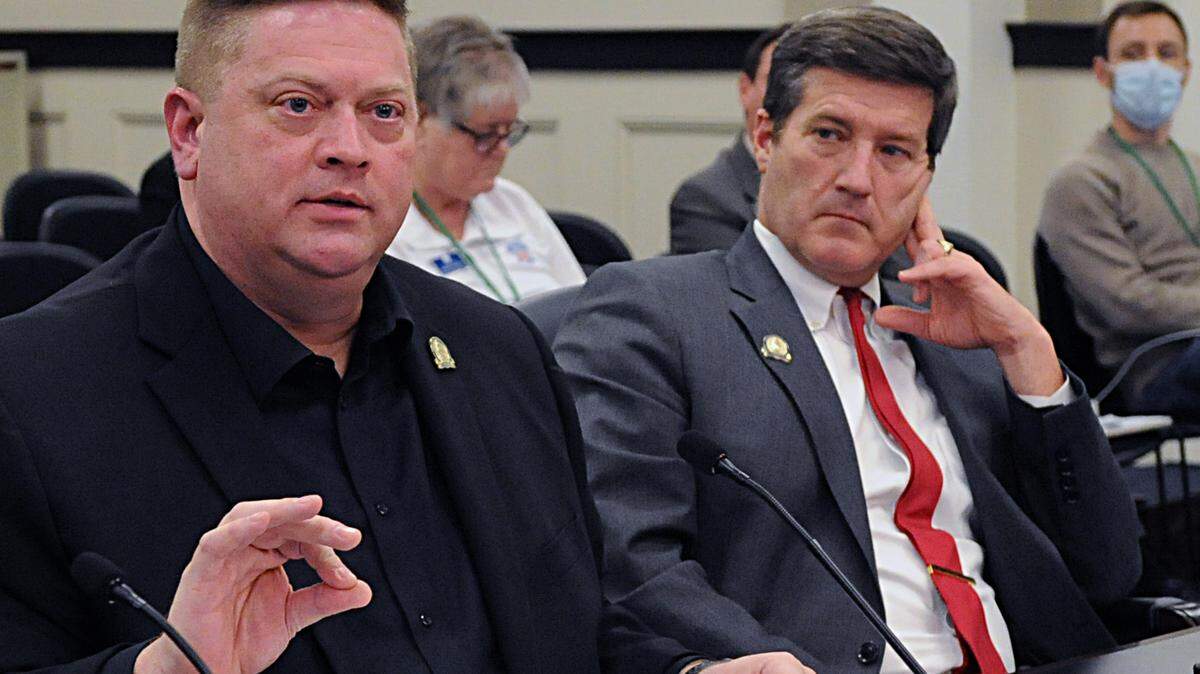
For some House Republicans Thursday was an “epic day” that kicked off the legislative process for putting Kentucky on a path to get rid of the individual income tax.
For Democrats and other observers at the House Appropriations & Revenue committee hearing on Thursday night, the state’s economic outlook if the legislature passes House Bill 8 is grim. Fewer than 24 hours after the bill was discussed in committee, the House passed it onto the Senate Friday morning in a near-party line vote, 67-23, with most all Democrats voting against it.
“It’s a budget buster – honestly the worst bill I’ve seen in 23 years,” Jason Bailey, Director of the Kentucky Center for Economic Policy, said.
The bill would dramatically change Kentucky’s tax code, starting with a cut on the individual income tax rate from 5 percent to 4 percent starting next year. Further cuts, in 0.5% increments, would only occur if Kentucky’s General Fund hits certain “triggers” in additional revenue raised by the sales tax, which would be applied on more goods and services.
The sales tax base would be expanded to include several items previously untaxed in Kentucky. Bill sponsor Rep. Jason Petrie, emphasized that the sales tax base would not be extended to “essential” goods and services like groceries, medical expenses, and family utility bills.
“(The bill) tries to get over to entertainment issues and things that are not going to affect people as much where they live on an ordinary, daily basis,” Petrie said. “… I’ve heard a lot from different groups, ‘you have to (tax) these things.’ In fact, we did not do those things.”
Petrie, many conservative legislators and business groups like the Kentucky Chamber of Commerce, say that such a tax code change without hitting those categories will attract businesses and more workers to the state while shielding poor and middle-income folks from a sales tax hike.
Bailey and House Democrats argued that the bill is an unfair handout to the wealthy, and that while the state’s coffers may be fine for a short period, tinkering with the stream that now brings in over 40% of the state’s revenue will cripple future budgets.
“HB 8 will ensure that budgets are grossly imbalanced in the near future and will become more imbalanced over time, leading inevitably to massive budget cuts, a failure to meet obligations like pensions, and/or huge tax increases on middle- and low-income Kentuckians,” Bailey said.
Rep. Brandon Reed, R-Hodgenville, painted the bill as a triumph for the state of Kentucky. He called Thursday an “epic day.”
Petrie added that the most dramatic change would not occur overnight. The first drop down to 3.5% personal income tax rate would only occur if the state’s General Fund collects $14.5 billion. General Fund receipts totaled $12.8 billion in the most recent fiscal year, and is expected to grow in the current year.
The state’s General Fund would have to pull in more than $21.5 billion for personal income tax rates to hit zero.
“I believe this is a monumental shift of the barge, but it doesn’t change overnight,” Petrie said. “It changes the barge a little, and I believe it puts it in a healthier direction.”
A committee substitute on the bill changed an earlier version. It increased the revenue “trigger” that the General Fund revenues would have to raise in order to cut the income tax, it removed a provision that would have taxed advertising services – organizations like the Kentucky Broadcasters Association were against ad taxation – and it added the “Kentucky Tax Amnesty Act.”
In a brief discussion about why the bill did not yet have a public “fiscal note” attached to it, Petrie said that the new services taxed under the initial version House Bill 8 were projected to generate $160 million, but that the figure has shrunk since eliminating advertising from the list.
Petrie did not take questions from the media following the committee meeting.
Republican House committee members, business groups like the Kentucky Chamber of Commerce, and conservative organizations like the Bluegrass Institute for Public Policy welcome the changes.
“The Kentucky Chamber supports House Bill 8 as a strong step forward in continuing the critical work of comprehensive tax reform in Kentucky,” a statement from the chamber reads. “True pro-growth tax reform is the Chamber’s top strategic priority and we call on the General Assembly to ensure Kentucky has a competitive tax structure by aggressively driving down our income tax to attract residents, support working families, and attract business and opportunity.”
The proposed changes would certainly not take place in a vacuum. The Senate has already passed a massive tax rebate for Kentuckians that would cost about $1.15 billion in state funds. Gov. Andy Beshear issued an executive order to freeze skyrocketing auto vehicle taxes to 2020 rates – that will cost the state about $873 million.
The current fiscal year budget surplus is $1.1 billion, while the projected surplus for next fiscal year is $1.9 billion.
House Bill 8 proposes to expand the state’s narrowly applied 6% sales tax to the following and more: non-primary residential electricity, taxi cabs and ride-hailing apps like Uber, lobbying services, security systems, parking services, pleasure watercraft docking, cosmetic surgeries, entertainment venues, telemarketing, and personal financial planning.
Opposition to HB 8
Democrats and more progressive policy groups like the Kentucky Center for Economic Policy, Kentuckians For The Commonwealth and the Kentucky Council of Churches are strongly opposed to House Bill 8.
“Everybody gets something back, but some people get a whole lot more back. There’s an absolute value for everybody, but not (the same) relative value,” Rep. Josie Raymond, D-Louisville, said. “The people at the bottom end of our economic spectrum are not better off, they’re worse off in my mind, because the gap is wider.”
Raymond added that with just the shift from 5% to 4%, some people would get only a single-digit dollar amount back in taxes per week because of the cut while some of the richest Kentuckians could get back $1,000 per week.
Bailey said that in the first year of the cut to 4% income tax, Kentuckians in the top 1% of earners would receive an average of $11,000 while the typical Kentucky family would get just $278.
Rep. Lisa Willner, D-Louisville, filed House Bill 201, which features graduated income rates that tax wealthy Kentuckians at a higher percentage than those who make less money.
“What works better for states is if we have a graduated income tax, where those who can afford to do more, do more. It’s a rising tide that lifts all those where we can invest in public schools and public universities and pay our public employees what they deserve,” Willner said. “But I acknowledge that I live in the land of reality, and that’s not the direction we’re going.”
Skeptical commenters at the committee asked how House Bill 8 was different from the notorious “Kansas Experiment” wherein that state saw major hits to its revenue and sclerotic economic growth due to a fast shift away from income tax without a commensurate increase in sales tax.
Petrie said that the big difference is that Kentucky can already afford the drop from 5% to 4% based on the appropriations in his House Bill 1, which is still being considered by the Senate, and that the revenue triggers prevent Kentucky from getting ‘in front of its skis.’
“We have the funding for five to four, which is basically reducing our revenues to meet our appropriation needs. Four to zero, we did not go out in front of our skis and reduce our revenues before they’re there,” Petrie said. “We’re not counting on whether we have to get a certain amount of money that comes later on. If the revenue trigger’s not hit, we don’t go down.”
Bailey said that the triggers don’t account for inflation, and because of that the shift is more likely to make the state downsize the services it offers to Kentuckians.
“If you want to get rid of the income tax, which we don’t agree is a good idea, you have to have a plan to pay for it. There’s not a plan at all,” Bailey said. “... You can’t get rid of 40% of your revenue with very little to replace it and expect to continue to keep your schools open, your teachers paid and your hospitals open.”
He also pointed out that the amount of money cut from the state’s revenue by the first-year shift in income tax rate is over a billion and roughly equivalent to what the state pays to fund all eight public higher education universities and all 16 of its community colleges. The replacement in sales tax, he said, would be much less than $160 million.
He added that some of Petrie’s revenue triggers – which are not inflation-adjusted – are likely to be met because of inflation, but with rising costs the government may not be able to afford the services it provides now into the future.
For example, Bailey said that 20 years ago the state’s revenue was half of what it is today but it was able to employ 6,800 more people.
“We know that just because you have more money doesn’t mean you can buy more stuff,” Bailey said. “That’s true with government as well.”
This story was originally published March 4, 2022 at 10:21 AM.