
Kentucky personal income tax cut remains but rebates likely done in new GOP bill
Kentucky’s personal income tax rate is likely to soon decrease after the passage of House Bill 8 in the Senate.
Less than two hours after the bill passed out of committee Tuesday, the Senate voted 27-8, with all Democrats voting no and only one Republican Senator passing on the measure.
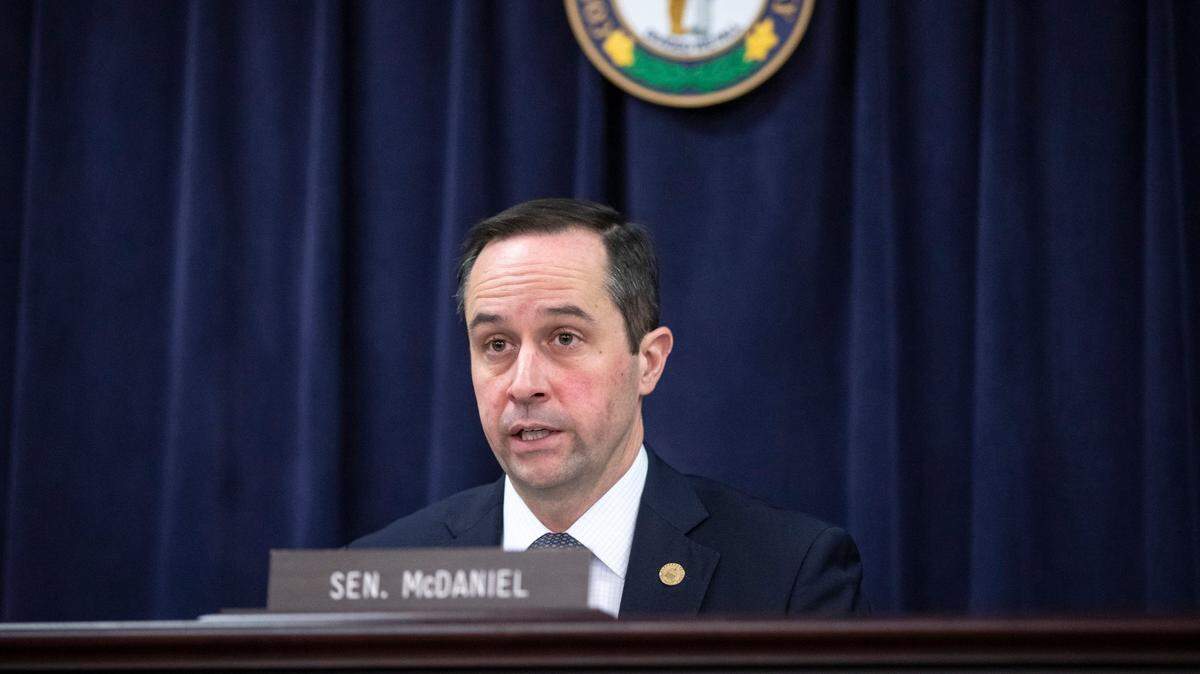
The bill received near-unanimous GOP support in both chambers, though the bill changed significantly with a Senate committee substitute presented by Senate Appropriations & Revenue Committee Chair Sen. Chris McDaniel, R-Taylor Mill, Tuesday.
The personal income tax rate does not drop as quickly as it would under the initial version of the bill sponsored by Rep. Jason Petrie, R-Elkton.
A new version of the bill does not immediately drop the state’s personal income tax rate and instead replaces previously static dollar amounts that triggered tax rate decreases with a more complex formula. That formula allows the income tax to drop in 0.5% increments if at the end of the fiscal year the actual revenues exceed expenses plus the dollar value of a 1% drop in income tax.
Fiscal analysis from the state on McDaniel’s latest version of House Bill 8 indicated that the legislation will create a negative impact of over $800 million to state coffers in lost tax revenue. The state is currently running on a historic budget surplus.
The tax rates would drop at the start of the calendar year, so Kentucky’s current 5% income tax rate could decrease to 4.5% as early as Jan. 1, 2023, for example. McDaniel said he expects that initial decrease to happen either then or one year later.
The bill also requires that the state maintain a Budget Reserve Trust Fund equivalent to 10% of the actual revenue drawn in a given fiscal year for the personal income tax rate to drop by half a percentage point.
McDaniel said that those provisions, as well as one that requires the General Assembly to approve a drop in the income tax rate, will protect Kentucky from becoming like the infamous “Kansas experiment.”
The Sunflower State saw major hits to its revenue and stagnant economic growth due to a fast shift away from income tax without a commensurate increase in sales tax. The move caused some public schools to shut down or consolidate and Kansas’ bond rating took a major hit.
“There’s in essence a series of three things that keep you from ending up in a situation like Kansas found themselves,” McDaniel said. “We do firmly believe in lowering the income tax rate in the state, but it has to be done responsibly. And this is a very gradual way to accomplish that safely.”
The measure has been supported by one of the state’s most powerful lobbying groups, the Kentucky Chamber of Commerce, and has been touted by its supporters as a way to ease the tax burden on Kentuckians and attract more middle- to high-earners to the state.
The latest version of the bill cut three different services that were to be newly included in the state’s selectively applied 6% sales tax: financial services, boat launching, travel agencies.
On the Senate floor, Democrats decried the process by which the bill was passed. Sen. Morgan McGarvey, D-Louisville, asked why Republicans were “hiding” the 200-plus page bill right up until the chamber was being asked to vote on it.
“It’s tough to read 208 pages in a couple of hours,” said Sen. Reggie Thomas, D-Lexington.
Thomas added that the savings due to personal income tax cuts will disproportionately help the wealthy and that he doesn’t see a “win” for residents making around the average income of less than $50,000.
Kentucky Center for Economic Policy Director Jason Bailey called a previous version of the bill the “most fiscally destructive legislation ever considered in the commonwealth.” On Tuesday, he struck a similar tone about the latest version of the bill.
Bailey wrote that the bill creates “perverse incentives” for the state, making it prioritize savings and keeping room for future tax cuts over addressing “critical needs,” and could also pressure the state into raising the sales tax on now-untaxed goods or services.
“In effect, these mechanisms make a goal out of failing to invest in Kentucky communities,” Bailey wrote.
McDaniel, for his part, said he doesn’t think increased taxation will be necessary.
“I don’t think that’ll be necessary at all… as we continue to see economic growth in the state, and also because of the nature of how this is written,” McDaniel said. “The top line revenues have to grow not in substantially to make it.”
The goal, like Petrie’s previous version of the bill, is still to get to zero personal income tax in the state, McDaniel said. He added that he thinks the state could hit that mark as early as “eight to ten years” from now.
With passage in the Senate, the bill will have to return to the House for a concurrence vote before hitting Gov. Andy Beshear’s desk. The House previously voted for the bill 67-23, with only Democrats voting against it.
What happened to rebates?
A sweeping proposal for tax rebates to Kenucky taxpayers seems unlikely to become law, according to McDaniel. McDaniel’s Senate Bill 194 is a separate piece of legislation, but he presented House Bill 8 as a compromise between himself and members of the House.
“Our House colleagues just had a different view,” McDaniel said.
His bill would have spent over $1 billion of the state’s surplus on rebates that would total up to $500 per person, depending on how much they paid in state taxes.
Anything else in the bill?
A new excise tax on electric-powered vehicles of 3 cents per kilowatt hour is also introduced in the bill. McDaniel said he’s open to further discussion on what the right amount taxation on such vehicles is, but that some form of taxation needs to “be on the books.”
An electric vehicle ownership fee of $120 annually for fully electric-powered vehicles and $60 for hybrids is also in the bill. Combined with the excise tax, those measures are expected to bring in about $4.5 million in tax revenue for the state in the next fiscal year.
Some tax credits and exemptions were also tucked into the latest version of House Bill 8.
Language that mirrors a once-dormant House Bill 555 was added into the bill, which starts a tax credit program for the decontamination of property. That credit can refund up to 100% of the amount spent on decontaminating property; that provision is capped at $30 million per property.
The bill also exempts drugs purchased by a farmer or farming company to treat certain livestock from the state sales tax.
Another exemption tacked onto the bill is for “refabricated homes held for sale in a manufacturer’s or retailer’s inventory.”
This story was originally published March 29, 2022 at 5:15 PM.