
Ky. Democrats argue in court that redistricting maps all but ‘guarantee’ GOP wins
A top Kentucky Democratic operative said his party’s odds of succeeding in Kentucky are severely hampered by the newly-enacted redistricting map during the first of a multi-day set of hearings for the party’s legal challenge against those maps.
The state Democratic Party is challenging the maps, which were drawn by GOP supermajorities in both chambers of the state legislature, on grounds that they would present an “extreme partisan gerrymander” and that they excessively split counties.
The two maps being challenged in Franklin Circuit Court are for the Kentucky House of Representatives as well as the state’s six U.S. Congressional Districts. The case is assigned to Franklin Circuit Judge Thomas Wingate, who has acknowledged that the challenge regardless of his ruling is likely to end up in front of the Kentucky Supreme Court.
In a February ruling, Wingate blocked efforts by the Democrats and the state to block the maps and dismiss the complaint against the maps, respectively.
Kentucky Democratic Party (KDP) Political Director Trey Hieneman said that the effect of the new maps will all but “guarantee” Republican victories in an outsized number of House districts.
“By being able to dilute the Democratic votes in certain areas, it makes it so that the next election is guaranteed,” Hieneman said. “... It dissuades candidates from wanting to run in a district where the results are predetermined.”
Hieneman says that there are only 57 Democrats running in contested races, down from 77 in 2020. There are no Democratic candidates filed to run in the Jackson Purchase region, where there are 6 House districts, he said.
Hieneman and Harvard political science professor and researcher Dr. Kosuke Imai testified for the KDP on Tuesday. Imai ran a simulation that he says shows the Republican-drawn map is heavily tilted to benefit their own party, while Hieneman spoke to what he said were the on-the ground effects.
In cross-examination, attorneys with the state indicated that the map wasn’t unfair to Democrats, that it followed all the rules set out in the Kentucky Constitution, and that an expert analysis backing the Democrats’ point of view is flawed. Further, they argue that Republicans in the statehouse outperforming statewide elections is a natural result of progressives in the state concentrating in urban areas.
Hieneman pointed out several cities – including Richmond, Bowling Green, Hopkinsville and Covington – that he believes were unfairly split up to benefit Republicans. He also said that some candidates recruited to run in Louisville were drawn out of districts in which they might have been more competitive.
Data analysis questions fairness
Imai was the first expert witness called to testify for the Democrats on Tuesday.
The Harvard professor and author of books on quantitative social science said that he ran an algorithm that generated 10,000 possible U.S. Congressional and House maps.
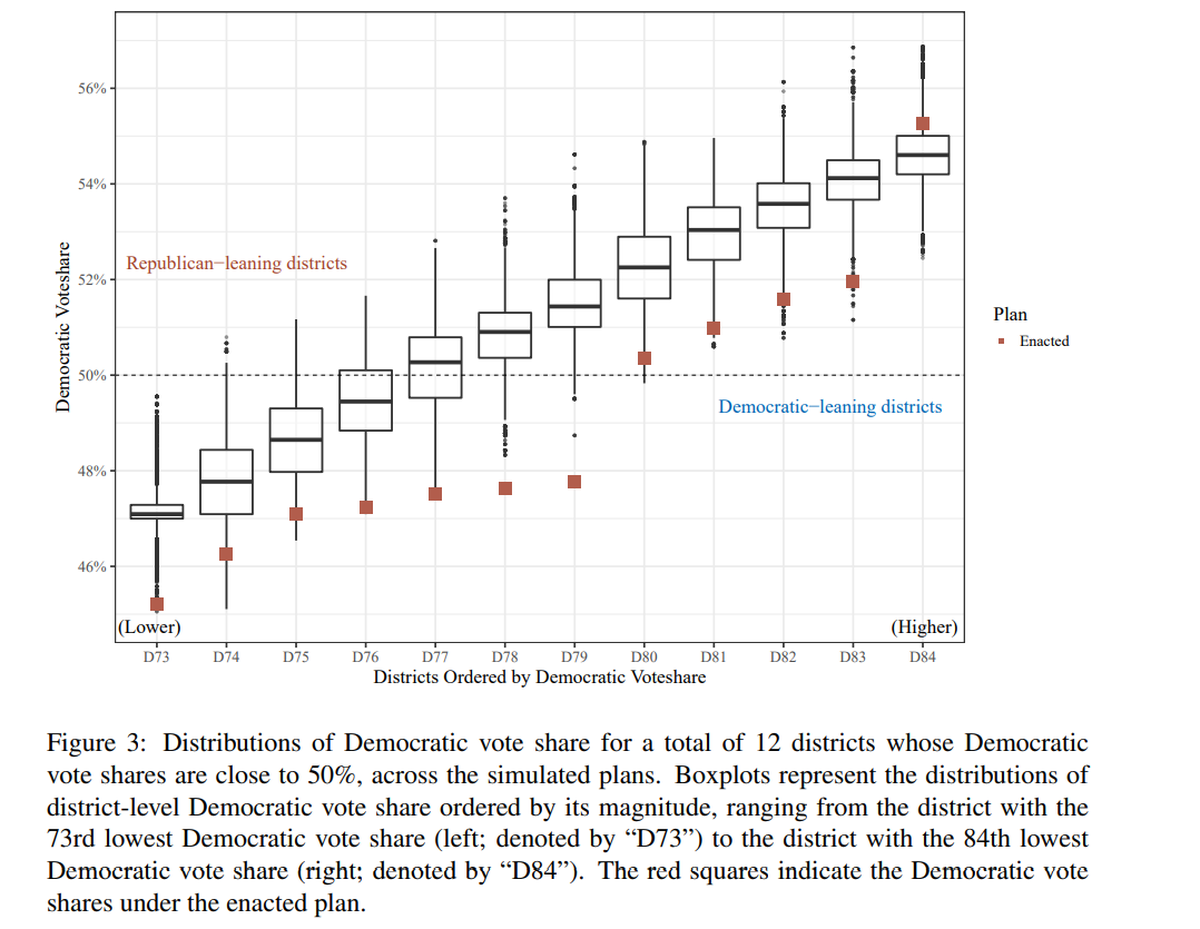
In all of those 10,000 maps simulated, none of them included as many county splits or as many districts with more than two counties as the newly enacted maps. Imai also concluded that the new House map is significantly more kind to Republicans than a majority of simulated maps.
Franklin County – the source of some consternation in the initial lawsuit, as it was included in the Western Kentucky-dominated 1st Congressional District – was also part of Imai’s analysis. The county is home to both the seat of state government and one of the few somewhat Democratic strongholds left in the state, though it swung for Trump in both recent presidential elections. Imai said that the more than 99% of the maps his algorithm created has Franklin County in both a more compact district and one that is more Democratic.
In court, Imai focused on the House map’s effect in Fayette and Jefferson counties.
Imai said that despite the growth of the urban, more Democratic-leaning Fayette county, the balance of power in the area was shifted towards Republicans. Reps. Killian Timoney and Cherlynn Stevenson’s districts, both swing districts, were made much more Republican-friendly in the latest version of the map, with Stevenson’s district swinging from southern Fayette County to the northern reaches and into the more GOP-friendly Georgetown. Meanwhile, Timoney’s district lost bits of Fayette County and gained a chunk of suburban and rural Jessamine County.
State defends new maps
State attorneys and University of Kentucky political science professor Dr. D. Stephen Voss poked holes in Imai’s analysis.
Associate Attorney General Victor Maddox asked Imai several questions about Kentucky politics, to which Imai admitted ignorance – Imai was not aware of some of the actions of former governor Matt Bevin, which made him unpopular with some voters in his own party.
He brought up that particular race because Imai’s analysis was partially based on that election, along with 2016 Presidential and U.S. Senate as well as 2019 statewide constitutional officers.
Maddox also points out that in many areas, counties previously split up were made more whole in the new map.
One part of Imai’s analysis, a plot that showed what he considers to be the state’s 10 most competitive districts and how they were made to favor Republicans, drew Maddox’s attention: it showed that 76 districts in Imai’s simulation would lean Republican. It also showed, however, that 79 would be likely Republican in the enacted plan, while all but one of those races is tilted more heavily towards the GOP in the enacted plan as opposed to the simulation’s 10 most competitive districts.
In Voss’ response to Imai filed in court, the UK professor calls the algorithm-based analysis “naive” to Kentucky’s political geography. He points out that, just as Hieneman criticized the new maps, Imai’s House map simulation often splits up cities and that the U.S. Congressional map does not benefit Republicans.
In fact, Voss says that while the 1st district was made less compact in the new maps, most other districts benefit as a result.
“Drawing that one district may have helped other parts of the mapping scheme become more compact,” Voss wrote. “What’s going on in the rest of the state, about which Imai remains mostly silent? Leaving aside Louisville’s 3rd District, which hardly changed, every other Kentucky congressional district becomes more compact under the enacted plan than it was during the last decade.”
Voss also wrote that not taking into account race allowed Imai to create “fantasy” maps that were not practical in the way the enacted maps were.
“Imai is comparing the enacted plan to fantasy maps that could have landed the Commonwealth in a federal courtroom. It’s neither a fair nor a realistic comparison,” Voss wrote.
This story was originally published April 6, 2022 at 12:27 PM.