
Redistricting maps likely to hold for 2022, though legal battle continues
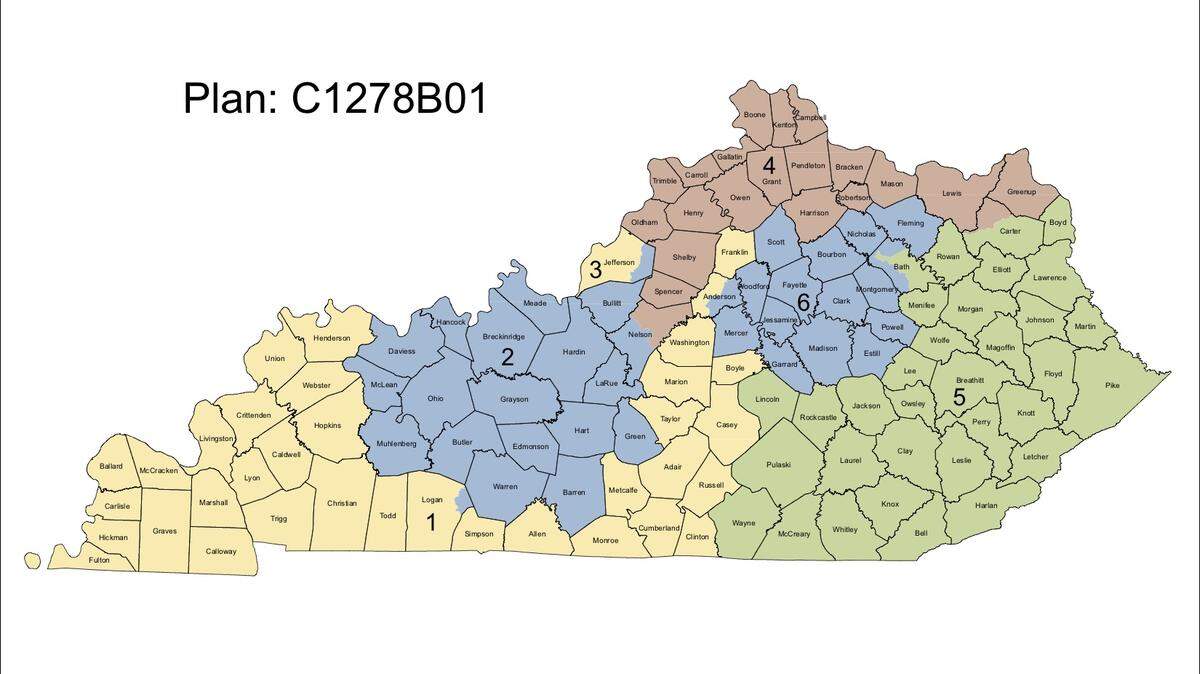
The maps passed by the General Assembly are very likely the maps that candidates will run on in 2022, according to attorneys on both sides of the state’s redistricting lawsuit.
“Never say never, but I think given where we are today and the approaching primaries, it’s more likely that this case is going to govern future elections than 2022,” Michael Abate, attorney for the Kentucky Democratic Party and a series of Franklin County-based citizen plaintiffs said.
Attorney for the state, Deputy Attorney General Victor Maddox, added that it was a “safe bet” that the 2022 maps will not be affected by the lawsuit.
Though most involved in the case, including Maddox and Abate, agree that the matter will ultimately be decided before the Kentucky Supreme Court, Franklin Circuit Judge Thomas Wingate is on no tight deadline to rule on the case. All briefs and conclusions are due on June 15, Wingate said at the hearings’ close on Thursday. That would be nearly a month after the May 17 primary.
Paula Setser-Kissick, a Lexington-based candidate who gave 12th District Senator Alice Forgy Kerr, R-Lexington, a tight race in 2018 and filed to run again in 2022, said she won’t withdraw from the race for that seat. She and two Republicans who had filed for that seat were drawn out of the district, leaving only Republican Lexington councilwoman Amanda Mays Bledsoe.
Setser-Kissick said she was “gerrymandered” out of the district.
“Since I didn’t gerrymander myself out of Senate District 12, I don’t feel the responsibility for withdrawing from the race falls upon me. I’ve already spent money on the filing fee. Why would I also waste money and time on getting a withdrawal form notarized? The Republicans knew their hand-picked candidate couldn’t win, and now she’s the automatic Senator. If the Republicans don’t want my name to appear on the ballot, they’re welcome to complete the paperwork themselves to remove it.”
Bledsoe has said previously that she did not ask for the changes to the map and felt “terrible” for the other candidates.
The 12th Senate District changed significantly in the latest round of redistricting. The district used to only include Fayette County; now it shares a much smaller portion of Fayette County while also covering Woodford, Mercer and Boyle counties.
The lawsuit only challenges the House and U.S. Congressional District maps, not the State Senate.
In three days of hearings before Wingate, the plaintiffs argued that the maps were uniquely unfair to Democrats as well as the people of Franklin County and that the House map excessively split counties. They brought forth two expert witnesses from Harvard and the Massachusetts Institute of Technology (MIT) who ran analyses that purport to show both of those deficiencies.
The state attempted to poke holes in the analysis of the Democrats’ two experts with the help of University of Kentucky Political Science Professor D. Stephen Voss.
MIT professor Devin Caughey’s analysis paints a grim picture for Democrats seeking election to the Kentucky House. He projects that the current 25 Democrats in the 100-person will soon decrease to 20.5 or fewer.
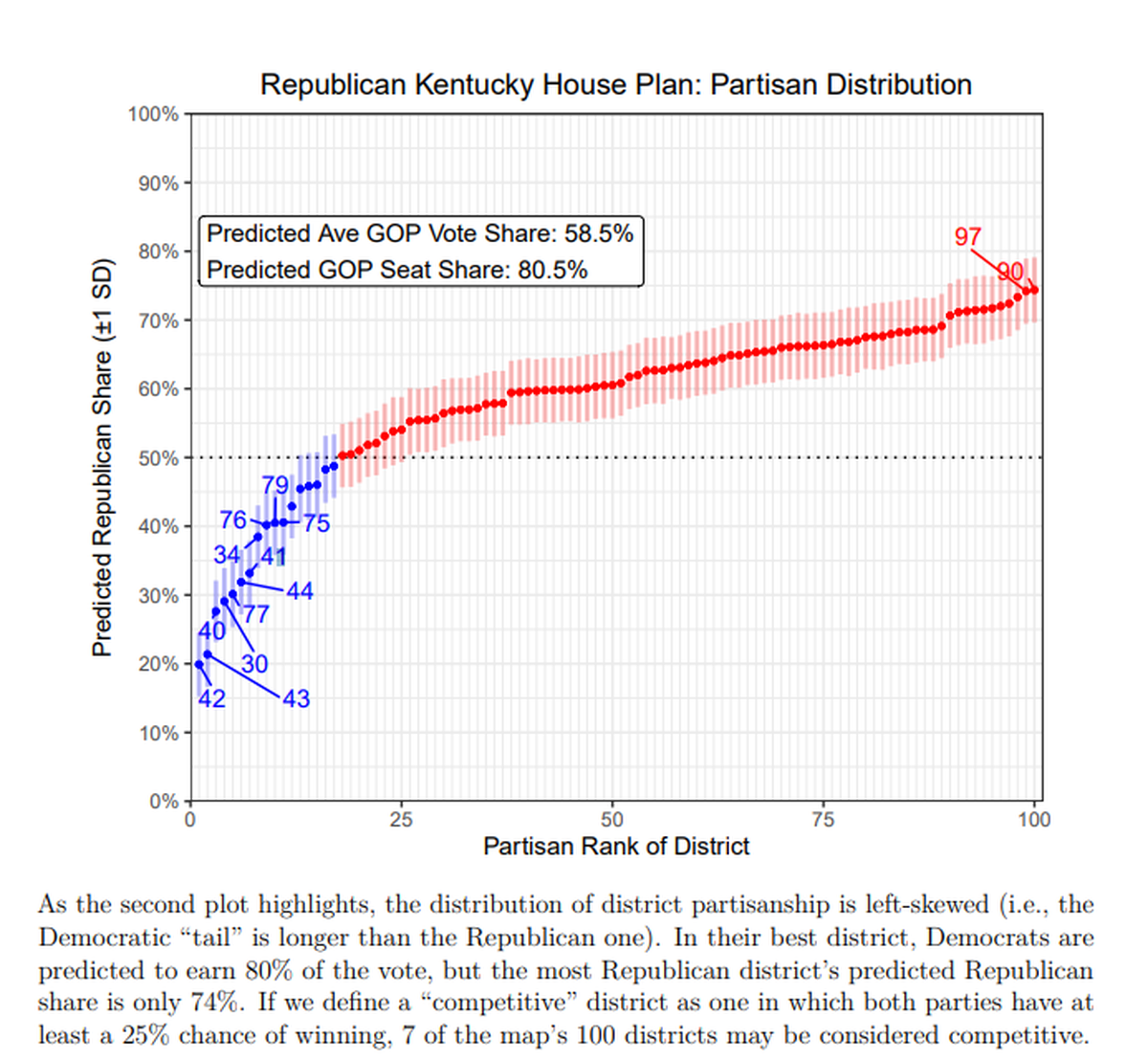
Voss said that Caughey and Imai’s projections don’t take into account the political geography of Kentucky and that they assume presidential and statewide voter preferences predict legislative preferences.
Criticism of the U.S. Congressional District map centered around Franklin County, where the trial took place and where Wingate is a native. In an earlier hearing, Wingate expressed some puzzlement at Franklin County’s inclusion with Western Kentucky in the 1st Congressional District’s extended “arm” that snakes under the 2nd District and Northward into Central Kentucky’s Anderson and Franklin counties.
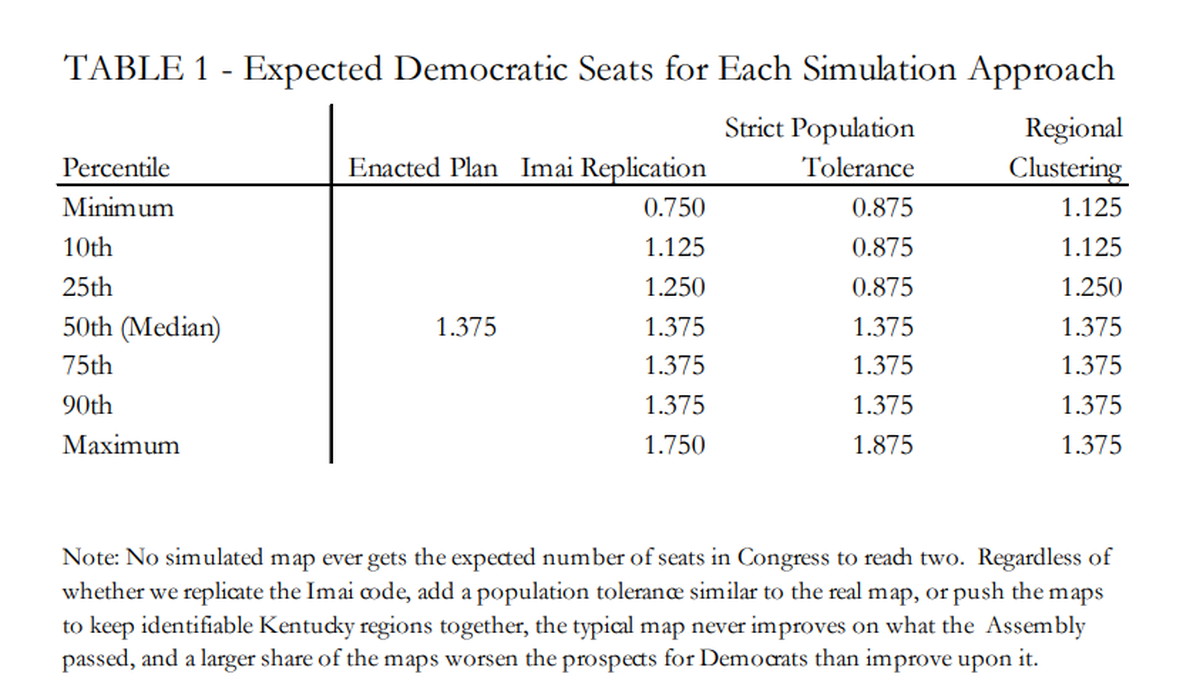
In the hearing, Voss said that according to Imai’s analysis of 10,000 simulated plans, the enacted U.S. Congressional District plan does no favors to Republicans.
After the hearings wrapped up on Thursday, both Maddox and Abate expressed confidence that their side will get a fair shake.
Maddox says it’s clear that the maps violate neither section 6 nor 33 of the constitution, as Abate alleges. Those sections hold that Kentuckians are guaranteed “free and equal” elections, which Democrats have argued is curtailed by allegedly gerrymandered maps, and that counties cannot be split.
Abate said that the state often pointing out unfairness of previously-drawn maps by Democrats was a weak defense of the current, GOP-drawn maps.
“I think what we’ve heard from the other side was litigating the past in terms of what’s happened in past election cycles as opposed to trying to defend the current maps. There was no analysis from the other side about the fairness. They were not asked to opine on the fairness of the maps, they were only asked to try to poke holes in our experts analysis. So the state’s playing defense and did not come in with any evidence showing that what the legislature passed was fair.”