
In Kentucky, ‘moderate’ McConnell stands alone among Republicans on red flag law
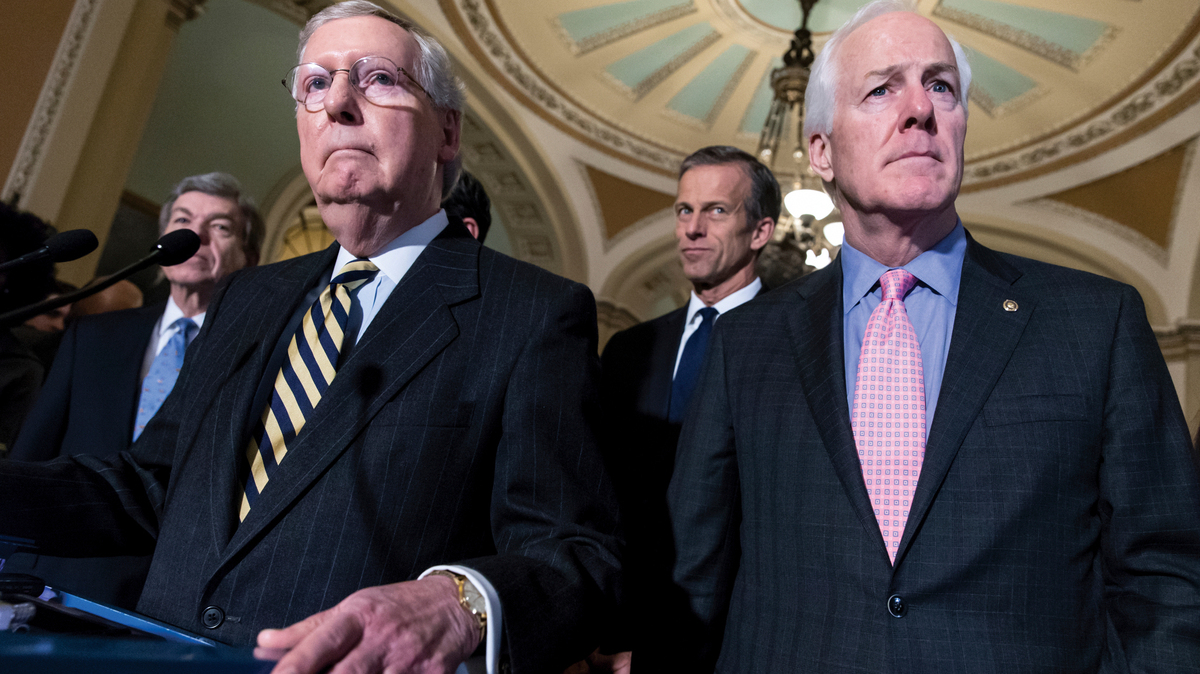
In the eyes of liberals in Washington and around the country, Mitch McConnell remains a vanguard of obstruction and a bulwark of the gains made by the conservative movement.
But on this summer’s most significant piece of federal legislation – the first gun control measure to clear Congress in nearly 30 years – McConnell is seen as a moderate, at least among Republicans in Kentucky.
The lone Republican in the commonwealth’s delegation to vote for the Safer Communities Act, McConnell joined a majority of Democrats to support $750 million for states to implement “extreme risk protection order” laws, more commonly known as red flag laws. They are designed to allow authorities to intervene and temporarily seize a firearm from someone deemed dangerous – before they might act.
But it’s the provision that most Republicans drew a hard red line against.
“There is no room for compromise when it comes to defending our 2nd Amendment rights, yet that is exactly what some moderate Republicans in Congress have done by voting in favor of red flag laws,” said Savannah Maddox, a state representative from Dry Ridge and a candidate for governor.
Maddox said she would do everything in her power to stop passage of a red flag law as a member of the general assembly and added, “I am the only gubernatorial candidate who has gone on record publicly opposing red flag laws and other efforts to infringe upon our right to keep and bear arms.”
A spokesman for Daniel Cameron’s gubernatorial campaign did not respond to several inquiries seeking his position.
Rep. Andy Barr, who represents Lexington, said there were several components of the Senate-drafted proposal that he agreed with, including the funding for school security grants, background check systems and mental health services.
But he ended up voting “no” on the legislation due to the money that would enhance red flag laws, because they don’t include “due process” for those who are suspected of potentially committing a crime with a gun.
“Specifically, I cannot in good conscience, consistent with the Constitution, enable the implementation of a ‘crisis intervention program’ that would deprive Americans of their 2nd Amendment rights in an ex parte proceeding without a pre-deprivation opportunity to be heard, confront his or her accuser, with representation by counsel and subject to robust evidentiary standards,” Barr wrote in a statement. “Such a program, as contemplated in the legislation, could have the unintended consequence of disarming innocent but at-risk individuals who need a firearm for self-defense.”
Both Barr and Rep. James Comer, who also voted “no” on the Safer Communities Act, cited their support for the “Restoring Hope for Mental Health & Well-Being Act,” which breezily passed the House 402-20 in June.
That legislation focuses on delivering services to those suffering with mental disorders, drug addiction or suicidal tendencies, which Republicans argue is the crux of the epidemic of gun violence and mass shootings plaguing the country.
The bill has yet to be taken up in the Senate. Another piece of legislation supported by Barr, the Stop II Act, takes unspent Covid relief funds and rededicates the money to mental health counselors and resource officers in schools. It’s currently stuck in committee.
Sen. Chris Murphy, a Democrat from Connecticut and lead sponsor of the Safer Communities Act, has argued these new red flag laws could have prevented the Highland Park, Illinois shooting during a Fourth of July parade.
Because police had intervened with the shooter before – when he threatened to kill himself and family members in 2019 – they would have been alerted of his more recent weapon purchases.
“A red flag order removes guns from the subject and prevents him from buying new guns,” Murphy wrote on Twitter. “It lasts for 6 months and can be renewed. If a red flag order had been issued in 2020 when [Robert] Crimp started buying guns, it could have still been in effect today.”
“Of course there’s no way to know for sure whether the new gun law would have prevented this massacre, but the law is kind of tailor made for this scenario,” Murphy continued. “The new law gives law enforcement the tools to connect the dots to prevent a shooting like this before it happens.”
A Marist poll taken late May through early June found that 74% of Americans support national red flag laws, including 60% of Republicans.
“Support for the provisions of the framework is off the charts, overwhelming,” McConnell said in mid-June when he announced he was comfortable with the legislative framework.
Following the Highland Park shooting, McConnell said it was important to identify troubled young men. “Because after every one of these shootings there are people who say, ‘Oh you know I thought he was pretty strange. I wish I notified somebody about it,’” he said.
But that support is hard to spot among Kentucky Republicans.
Chet Hand, the chairman of the Boone County Republican Party chairman who is active in the state’s Liberty movement, said the compromise is actually “the slow death of the 2nd Amendment by legislation.”
“The language of our Constitution is clear: ‘the right of the people to keep and bear arms, shall not be infringed,’” Hand said. “Senator McConnel has demonstrated over and over that he cares very little for our Constitution and the freedoms our Founding Fathers intended us to have. His support of this unconstitutional gun deal will have lasting negative impacts on Kentucky citizens and cannot be tolerated.”
But Jonathan Spalding, a GOP party chairman in Marion County, said he believed the new law was necessary given the spate of mass shootings.
“Hence, I agree with Senator McConnell. Whether it actually will do any good, I guess we have to hope for the best,” Spalding said, adding, “I think if you took a poll of Republicans I am in the minority, but not as much as you might think.”
This story was originally published July 13, 2022 at 12:53 PM with the headline "In Kentucky, ‘moderate’ McConnell stands alone among Republicans on red flag law."