The 2023 Kentucky General Assembly has started. Here’s what lawmakers are prioritizing
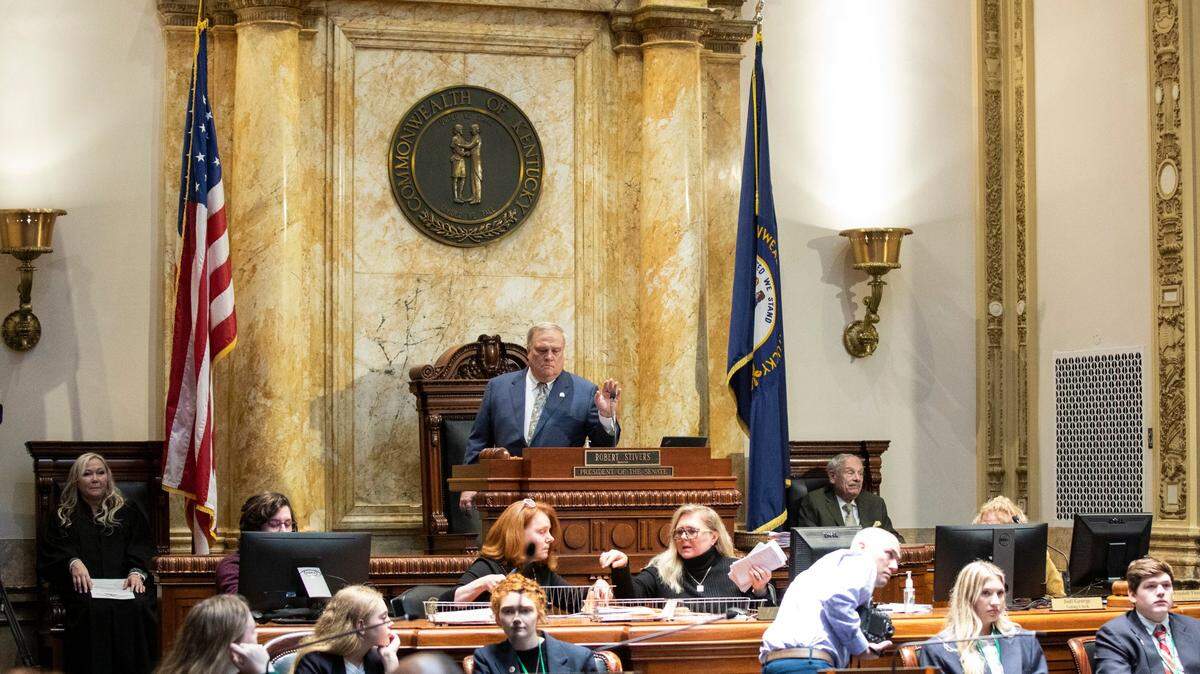
With just 30 days in the 2023 legislative session, Republican leaders say they plan to move quickly to take action on some of the priority bills.
Among them, codifying the cut to Kentucky’s state income tax and approving additional money for a veterans nursing home in Bowling Green.
The fate of other high-profile issues, like medical marijuana and sports betting, are less clear.
House Speaker David Osborne, R-Prospect, said that the House would pass three bills this week: House Bill 1, affirming the tax cut all the way to 4% by Jan. 1 of next year; House Bill 2, which allocates $16.8 million in the budget for a veterans center in Bowling Green; and House Bill 11 which draws back some funds from the transportation budget.
Senate President Robert Stivers, R-Manchester, also cited the tax cut and veterans center as week one priorities, along with an “issue that has arisen with the unemployment insurance.”
“If we don’t deal with that, it’s going to be pretty dramatic increases in the unemployment insurance payments that various businesses will have to deal with,” he said.
A rally was held at the Capitol, hosted by the Kentucky Center for Economic Policy, just before the legislature gaveled in protesting the tax cut for its disproportionate benefits to wealthy Kentuckians and its potential to cause future cuts in state services. But Osborne said that the House GOP caucus is unfazed by the group’s complaints, and wants to allow Kentucky taxpayers to keep more of their income through the tax cut.
“Certainly it does take money out of state coffers – about $600 million this year and about $1 billion in 2024. We happen to believe that it’s good policy to allow taxpayers to keep more of their hard earned money,” Osborne said.
In recent sessions with Democratic Gov. Andy Beshear at the helm of the state’s executive branch, the Republican-controlled legislature has passed laws targeting his powers. They’ve also bashed the governor over his vetoes of social policy legislation, such as issues affecting transgender people.
Could that be in store for this session?
Newly minted House Whip Jason Nemes, R-Louisville, said that it won’t be the caucus’ intention to make the governor look bad through legislation, but that Beshear would, in his opinion, come across as “extra, ultra woke” this session.
“Our priority in our caucus is to do what we think is right and good policy. I think Beshear is an ultra liberal, and I think his responses to things that we believe are good policy will show who he is. But trying to put Andy Beshear on the hot seat is not our intention at all. I think his being extra, ultra woke will show for itself,” Nemes said.
Osborne did not say whether the caucus would support a “bathroom bill” filed by Rep. Bill Wesley, R-Ravenna, which would ban transgender people from using school bathrooms of their gender identity. He said that no caucus-wide discussions had taken place on transgender issues yet.
There is likely to be heightened sensitivity to anti-transgender policies among Democrats, as Sen. Karen Berg, D-Louisville, announced last month that her son, Henry Berg-Brousseau, died by suicide at age 24. Berg-Brousseau was transgender, and was an outspoke advocate for trans rights, even as a high school student.
Osborne did mention, though, that legislation on “parental rights” could come down the pike.
That term was used to describe a controversial bill in Florida that banned “classroom discussion” on sexual orientation or gender identity from kindergarten through to third grade and also prohibited schools from adopting procedures to maintain the confidentiality of a disclosure by a student regarding their sexual orientation or gender identity.
“There are several people that are working on different types of (legislation), you know, under an umbrella of parental rights. But we’ve not gotten into specifics as a caucus as to what those will ultimately look like,” Osborne said.
As for opening up the budget, a small portion of the state’s $13 billion budget ($16.8 million) is expected to be spent for the Bowling Green veterans center. That raises the question of whether+ the legislature could take out more money for another cause: Eastern Kentucky flood recovery.
Some legislators in Eastern Kentucky are calling for well over $100 million in additional funds to flow into the region to help it recover from historic and deadly floods.
Osborne said that it’s possible a circumstance could arise such that the legislature would need to appropriate more funds to Eastern Kentucky, but that there was no plan to do so as of now. That could change if the governor’s administration requests more from the legislature, Osborne said.
“There may be a necessity to appropriate some additional funds once identified, but as of right now there’s been no additional funds that have been requested through the administration. So as of right now it’s only conjecture,” Osborne said.
On medical marijuana, Stivers said he’s not opposed to it, but it needs to be handled in an appropriate way.
“We have appropriated money to the University of Kentucky so they can give us indicators, ideas, methodology, for the use of marijuana for medicinal or therapeutic values. So I think that would be a more appropriate path. But, if there are votes in the caucus and in the Senate to move it, it’ll come to the floor for passage.”
For sports betting, Stivers said “it’s not a big deal.”
“I’m not for it or against it. I have no energy about it,” he said. “Anybody who estimates the revenues, who’s thinking it’s going to be a good revenue measure is probably wrong. It’s an entertainment value.”
Osborne was quick to point out that the House, with his and many GOP legislators’ backing along with the lion’s share of Democrats, had success in shepherding both sports betting and medical marijuana legalization through the House last year. The initiatives are believed by some to have popular support in Kentucky.
The house speaker said that he wasn’t sure if the Senate had changed its mind on either front, but he remains hopeful that he could change minds.
“I am hopeful that, should we have those conversations, we’ll do a better job of explaining it to (the Senate) this time than we did last time,” Osborne said.