
KY education chief defends state pronoun guidance after legislators’ attacks, bills
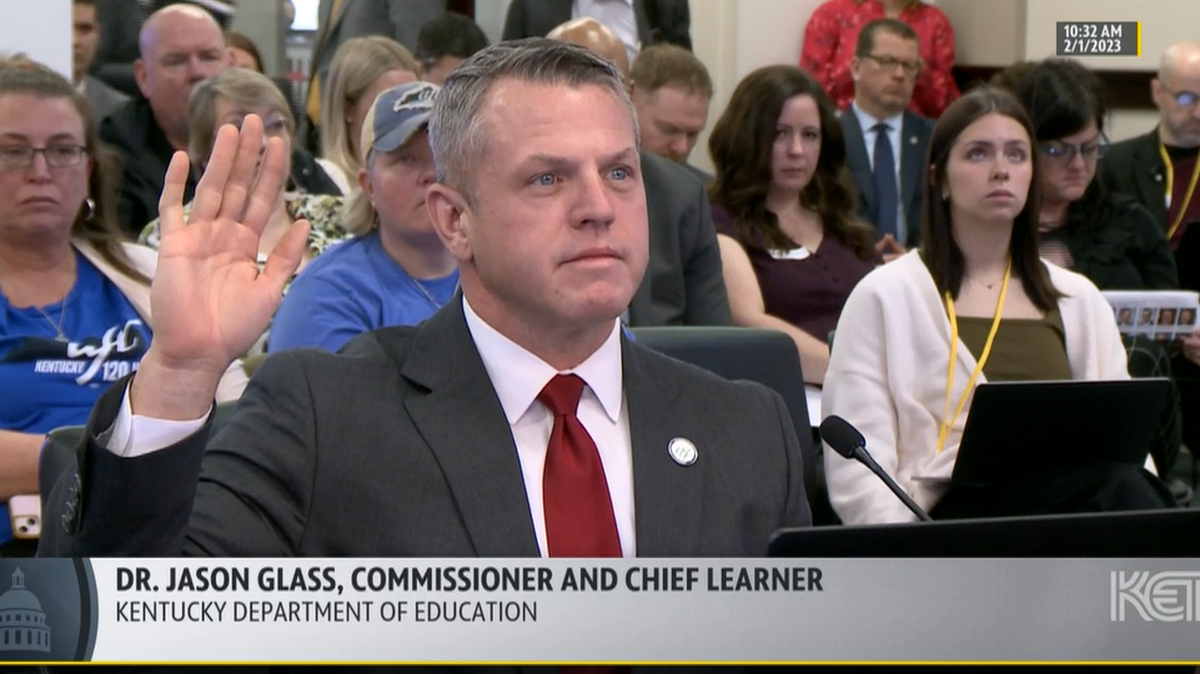
Kentucky Education Commissioner Jason Glass spoke out Monday in response to lawmakers’ criticism about a state guidance document recommending the use of a student’s preferred pronouns and legislation that seeks to strengthen “parental rights” in schools.
In a Monday email to state education employees, Glass referenced his comments last week to the House Education Committee, where he was testifying about long-standing shortages in the educator workforce.
“While I was happy to share information with them about the shortages we are facing and trend lines in the teacher workforce,” Glass said, “I was disappointed with the turn the meeting took toward the end of the time I was there. Instead of staying focused on what we can do to support the teaching profession, some of the legislators ended up focusing on guidance the agency produced regarding use of student’s preferred names.”
At the meeting, lawmakers openly criticized Glass and the guidance, calling it part of a “woke agenda” driven by Glass.
The guidance says, in part, school leaders should consult with their local board counsel for advice on specific issues in their districts. It is considered best practice to recognize and use a student’s preferred name and pronouns when these preferences are requested, the document said.
If a student voluntarily discloses their sexual orientation or gender identity to an educator with the assumption that this information is to be kept private, it is best practice for the educator to maintain that confidence and keep the information confidential, the document recommends.
In his Monday email, Glass emphasized the guidance is not a requirement for schools and districts, but is rooted in evidence-based best practices designed to promote the health and safety of students.
Schools and districts are not required to adhere to the guidance produced by the Kentucky Department of Education, “rather, we view guidance as tools that should be used in combination with their own local contexts and practitioner knowledge to make an informed decision,” Glass said.
“While I know this guidance document — and the treatment of LGBTQI+ students overall — is being hotly debated during this legislative session and election year, I want to assure you that my commitment to all of Kentucky’s students will not waiver. All of Kentucky’s students deserve to feel welcomed and supported in our public schools,” Glass said.
He noted that Sen. Max Wise’s Senate Bill 150, approved by the Senate Education Committee last week, says neither the state board nor KDE can require or recommend policies regarding the use of pronouns that do not conform to a student’s biological sex at birth. A school district also couldn’t require school personnel or students to use pronouns that don’t conform to a student’s biological sex at birth under the bill.
Rep. Josh Calloway also introduced House Bill 173 last week, Glass said.
“While it covers some of the same subjects as SB 150, it goes further, allowing parents to sue a school district if they felt their rights were violated. School staff also would be required to notify parents if their child starts dressing in a way that doesn’t conform to their gender or asks to be referred to by a different pronoun or name, among many other requirements in this 27-page bill,” he said.
“Neither of these bills will do anything toward solving our teacher workforce shortage. HB 173 would actually hurt our recruitment efforts, since teachers would be under constant threat of being sued if someone misinterpreted a lesson plan, not to mention the devaluing of the years it takes to become a licensed educator,” Glass said.
Critics of the bills have said they do not protect students who are members of the LGBTQ community, leaving them vulnerable.
Calloway, Wise on their bills
“This bill empowers parents, that’s the key,” Calloway told the Herald-Leader in an interview last week. “We just want to make sure that the world understands that ‘as a parent, my right trumps everything else.’ We have systems to deal with bad parents — and those systems are already in place — but we want to make sure that we codify some rights that parents have.”
Calloway said the passage and ostensibly strong Republican support behind Wise’s bill dealing with a similar issue doesn’t deter him from pushing House Bill 173.
“We work up here as caucuses, but we also work here as individuals that represent the people of our district. I’m not in competition with anybody on anything. I’m here to do the right thing. The goal is that we address the issue. What I’m going to try to do consistently is address the issue — that could be through the vehicle of Max Wise’s bill, my bill, Shane Baker’s bill. What I’ve filed was what I feel is essential, and I’ll be working with everybody here to try to address the situation as a whole,” Calloway said.
Wise, in an opinion column sent to the Herald-Leader, said his bill was about communication.
“I have filed Senate Bill 150 (SB 150) giving schools both the parameters and the process by which to support and advocate for the students in their care. But, just as importantly, this bill empowers parental engagement and strengthens the rights of parents over their children’s wellbeing, especially within their education and life-altering health decisions, Wise said.