Abortion remains illegal in Kentucky as state Supreme Court denies injunctive relief
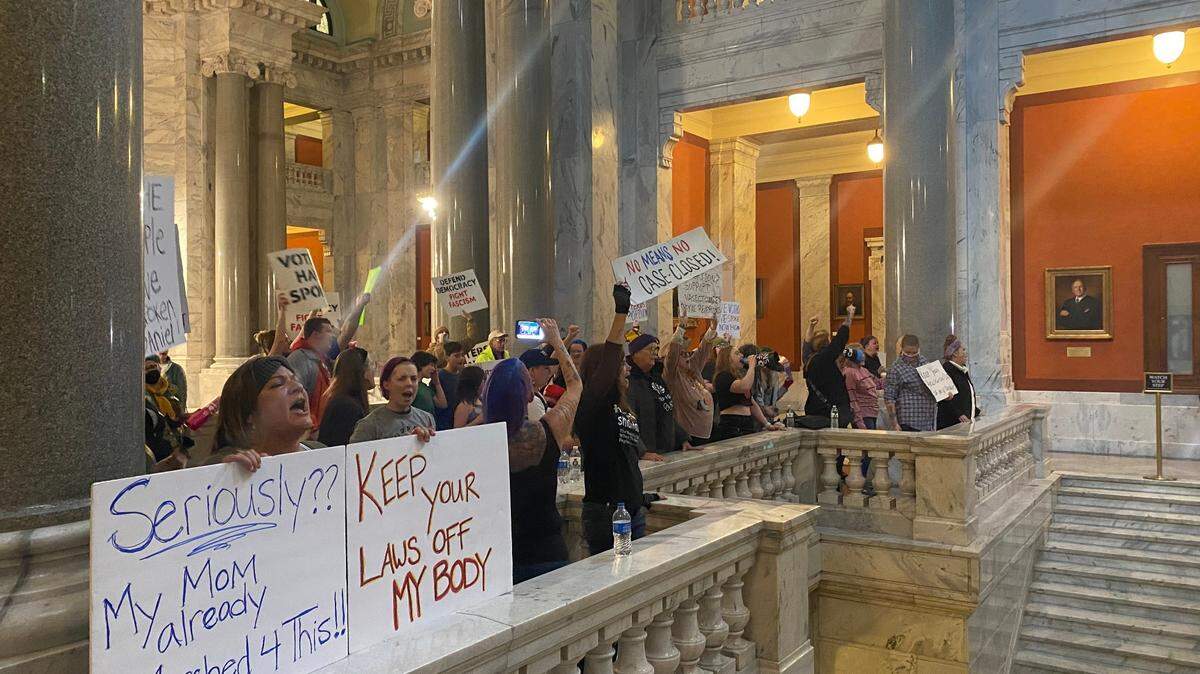
In a major blow to reproductive rights advocates, the Kentucky Supreme Court declined on Thursday to reinstate a lower court’s injunction that had previously blocked the state’s abortion bans.
“We hold that the abortion providers lack third-party standing to challenge the statutes on behalf of their patients,” the high court wrote in its February 16 decision. “We affirm the Court of Appeals’ holding that the circuit court abused its discretion by granting the abortion providers’” the relief they requested.
Deputy Chief Justice Debra Lambert wrote the majority opinion. Four of the seven justices, while concurring in part with the majority, also dissented in part, including the court’s newest justices who joined the bench in January, Justice Angela McCormick Bisig and Justice Kelly Thompson.
Abortion has been largely illegal and criminalized in Kentucky since late June, when a pair of bans took concurrent effect immediately after the U.S. Supreme Court felled Roe v. Wade. The commonwealth’s trigger law prohibits all abortion except in medical emergencies that threaten a pregnant person’s health. Its fetal heartbeat law — also known as a six-week ban — bans abortion after fetal cardiac activity begins, usually around six weeks. Health care providers who perform abortions in violation of Kentucky’s bans can be charged with a felony.
EMW Women’s Surgical Center and Planned Parenthood sued the state in June after these laws took effect. The clinics argue that both violate an individual’s constitutional rights, which include self-determination and bodily autonomy. A Jefferson Circuit Judge upheld that argument in late July and issued a preliminary injunction temporarily blocking both bans from enforcement. But fewer than two weeks later, the Kentucky Court of Appeals reversed that order.
The high court on Thursday agreed with the Court of Appeals’ ruling and kicked the case back down to the circuit court. Abortion has been largely illegal in Kentucky for nearly eight months.
Attorney General Daniel Cameron, a Republican, celebrated the high court’s decision in his favor on Thursday, calling it a “significant victory.”
Since federal abortion protections were overturned in June and Kentucky’s bans became law, “we have vigorously defended Kentucky’s Human Life Protection Act and Heartbeat Law,” Cameron said in a statement. “We are very pleased that Kentucky’s high court has allowed these laws to remain in effect while the case proceeds in circuit court, (and) we will continue to stand up for the unborn by defending these laws.”
The American Civil Liberties Union of Kentucky, which is representing EMW in the lawsuit, said, “we are extremely disappointed in today’s decision, but we will never give up the fight to restore bodily autonomy and reproductive freedom in Kentucky. The fight is not over.”
Abortion clinics lack constitutional standing
The ultimate question posed to the judicial system with this lawsuit — does the Kentucky Constitution protect an individual’s right to access abortion? — won’t be answered for some time. The question before justices that prompted Thursday’s decision was whether there existed adequate reason to reinstate a lower court’s injunction and block both laws restricting abortion from being enforced.
The high court made sure to paint this distinction in their 150-page decision: “To be clear, this opinion does not in any way determine whether the Kentucky Constitution protects or does not protect the right to receive an abortion,” they wrote. “Nothing in this opinion shall be construed to prevent an appropriate party from filing a suit at a later date.”
Much of the high court’s Thursday decision came down to constitutional standing.
EMW and Planned Parenthood contest that Kentucky’s abortion restrictions cause harm to individuals, broadly — legally referred to as third-party standing. Since both clinics are seeking relief for third party individuals, in order to be recognized as having sufficient third-party standing, justices concluded, it’s necessary for both clinics to provide specific, concrete examples of the harm caused by the law, and to show there is a “genuine obstacle or hindrance” that prevents a third-party from asserting their own interest.
Justices said both clinics met the requirements of first-party standing when arguing harm from the trigger law, since a cause and effect were clear: a full-stop ban on elective abortions meant EMW and Planned Parenthood had to cease providing that service. But they lack first-party standing in challenging the six-week ban, because its impact on their ability to provide service is less clear.
As for clinics’ arguments that the six-week ban and the trigger law violated their patients’ constitutional rights to privacy and self-determination, the high court essentially said those claims weren’t specific enough. In other words, EMW and Planned Parenthood did not meet the constitutional third-party standing threshold to challenge either ban on behalf of their patients, justices said, affirming a claim Attorney General Daniel Cameron’s office made during oral arguments.
The high court’s majority said the circuit court erred in siding with abortion clinics and issuing its temporary injunction because “the personal harm asserted by the abortion providers (and) the harm to their business is not considered an irreparable injury” — a threshold that must be met when issuing a temporary injunction.
Dissenting opinions
The high court’s Thursday decision was far from unanimous; four of the seven justices concurred in part while also issuing their own dissents.
Newly elected Justice Bisig and Justice Michelle Keller, who won reelection in November, joined one another in their respective dissents. Bisig said she agreed with the majority’s conclusion that EMW and Planned Parenthood have first-party standing to challenge the trigger law, but she disagreed with the rest of their findings and supported reinstating the temporary injunction.
Bisig and Keller said abortion clinics did show, concretely, the impact of both bans on third-party individuals that rises to the level of irreparable harm. The limitations of the bans, themselves, even imply a concrete enough impact, they said.
“The extremely limited medical emergency exceptions and the lack of any exception for rape or incest in the bans also demonstrates an additional — and profoundly grave — risk of irreparable harm,” Bisig pointedly wrote. “Indeed, it cannot reasonably be disputed that a woman who is forced against her will to carry a pregnancy to term following rape or incest faces not merely ‘irreparable harm,’ but an overwhelming, devastating, and tragic injury that can never be remedied.”
Bisig also cited a Herald-Leader report published earlier this month that detailed the experiences of two Kentucky women with nonviable pregnancies who were denied medically-recommended pregnancy terminations under the state’s abortion laws.
“We need not merely speculate as to the pragmatic effect these bans have on health care providers tasked with treating pregnant patients,” Bisig wrote. “These real-world examples demonstrate how the bans undoubtedly impact both health care providers and patients in concrete ways.”
Justice Keller echoed this point, calling attention to the insufficient protections in both laws’ listed exceptions and citing those as adequate standing to show irreparable harm.
“Because the statutes lack meaningful exceptions or distinctions to protect the life of the mother, they likely fail to be narrowly tailored to protecting life,” Keller wrote in a dissent Bisig joined.
“These exceptions do not save the trigger law from violating its own intent to protect life,” Keller wrote. “Instead, they show how broadly tailored the trigger law is to the Legislature’s purpose. The trigger law cannot be narrowly tailored to the state’s interest in preserving life if it is so broad as to work against that interest.”
Three of the dissenting justices remarked on the consequential nature of this case and the need for the judiciary to weigh the larger question of whether abortion is a constitutionally-protected right as quickly as possible.
Until then, Bisig warned courts against citing this decision as doing just that.
“In the interim, the majority opinion in this case should not be used in the courts of this commonwealth for the proposition that such a right is or is not constitutionally protected,” she wrote.
This story was originally published February 16, 2023 at 10:37 AM.