
Behind the scenes: How an effort to soften Kentucky’s ‘anti-trans’ bill fell apart
At 6:35 a.m. on March 16, a small but politically engaged group of conservative Kentuckians got an email.
The subject line: “URGENT ALERT — Last Day to Protect Kids!”
It came from The Family Foundation, a socially conservative Christian group that has advocated for various bills in the past but has been particularly active this legislative session.
Members of the foundation’s mailing list, upon opening the message, saw the face of a worried little boy. Lying in a hospital bed, the boy’s pleading eyes stare directly at the camera, his mouth a worried frown. In the background, a doctor’s hands rest beside the boy’s midsection.
A caption overlaying the picture reads, “Protect Kentucky Children From Hormone Experimentation and Mutilation.”
Hours earlier, late Wednesday night, 12 of 29 present Republican senators formed a rare coalition with Democrats to scale back an omnibus version of House Bill 470, which sought to ban gender-affirming health care for Kentucky youth and regulate curriculum on sexuality and gender in K-12 schools.
The proposal to rein in the sweeping bill came from Benton Republican Sen. Danny Carroll. His amendment would have exempted puberty blockers from the ban and allowed doctors more discretion over the care they provide to trans youth. Carroll’s amendment passed 19-17.
“When all is said and done, when you get away from all the noise surrounding these issues, it’s about those kids…We have got to make sure that the services are there to help them get through what they’re going through,” Carroll said after filing the amendment.
But the Senate did not give final approval to the newly amended bill; a motion to table from Sen. Gex Williams, R-Verona, with a similarly slim majority, set the amended bill aside for potential later consideration.
Observing a potential shift in Republican support, the Family Foundation fired off its email the following morning, pleading with subscribers to contact the 19 senators “who voted to harm Kentucky children” and “urge them to right last night’s wrong.” It listed each Senator’s email addresses and the legislative message line.
Some Republican Senators who supported Carroll’s amendment got hundreds of emails that Thursday morning from people asking them to do just that.
It might have played a role in the result. That day, the last day of session before the veto break, a similar bill banning most all gender-affirming care including puberty blockers, Senate Bill 150, got resurrected in the House and later sailed through both chambers
“In the last 24 hours, my Christian values have been called into question. I know (Carroll’s) have been as well,” Sen. Whitney Westerfield, R-Fruit Hill, said on the Senate floor. “Everybody else who had voted on last night’s amended version of 470 was blasted with hundreds of emails today.”
Westerfield joined every other Republican aside from Carroll in voting yes on Senate Bill 150.
So what changed?
Those involved in the fight over the bill say the debate shifted because of a combination of intense outside pressure and last-minute lobbying, an assertive push by upstart leaders of the GOP’s more conservative wing that influenced leadership and last-minute (some say “dirty”) maneuvers that threw opponents off balance.
In a clearly-divided Republican caucus, social conservatives prevailed in passing what some say is one of the most sweeping ‘anti-trans’ bills in the nation. A Republican-led effort to change the bill fell apart. The events could prove consequential for this year’s closely-watched governor’s race, too. Addressing Gov. Andy Beshear’s veto of the bill, Republican Party of Kentucky (RPK) spokesperson Sean Southard said the moment “may very well be remembered as the day Andy Beshear lost his bid for re-election.”
‘Factions getting worse, leadership losing control.’
The strained seams that hold together both House and Senate GOP caucuses on social issues were exposed on March 15, the penultimate day of session.
Carroll’s floor amendment saw a significant minority of Republicans, 12 who supported exempting puberty blockers from the gender-affirming care ban and 10 voted against tabling the bill as amended, supporting moderating a bill.
Meanwhile in the House, Rep. Josh Calloway, R-Irvington, crusaded on the opposite side of the issue. In an impassioned floor speech, Calloway called for a roll call vote on several floor amendments that would have made a bill establishing processes for book review in school much stronger through the conservative lens of “parents rights.” Those amendments included adding a ban on public drag performances, giving parents significantly more control over what their children can learn in schools, and more.
Calloway, visibly upset, told the members of the House in a 30-minute display that he was putting his career and friendships on the line by stepping out and proposing the amendments.
“I want the public to understand that on this floor is the votes to make sure that we protect our parents rights. And for some reason somewhere in this big House, it gets blocked time and time and time again,” Calloway said. “We’re not talking about whether or not we’re going to give big business a tax cut or a tax hike. We’re talking about our kids, we’re talking about protecting their innocence.”
Later Calloway said, “I have never been more burdened, I have never been more overwhelmed, I have never been more oppressed in all my life because I’m talking about our kids.”
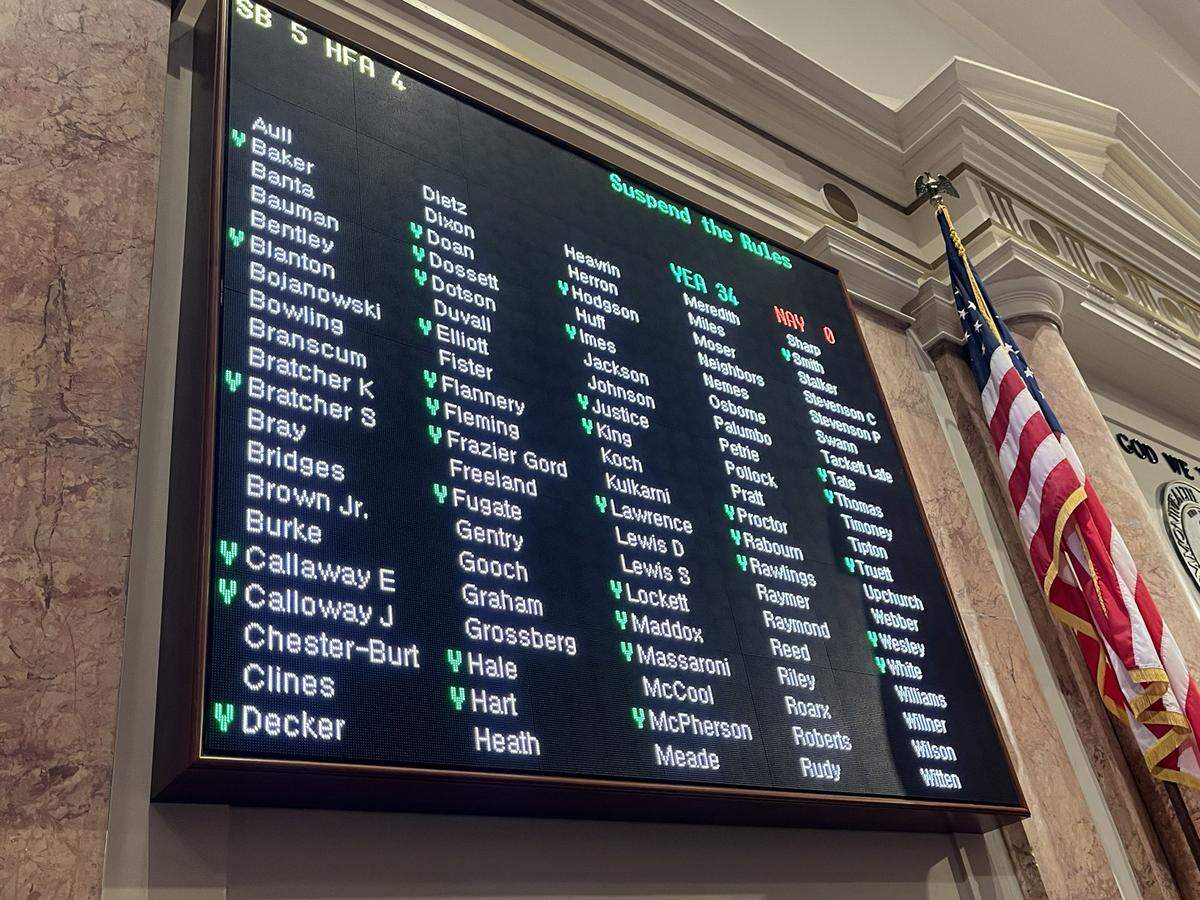
Calloway’s roll call votes on the amendments all failed. But almost half of the House GOP caucus, as many as 34, supported his effort. The rest didn’t vote.
Michael Frazier, a Republican lobbyist who has pushed back against bills he sees as “anti-LGBTQ,” said that it’s a symptom of greater discontent within the House GOP.
Since the House majority ballooned to 80 members after it drew and passed its own maps – which are still in court over alleged gerrymandering – Frazier said the factions within the caucus have grown larger, causing more division.
These factions are informal but real. The Northern Kentucky and greater ‘Liberty’ caucus got boosts with several wins in 2022, including the defeat of three committee chairs seen by some as too ‘establishment;’ a swath of rural preachers holds a strong presence; every region has its own contingent; and business-minded conservatives deferential to the state chamber of commerce have traditionally held the most sway.
“Not only are the factions getting worse, leadership is losing control. The House became more conservative this year. There’s more in-fighting, there’s more reason for membership to be afraid,” Frazier said.
Close intra-caucus elections to replace current leadership, the selection of Louisville-area Rep. Jason Nemes to fill the House GOP whip post instead of a rural legislator, and an inability to get what many saw as true conservative legislation passed – these were the frustrations that bubbled up to the surface in Calloway’s amendment, according to Frazier.
“I believe it was revealing,” Calloway said of the vote board on his amendments. “I struggle with some of these issues in trying to figure out how someone who is a Republican would be on the opposite side.”
On the opposite side of Calloway, as well as most Republicans in the Senate, was Carroll. Carroll’s amendment to House Bill 470 created a coalition of all seven Democrats and 11 other Republicans.
Carroll is no progressive. Carroll — a former cop from Western Kentucky who speaks in a slow southern drawl — has sponsored legislation that would have made taunting a police officer a crime, reliably supported his colleague’s bills in recent years restricting abortion access, and carried a bill banning immigrant “sanctuary” cities in Kentucky. He also voted in committee for a 2016 bill that would have banned transgender students from using a restroom that corresponds with their identity.
Fast forward to 2023, and Emma Curtis, one of the most visible transgender activists in the statehouse, dubbed Carroll a “hero” for his amendment.
.JPG "190109SchoolSafetyBillcb284 (1).JPG")
The amendment, per Kentucky Voices For Health lobbyist Cara Stewart, would have let Republicans score a political point without putting an immediate halt on puberty-blocking medication.
“They could have all gone home and said ‘we stopped surgeries on kids’ and been done. That would have been a political win for them without doing actual harm,” Stewart said.
Beyond politics, the amendment was seen as a solid compromise by some like Sen. Mike Nemes, R-Shepherdsville.
“On Danny’s bill, we did make concessions, and I hate to call them ‘concessions,’ that some drugs could not be used for some circumstances, but you could still use them for what needs to be done between a doctor and a patient. It was more open for doctors, which I voted for and liked,” Nemes said.
But the most powerful will in the Kentucky legislature is that of each chamber’s Republican majority, not that of the chamber as a whole. The GOP caucuses generally operates under the Hastert rule, meaning that a bill will not advance unless a majority of the party’s membership approves. In other words, the majority of the majority rules.
GOP Senators voted against it 17-12. The 19-17 result made the opinion of the Democrats – in Lexington Democratic Sen. Reggie Thomas’ words, the amendment “made a bad bill better” – actually matter.
One Republican Senator, Berea’s Jared Carpenter, told veteran journalist Al Cross that he got uneasy by the amendment’s narrow approval. He “flipped” from a yes on the amendment to a yes on the motion to table.
In responding to the amendment vote, Thayer said that leadership is “here to lead at the will of the caucus.”
Frazier said that he never felt particularly enthusiastic about the odds of the amendment because it became “a question of leadership legitimacy.” It tested their ability to impose the will of the majority of the caucus on the lawmaking process.
GOP-backed bills ostensibly aimed at protecting “parental rights,” but seen by opponents as targeting the LGBTQ community, had become the theme of the session. But on that Thursday, with just one day left to pass a bill to this end with time to overturn a veto from Beshear, no bills had floated to the top. The caucus’ fractures were on public display.
“It’s clear there was initially no consensus on either one of Senate Bill 150 or House Bill 470,” Frazier said. “In order to show Kentucky that we can keep our super majorities together, they had to find a way to build consensus.”
The onus of doing that was on leadership.
Late on the night after the Senate adopted Carroll’s amendment, Republican leaders from both chambers met.
“We met with the House late (at) night, and they made the suggestion that they would pass Senate Bill 150 and put the South Dakota language in a substitute that we would concur with. That way we didn’t have to send the bill back to committee for further work,” Thayer said.
House Speaker David Osborne, R-Prospect, told the Herald-Leader that House leadership had a version of Senate Bill 150 that ended up very similar to the final product “ready to go for the last several days” before it passed.
Among leadership, House Speaker Pro Tempore David Meade, R-Stanford, took the lead. Rebecca Blankenship, Kentucky’s first openly transgender elected official, thinks the strength of Meade’s conviction played a major role in ensuring something on the topic got passed.
“The fact that David Meade was so invested in passing a version of it that included the ban on puberty blockers, that he took it to committee itself in a special call hearing out of nowhere, that says to me that there was a strong investment in doing this. I think that there was either an ideological or a ‘power over the caucus’ type of motive.”
In justifying the bill, Meade said that a poll he’s seen showed a majority of Kentuckians supported the ideas behind the legislation. He has yet to share that poll.
Another source of speculation about the push for the legislation, particularly under the banner of Senate Bill 150, is the connection to sponsor Sen. Max Wise, R-Campbellsville. Wise is running for lieutenant governor on a ticket with former U.S. ambassador to the United Nations Kelly Craft this year.
Blankenship said that there are plenty incentives for Republicans to keep the Craft family happy. Craft’s husband, billionaire coal magnate and philanthropist Joe Craft, is a nationally known GOP megadonor who also gives locally. In the 2022 election cycle, he gave donations to 30 different House Republican candidates and 7 for Senate, often contributing the maximum $2,000 amount.
The Craft campaign has included Wise’s sponsorship of Senate Bill 150 in its messaging since its passage.
Wise did not speak on behalf of the contents of Senate Bill 150 outside of his original, much more pared down, bill in committee. He also did not speak on the bill at all on the Senate floor. Aside from sending a brief statement in support of the bill, Wise did not agree to be interviewed about the process of its passage.
Outside pressure: ‘Make a ruckus’
Family Foundation Executive Director David Walls said that he didn’t leave Frankfort the night before Senate Bill 150 passed.
“That (night) may have been the first time that it really hit that there might not be something passed, or that what would pass wouldn’t provide any of the serious protections that so many legislators felt like needed to be attached,” Walls said.
Walls, legislators sympathetic to his cause, and other supporters worked until the wee hours of the morning. Calls, meetings in the Capitol with Senators who voted “the right way” as well as those didn’t, and planning for action Thursday.
As for the newsletter email sent out to the Family Foundation’s mailing list, Walls defended the use of a menacing photo insinuating that an unwilling child was going to undergo surgery — despite the amendment it was rallying against retaining the ban on gender transition surgery — saying that he didn’t think readers would get the wrong idea.
He also argued that allowing puberty blockers would be a “gateway” toward allowing such surgery for minors.
The organization also got a hand from the Kentucky Baptist Convention via its news publication Kentucky Today, according to Walls, for allowing them to spread their message using their platforms.
“It was just a lot of advocates, some of which are not attached to any organization. Just concerned parents and concerned citizens, pastors that we have relationships with, and some that I’ve never interacted with that I’ve come to find outreached out to legislators in their congregations,” Walls said.
At home, Calloway’s own ‘parental rights’ bill, House Bill 173, was bolstered from the pulpit. The pastor at Pleasant View Baptist Church, where Calloway attends, rallied his congregation to “make a ruckus” about the bill.
Though the network of Kentucky advocates was strong, per Walls, most all of the voices testifying on behalf of the bill in a public committee were from out of state.
Only one out of the several non-lawmakers this session testifying in favor of those bills was from Kentucky. The group that testified against the bills has been composed entirely of Kentuckians.
This may not come as a surprise to those following the issue nationally. The networks pushing similar bills are strong, and they’re popping up in conservative states all over the country. A quick internet search of most of the expert witnesses shows that they’ve testified in several states before.
The process: ‘dirty tricks’
Chris Hartman, the Executive Director of the pro-LGBTQ rights group the Fairness Campaign, found an unlikely jogging partner in the halls of the Capitol annex building on Thursday. He and Rep. Jennifer Decker, R-Shelbyville, were near each other when they found out about a plan to resurrect the gender-affirming care ban via Senate Bill 150. It was moments before the House Education Committee was meeting to adopt what would become the final version..
“They didn’t even give their own people notice. That’s how dirty it was,” Hartman said.
Unlike most every other meeting, it was not announced on the House floor on a microphone. It wasn’t posted online until moments before the meeting, a detail which has caused some open meetings advocates like former assistant attorney general Amye Bensenhaver to cry foul.
The new version of the bill reflected some of the work done by Calloway and Rep. Shane Baker, R-Somerset, with the Family Foundation. The group was seen marking up the bill, and House Bill 470, just below the steps up to the House days prior. It also used the language that Williams found from the South Dakota bill.
The GOP’s outward unanimity on Senate Bill 150 didn’t tell the full story of contentious caucus meetings, where most business is hashed out behind closed doors.
“I don’t remember a bill in my time in the Senate, where we’ve spent more time on – certainly not hours and hours on back to back days. But we’ve done that (here),” Westerfield said. “There were people passionate on both sides, or all eight sides, of the debate. I honestly couldn’t call it ‘both sides.’”
Nemes said he believed the bill was imperfect, but better than House Bill 470. He compared the process of getting there to a doctor who worked behind the scenes to extend a patient’s life and lessen their pain.
“You did lessen their pain and extend their life, and nobody will hear that. They only know the vote you took, not how you changed a bill that was going to go through anyway (by) lessening the bad effect of it,” Nemes said.
Carroll was disappointed that night. He said that he personally didn’t “get” being transgender, but that he wanted to find a solution that could work for doctors and families. A majority of the GOP caucus didn’t agree with him, though.
“The will of the majority rules,” Carroll said.
Curtis, the trans activist, claims that members were “bullied” into voting for Senate Bill 150.
“On Wednesday, we saw a number of Republican senators stand up for what was right rather than what was politically convenient. They were bullied and harassed,” Curtis said.
That’s not how Thayer put it.
“We don’t do that,” Thayer said when asked if he had to do any arm-twisting. “It’s not our style. We’re very caucus driven. Our members get a great deal of input on where we go, what we do, how we do it… We’re not enforcers.”
But politics is a game of influence. And there are many legislators and outside groups aside from leadership working to sway the state’s policymaking caucus.
On the night of Senate Bill 150’s final passage, Sen. Williams — who last year made the pitch to GOP primary voters that he could “make Thayer more conservative” — was speaking with Walls near the back of the Senate chamber. Lobbyists aren’t permitted on the floor of either chamber.
Thayer had to shoo Walls off the Senate floor.
“He can’t be here,” Thayer said, motioning to Walls that he’d speak to him outside the chamber.
This story was originally published March 27, 2023 at 11:17 AM.