‘Not the right way.’ KY juvenile justice agency still misusing pepper spray on teens

Last September, the Kentucky Department of Juvenile Justice described several wrongful uses of pepper spray on youths in detention as isolated errors that happened in early 2023 while employees learned how to use the newly available defensive weapon.
But at least seven more confirmed reports followed over the next few months as teenagers were unjustly blasted with pepper spray, not for fighting or starting riots but because they had failed to follow instructions, according to internal investigative reports the Herald-Leader obtained under Kentucky’s Open Records Act.
Employees’ punishments ranged from reprimands to a three-day suspension. One employee resigned.
In one case, a guard sprayed a teen girl in Campbell County as she faced a wall without resisting him. She had to wash the burning chemicals off her face in the toilet of her cell, documents revealed.
In another, a guard sprayed a teen boy in Graves County as he lay face-down on his bunk and then sprayed the boy again as he curled into the fetal position, trying to use his pillow as a shield.
Experts say the haphazard use of pepper spray in juvenile detention facilities should be avoided.
“It’s the equivalent of the cop going for their gun rather than using their verbal deescalation skills,” said Betsy Matthews, a former residential treatment facility child care worker and adult probation officer who teaches about correctional systems at the Eastern Kentucky University School of Justice Studies.
“It’s quicker and easier, but it’s not the right way,” she said.
Some juvenile justice employees told investigators there is confusion as to whether the painful spray can be used to deal with youths who won’t follow verbal commands, such as refusing to return to their isolation cells, according to the reports.
Also, two of the seven wrongful use incidents weren’t reported to investigators until more than a month later. That’s a problem, state officials acknowledge, because all uses of pepper spray are supposed to be reviewed for appropriateness.
Asked about the problems last week by the Herald-Leader, Gov. Andy Beshear said he stood by his January 2023 decision to equip employees with pepper spray for self-defense following a high-profile series of assaults and riots.
“We always want to do better,” Beshear added at a Capitol news conference. “And we always want to learn from every incident or any report that we are provided.”
But giving pepper spray to juvenile justice employees has made the detention facilities safer over the past year, the governor said. Interim Juvenile Justice Commissioner Larry Chandler estimates the facilities have seen a roughly 40% decline in violent incidents since pepper spray was introduced, he said.
“Most often when it’s used, it’s used to break up fights,” Beshear said.
From March 2023 to this month, there have been 91 investigations of the use of pepper spray in juvenile justice facilities, according to the Kentucky Justice and Public Safety Cabinet, which oversees the Department of Juvenile Justice.
Of those 91 investigations, fewer than 20 so far have ended in a finding of inappropriate use, according to the cabinet.
When to pepper spray?
Staff in Kentucky’s juvenile detention centers have used pepper spray at a rate 73.9 times higher than in federal prisons that house adults, according to an independent report released last month by state Auditor Allison Ball.
At the Adair Regional Juvenile Detention Center in Columbia, staff used pepper spray at least 41 times over a nine-month period last year, auditors wrote.
It’s clear that a year after the Department of Juvenile Justice introduced oleoresin capsicum spray, or OC spray, employees still aren’t correctly trained in when to use it, said Rebecca DiLoreto, a longtime Kentucky children’s advocacy attorney who has dealt with the agency for decades.
According to department policy, pepper spray should be used by specially trained staff in order to prevent loss of life, injuries, significant property damage or a riot.
Given the agency’s own policy, pepper spray should not be used to enforce an order or punish a youth who has angered staff members, DiLoreto said.
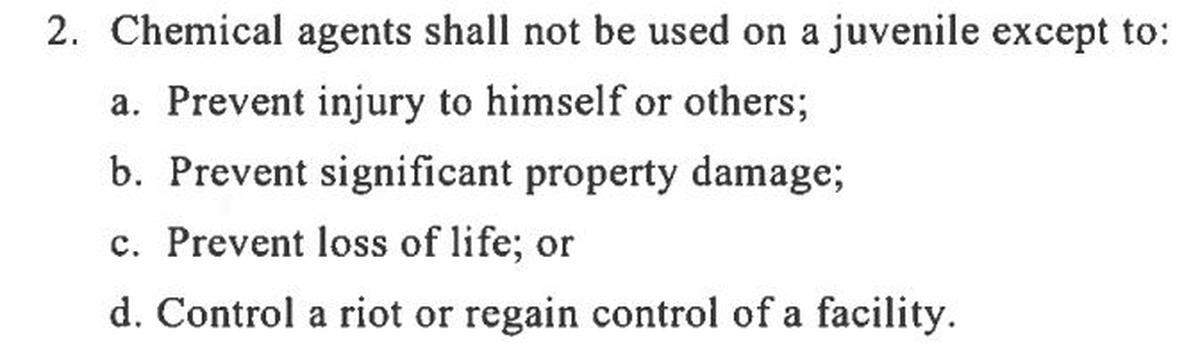
“Yet this policy is repeatedly flouted,” DiLoreto said.
“These practices will make the youth more hostile and more afraid towards anyone identified as being in law enforcement,” she said. “Youth will shut down emotionally and be less responsive.”
Washing face in toilet
On Sept. 15, 2023, a correctional officer at the Adair Regional Juvenile Detention Center pepper sprayed a teen boy without any verbal warning and then grabbed the boy around his torso and threw him to the ground for refusing to go to his room. The officer received a written reprimand and retraining.
The boy wasn’t allowed to wash off the burning chemicals for at least 45 minutes. Then he was handed a cup of baby shampoo and a washcloth, which investigators said “would not be adequate to stop the effects of the OC spray.”
On Sept. 29, 2023, a correctional officer at the Campbell Regional Juvenile Detention Center in Newport pepper sprayed a girl in the head as she passively faced the wall inside her room, where she was being secured for a stay in isolation, according to a report on the incident.
Once the officer and a colleague left the girl alone in the room, she stuck her head in the toilet to wash the chemicals off her face, stripping off her sweatshirt to use as a washcloth.
Other employees on the scene told investigators the pepper spray was inappropriate because the girl — who had a history of physically acting out — was not resisting anyone at the time. The officer who sprayed her resigned.
On Nov. 20, 2023, a youth worker at the Mayfield Youth Development Center in Graves County repeatedly sprayed a boy in an isolation cell who was lying face-down on a bunk and then curled up in the fetal position, trying to use his pillow as a shield, according to a report.
The youth worker, suspended for three days because of the incident, told investigators the boy had earlier resisted his efforts to secure him in isolation by pushing back on the closing door. The boy countered by saying he shouldn’t have been sprayed while lying on his bunk.
“It is what it is,” he told investigators.
‘Reprimanded for not spraying’
Investigative reports obtained by the Herald-Leader show employees at several facilities say they’ve been urged to use pepper spray when youths fail to obey instructions, even if youths aren’t acting violently.
A correctional officer who was reprimanded and retrained after two separate inappropriate uses of pepper spray told investigators in September 2023 that juvenile justice employees get in trouble for failing to spray youths who don’t follow directions.
“He also stated he has seen staff reprimanded for not spraying residents for verbal non-compliance,” investigators wrote in one report. “He has seen other staff get coaching and counseling for not doing it.”
A lieutenant who was reprimanded for spraying a boy in the head as he defiantly walked away told investigators “at the time of this incident, they were instructed to use OC first” before attempting a hands-on escort to steer a youth where he’s supposed to go, according to a report.
The lieutenant “advised that philosophy seems to have changed recently. He said there were never any written policy changes, only verbally expressed in briefings,” investigators wrote.
Morgan Hall, a spokeswoman for the Justice and Public Safety Cabinet, said pepper spray sometimes can be appropriate when youths don’t obey verbal commands.
“The deployment of OC for when juveniles are not responding to verbal commands depends on the situation,” Hall said.
“For example, when a juvenile is not responding to verbal commands to stop destroying property, or refusing to move to another area, or continues to assault another juvenile after verbally being told to stop, OC spray may deployed.”
This story was originally published February 13, 2024 at 9:28 AM.