
Andy Beshear is in the mix for VP. But how does the vetting process actually work?
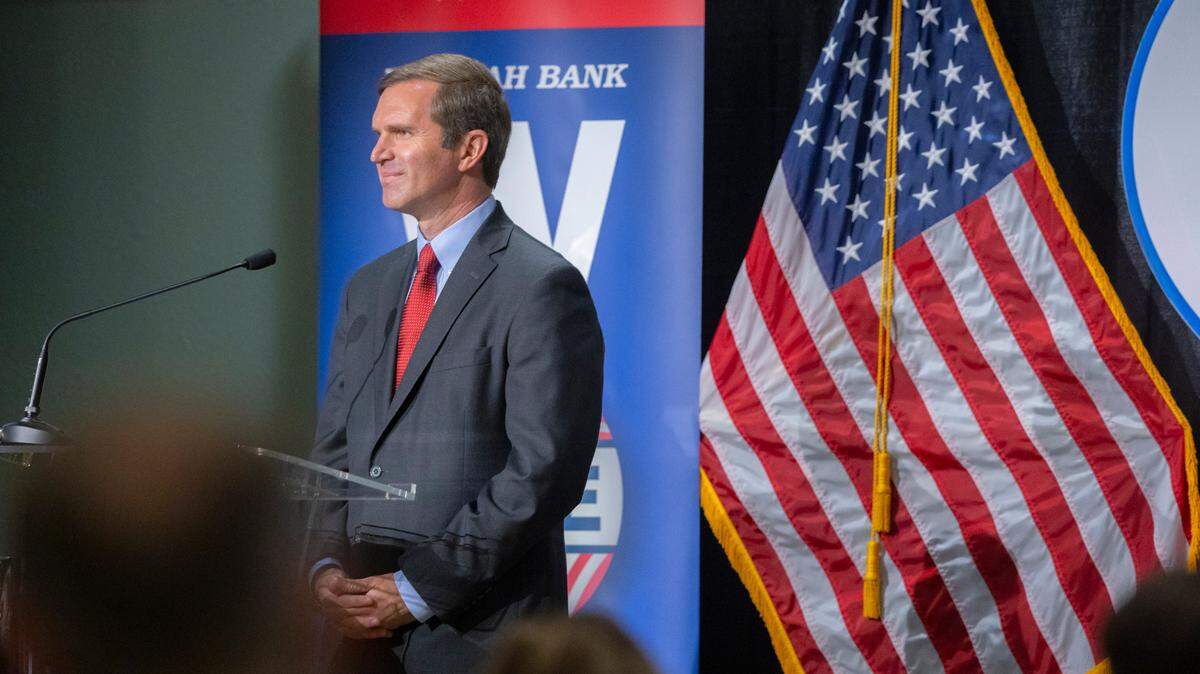
On the short list to run alongside Vice President Kamala Harris, Kentucky Gov. Andy Beshear’s name is gracing the pages of the New York Times and Washington Post, his face is appearing on CNN and MSNBC and his name has been searched on Google far more than ever.
This is the most national exposure the 46-year-old Democrat has received. For a politician as ambitious as Beshear, it is an undoubtedly an exciting time.
But it could also prove incredibly painful.
Joe Lieberman, who was former vice president Al Gore’s running mate in the 2000 presidential election, compared it to “a colonoscopy without a painkiller.”
This time, it’s a rushed procedure.
Compared to the months that former Republican President Donald Trump took to pick Ohio Sen. JD Vance as his running mate or the time that President Joe Biden had to pick Harris, the Harris team has less than two weeks to make their choice. This process is not even a week old, as Biden stepped aside Sunday and backed Harris, who now has more than enough delegates committed to secure the nomination.
Newly adopted Democratic National Committee rules set Aug. 7 as the deadline for a vice presidential nominee to be chosen in advance of ballot access deadlines.
Experts on the vice presidency like the University of Dayton’s Christopher Devine, a political science professor who authored the book “News Media Coverage of the Vice-Presidential Selection Process: What’s Wrong with the ‘Veepstakes,’” have also described the process as highly invasive and elaborate.
“They look for absolutely everything — any skeletons that could come out of the closet during the campaign, they want to know about it in advance,” Devine said. “Maybe they don’t pick you because of it. Maybe they do, but they price it in.
“They might even leak something before the selection just so it’s kind of known and factored in prior to that point.”
The details of the so-called “veepstakes” this year aren’t entirely clear.
The law firm of former attorney general Eric Holder, who served under former president Barack Obama, is running the vetting process. Around a dozen Democrats are reportedly being vetted, with Beshear often listed among the top tier of candidates alongside North Carolina Gov. Roy Cooper, Arizona Sen. Mark Kelly, Pennsylvania Gov. Josh Shapiro and Minnesota Gov. Tim Walz.
How is Beshear working this?
When peppered with questions from reporters on various aspects of the process on Thursday, Beshear offered the same canned answer over and over again.
“I am honored to be considered, and regardless of what comes next I’ll do everything I can between now and election day to elect VP Harris to the White House,” he said.
As he makes statements to the public — the most important audience member being Harris and her team — via press conference and television interview, a growing consensus has been built that Beshear would take the opportunity.
There’s little clarity on how Beshear’s team is working through it, though.
Eric Hyers, Beshear’s longtime top political consultant, did not respond to questions regarding who was coordinating his activities in Washington as the process moves along, including travel and booking appearances on the major networks.
Beshear’s newly-formed political action committee, In This Together, did not spend any money explicitly on “veepstakes”-related matters, according to its latest filings with the Federal Elections Commission.
The latest data from June shows payments made to Outperform Strategies, Hyers’ firm, and Against the Odds, LLC, a company run by former Beshear finance director Lucas Johnson, for fundraising services. Johnson is the same fundraiser blamed by London Mayor Randall Weddle for not flagging a $200,000-plus illegal contribution, which Weddle made on his credit card but in the name of family and friends, thus allowing him to donate far past the maximum amount to Beshear’s reeleection and the Kentucky Democratic Party.
It’s possible that one of Beshear’s most trusted advisors Jonathan Smith, a deputy chief of staff in the administration who’s slated to leave for the private sector soon, is involved, though Hyers did not respond to a question on that topic. Smith was with Beshear when he visited Washington shortly before Biden stepped aside.
Steve Beshear, the former governor who is Andy’s father, could also be making calls. The elder Beshear grew connections in the party during his two terms from 2007 to 2015, where he gained plaudits for expanding Medicaid and later delivered the Democratic response to the State of the Union.
It’s unclear to what extent donors are involved in advocating for their preferred candidate.
John Morgan, a Lexington native who founded the country’s biggest injury law firm Morgan & Morgan, is one of the most prolific Democratic fundraisers. He also “may be Andy’s number one supporter in America,” he told the Herald-Leader; members of the firm have contributed hundreds of thousands to Beshear campaigns and he often extols Beshear’s brand of moderate-tinged politics.
However, he told the Herald-Leader he’s mostly “hands off” when it comes to who Harris selects as a running mate.
“Look, Andy’s strengths are self-evident,” Morgan said. “I think if Andy was in a battleground state, he’s a no-brainer. He looks great, he’s authentic… and people like him are the future of the Democratic Party.”
But the sort of behind-the-scenes intrigue of who’s pushing for whom may not really matter, according to Mark Riddle, a Kentucky native who leads the political group Future Majority and co-founded a pro-Biden super PAC that raised massive amounts of money in 2020. Riddle also recently hosted a fundraiser for Beshear’s PAC in Washington.
“I think the press is interested in that sort of thing, but it generally comes down to what the vetting shows, the chemistry level, comfort, and then what the message is that the campaign is trying to portray,” Riddle said.
Organic or ordered — Beshear holds serious sway over the state party — there is relative unanimity among grassroots Kentucky Democrats: they want Beshear to be the vice president. Starting this week, dozens of prominent Democrats both elected and highly involved made posts to social media boosting Beshear.
Some made their case directly to Harris. House Minority Whip Rachel Roberts, D-Newport, began a post to social media site X, formerly Twitter, addressed “madam @VP.”
“Allow me to provide a reference for my friend/colleague @AndyBeshearKY. I can’t recommend him highly enough for the vacancy (VP) your presidency will bring about. I’m happy to discuss his qualifications with you further should that prove useful,” Roberts wrote.
This kind of coordination makes the message more and more clear: Beshear wants this.
“I think it’s obvious he wants it based on his performance in these interviews,” Al Cross, a longtime Kentucky political observer and journalist. “I watched him in these interviews and when it comes to J.D. Vance, he’s saying ‘let me at him.’
“I think he does want it, but this is not a process where it’s becoming to seem to want it. You don’t want to seem overeager.”
How has it gone in the past?
Though it’s likely this year’s process will be warped by the limited timeline, there’s been thorough reporting on the 2020 “veepstakes” that saw Harris emerge that could reflect how it will play out this year.
In Jonathan Martin and Alexander Burns’ book “This Will Not Pass,” the pair of POLITICO journalists describe a thorough deliberative process where four prominent Democrats led the process of interviewing and vetting potential vice presidential candidates.
Former U.S. Senator from Connecticut Chris Dodd, who served alongside Biden for decades, was one of four on the committee to screen candidates that ultimately recommended Harris in 2020.
Dodd told the Herald-Leader that he “assumed the decision will be made” by the middle of next week.
The last iteration was marked by extreme caution.
The committee members, according to Martin and Burns’ book, were tremendously impressed by Sen. Tammy Duckworth, D-IL. The senator had survived an RPG hit to her helicopter while serving in Iraq, losing the majority of both legs; her story, her demeanor and her background as a woman of color with serious military service under her belt made her feel like the right fit at one time.
But the fact of her being born outside the U.S. — despite her meeting the constitutional requirements to serve as a “natural-born citizen” — made the Biden team balk. She was born in Thailand to an American father, similarly to former GOP presidential nominee John McCain, who was born in the Panama Canal Zone, where his father was stationed in the U.S. Navy.
“Tammy, you’re great,” Biden told her, per the book. “But there’s this one thing…”
Beyond the vetting team, the knives were also out between the vice presidential contenders themselves.
A general sense among many who interviewed for the role in 2020 was that a San Francisco consulting firm with ties to Harris was responsible for an “onslaught” of opposition research used against them during the “veepstakes.”
“Tough scrutiny is inevitable in any vice presidential search, but something about this felt more deliberate, even targeted — and aimed at all of the most formidable Black women under consideration, except for Kamala Harris,” Martin and Burns wrote.
Another important note: Ron Klain, one of Biden’s top consiglieres during the search, placed a high value on prior national exposure as a way to know how each person would perform under the bright lights. That was a big part of his argument for Harris; she’d already put herself out there in her unsuccessful presidential primary run.
Among the crop of contenders this year — at least those that are being vetted, per reports — only Transportation Secretary Pete Buttigieg has run for president and only Michigan Gov. Gretchen Whitmer and Commerce Secretary Gina Raimondo have been vetted for the VP role previously.
What matters?
The conventional rule number one in picking a running mate is simple: do no harm.
“At the end of the day, people are not voting for the presidential ticket based on who the vice president is. Yeah, there’s a debate and some people watch it. The conventional wisdom is correct here: the vice presidential candidate cannot really help you, but they can hurt you,” Jody Baumgartner, a professor at East Carolina University who penned a book on the vice presidency.
Beyond a vice presidential candidate tanking the campaign with a horrible stage presence, shocking stories of their past or any other negatives, political scientists are in agreement that they don’t directly affect many voters’ choices.
That includes in their home states.
However, the selection does have some political relevance in how, as the “first act of the future administration,” it can reflect on the presidential candidate’s politics. Devine said “it is a fact” that perceptions of the vice presidential candidates’ ideology influence perceptions of presidential candidates’ ideology.
Devine added that Beshear’s perceived moderatism could reasonably help Harris buffer attacks from the right that she’s too liberal.
“Kamala Harris has something of an ideology problem. I don’t think it’s a huge one, but it’s certainly a leading line of attack for Republicans already,” Devine said.
“It can’t radically change views of her, but it can cause voters to say, ‘you know, I didn’t her that well, I had the impression that she was really, really liberal. But if she’s picking Andy Beshear, maybe that’s a signal that she’s not as liberal as I thought.’”
This story was originally published July 26, 2024 at 12:40 PM.