
Mayor Gorton adds opposition to Fayette solar proposal, but others ask: Why not?
Lexington Mayor Linda Gorton is putting energy toward opposition of a proposed 380-plus acre solar farm in eastern Fayette County.
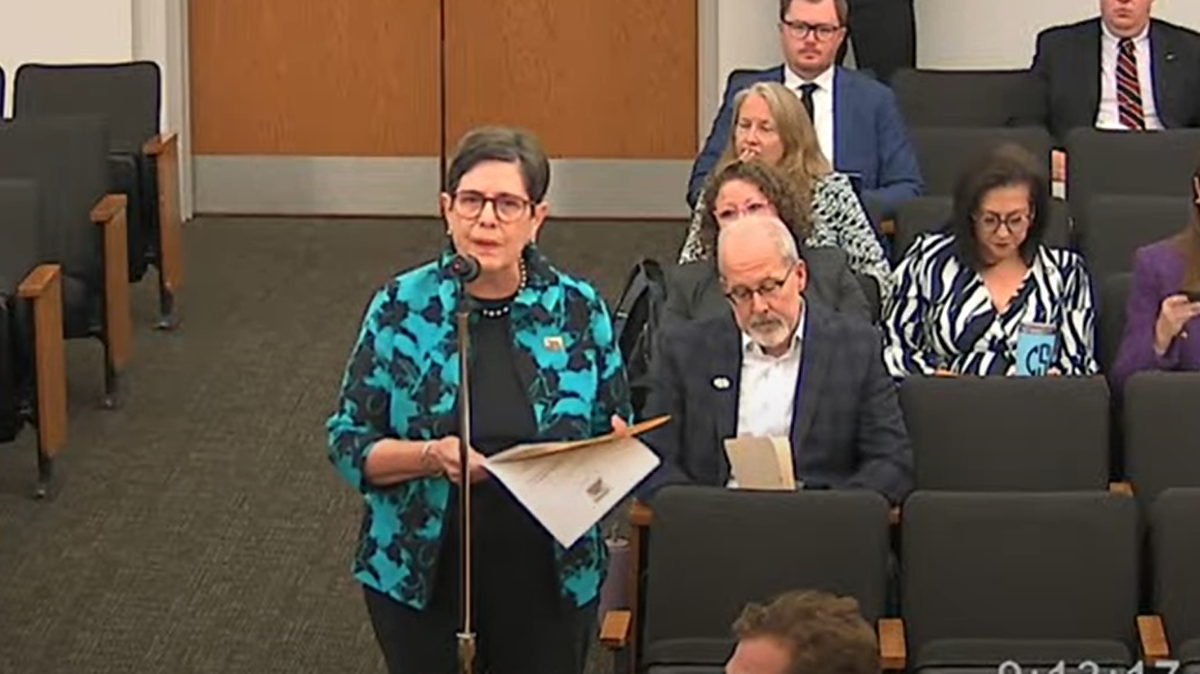
Gorton characterized the plans from East Kentucky Power Cooperative as a “new threat” to Fayette County’s “irreplaceable farmland” in a statement delivered to the Kentucky Public Service Commission Tuesday at a formal hearing held by the body, which regulates power providers across the state.
The Public Service Commission has final say over whether the project, near the Clark County line consisting of two parcels sandwiched between I-64 and U.S. 60., gets approval. The farm is projected to generate 40 megawatts of power, or enough to power about 4,558 homes.
The proposal, which EKPC has dubbed Bluegrass Plains, is also adjacent to an existing power cooperative substation and another potential solar farm property proposed by Tennessee-based company Silicon Ranch. That company proposed a zoning text amendment to allow solar farms on agricultural land in Fayette County under certain conditions, which was rejected by the Urban County Planning Commission this week.
East Kentucky Power Cooperative’s proposal is not subject to the local board’s decision, however.
So opponents like Gorton, and a couple citizens in favor, expressed their opinions on the matter in front of the PSC in Frankfort Tuesday.
The PSC is among the most important bodies whose members are appointed by the governor, as it regulates Kentucky’s water and utility providers both massive and small. It’s also charged with protecting Kentucky utility customers and vetting power generation plans, utility sales and rate hikes, among other things. Its three commissioners — Mary Pat Regan and former state representatives John Will Stacy and Angie Hatton, who is the chair — decide the outcome of cases.
Gorton touted Lexington’s careful planning over decades; the urban service boundary is the oldest such growth boundary in the United States and the city’s agricultural conservation easement purchasing program has been ongoing for 20-plus years. She characterized solar farms like the one proposed by EKPC as undermining the city’s preservation goals and the horse industry, a key driver of tourism to the area.
“Our government supports solar,” Gorton said. “We think solar projects are possible here without forcing us to give up irreplaceable farmland, a key component of our signature industry.”
Gorton and a handful of other Lexington officials and activists also questioned the benefit of the project to Fayette County, though the PSC is a statewide regulatory body. They mentioned that no permanent jobs would come into Fayette County as a result of the project and only about 7,000 Fayette Countians would be served by the project.
The vast majority of Fayette County is served by Kentucky Utilities, a for-profit power provider centered in much of the state’s urban and suburban areas.
EKPC is a not-for-profit organization owned by 16 smaller co-ops. According to a publicly available report from 2022, the Winchester-based group’s revenue was roughly $1.3 billion in 2022. Its territory includes much of the more rural swathes of Central, Eastern and South Central Kentucky.
EKPC is coming fresh off a round of positive news for its renewable energy future. A federal investment of $1.4 billion was announced earlier this week through the Empowering Rural America program, a product of 2022’s Inflation Reduction Act, that will be used to help the utility build 757 megawatts of solar generation and improve its power transmission.
Joining Gorton in speaking against the proposal was Rep. Adrielle Camuel, D-Lexington, and officials with the Kentucky Farm Bureau and Kentucky Thoroughbred Association, among others.
Camuel said that solar energy was “absolutely necessary,” but agricultural land in Fayette County is not the place for it.
“The proposal is located on a Kentucky Scenic Byway, U.S. 60, which is vital for tourism and designated by the state to have both economic and cultural importance. My family and I often take this scenic byway out of Lexington when we go home to Morehead, because of the peace and beauty it provides as you drive along the rolling ribbon of road.
“The people of Fayette County value their farmland for agriculture, and our local land use policies makes that clear. This location for solar is not appropriate.”
Other opponents made the allegation that, being on a visible stretch of road, the project amounts to a “billboard” for the utility. EKPC has a much smaller solar farm along the same roadway near its headquarters a few miles down the road in Clark County.
“That’s not a goal of the project. That’s not part of the consideration,” Julie Tucker, Vice President of Power Supply at EKPC, said.
While many spoke against the project, a couple spoke out in support. Chris Woolery, a Lexington resident and energy project coordinator at the Mountain Association nonprofit, pointed out that the project — in addition to a planned 635-acre, 96 megawatt proposed solar farm in Marion County — will move one of the state’s largest utilities toward renewables.
“I’m really excited to speak to this proposal, mainly because EKPC has been getting their energy from two coal power plants, two natural gas plants, six gas generation facilities, two hydro facilities, and as of 2017, one solar farm,” Woolery said. “I’m ecstatic to see EKPC take these steps towards a cleaner and more affordable future.”
“To me, it’s clear that utility scale solar is much less harmful to its host communities than any other alternatives, like natural gas generation plants. We need to build more centralized capacity, and we have to build it somewhere. The choice between solar and costly, polluting gas plants and pipelines should be an easy one, even if that solar farm is close to home, right here in my own community,” Woolery said.
Rachel Norton, another Lexington resident involved with the Mountain Association, questioned why the city has previously expanded the Urban Service Boundary but now expresses opposition toward solar energy.
“As a long time resident, I’ve seen the city expand the urban boundary for development time and time again, encroaching on farmland for years to develop neighborhoods, schools and shopping centers,” Norton said. “I’m not really certain why the development of solar is not seen as just as important for our jobs, communities, development and sustainability as the expansion of our Urban Service Boundary has generally been.”
She pointed out that the existence of solar farms does not necessarily exclude the possibility of retaining other agricultural practices like keeping livestock on the land.
The PSC must rule on whether EKPC can go forward with the project by late December, as state statute sets an eight-month deadline for a decision after a group files for such a project.
This story was originally published October 29, 2024 at 2:21 PM.