
What would a Trump presidency mean for Kentucky’s growing electric vehicle industry?
Who America chooses as its 47th president could have a major impact on the industry Kentucky has staked much of its future on.
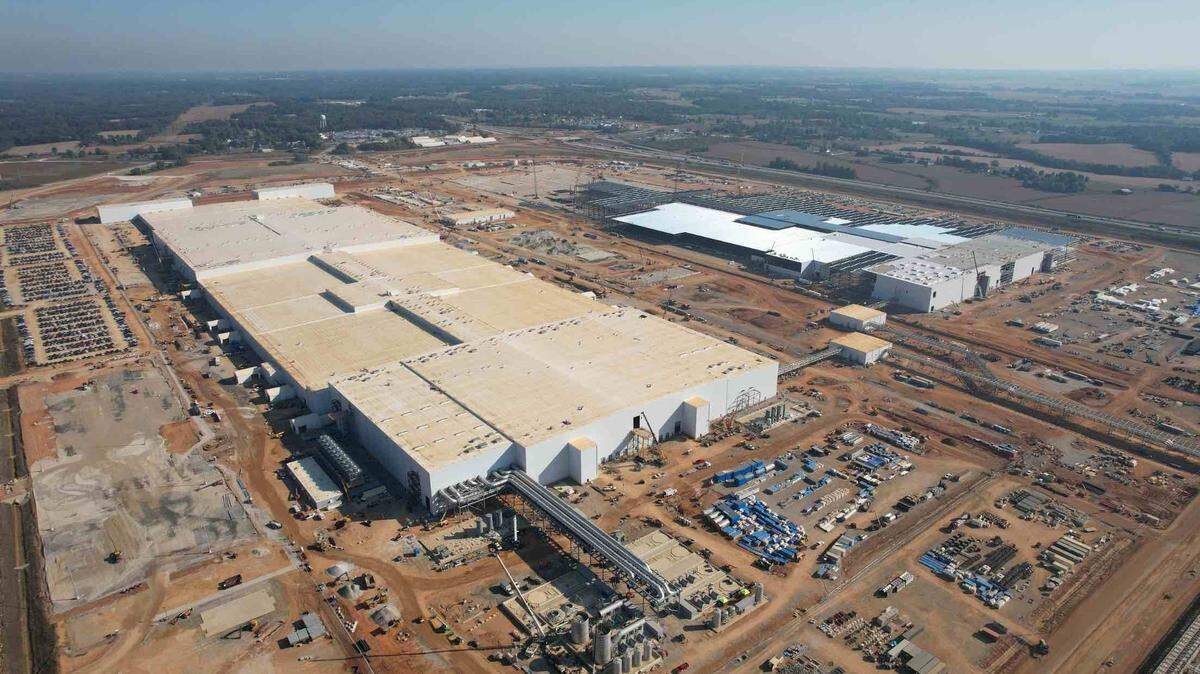
Gov. Andy Beshear has dubbed the commonwealth “the electric vehicle battery capital of the United States,” particularly in the wake of the Ford Motor Company-backed $5.8 billion twin battery plant project underway near Elizabethtown. Now he says the prospects of further investment could depend on who wins between former President Trump and Vice President Kamala Harris.
“There’s no question that the way president Trump talks about EVs is slowing down investments that would otherwise be happening,” Beshear said.
The governor said that electric vehicles are the future, but Trump’s plans to do away with electric vehicle rules and incentives could stymie future investments.
Trump has said several times he wants to scuttle those policies. Currently, half of new cars in the U.S. are set to be hybrid or all-electric by 2032 under a rule from President Joe Biden’s administration and national regulations have also funded major demand and supply-side incentives for the sector.
Additionally, blue states like California are setting their own more ambitious targets, with California aiming to make electric cars comprise 100% of new sales by 2035.
Harris’ potential presidency is seen as likely to continue Biden’s general support for the industry.
Trump’s campaign has seized on this as a talking point against Harris. The campaign has run ads claiming Harris wants to “end all gas-powered cars” — a position that she does not hold. and Trump himself told voters that “electric cars will kill more than half of U.S. auto jobs” and “decimate” the key auto industry-linked swing state of Michigan.
The consensus among industry experts and Kentucky politicians and economic development officials is that Trump’s presidency could delay the announcement of more electric vehicle-related investments.
However, it’s unlikely to completely derail the transition to electric vehicles.
Adam Edelen has a sunny outlook.
A former Democratic state auditor, Edelen has run the eponymous Edelen Renewables for the past eight years.
“The green energy transition is gravitational. It’s irresistible. Governments can either play a role in speeding up the pace or trying to slow it down, but the outcome is preordained,” Edelen said.
But the one potential dark spot, he says, is EVs.
“The sector that I’m in, we’re protected. I do think the EV sector has some vulnerability. It’s the one most likely to slow down. And I think Trump may succeed in making EVs, particularly in the near-term, a statement of politics,” Edelen said.
Captains of the industry are already signaling that could happen. While the nation awaits the election result, industry appears to be pumping the breaks on new EV investments.
“Depending on the election in the U.S., we may have mandates; we may not,” Volkswagen Group of America CEO Pablo Di Si said in September during an Automotive News event. “Am I going to make any decisions on future investments right now? Obviously not. We’re waiting to see.”
In America, EV sales are increasing, but demand hasn’t surged in quite the way many observers and industry leaders first anticipated. About one in five car sales last year was electric — full battery electric or hybrid — and the EV share of the automobile market is hovering around 9%.
Nick Nigro, founder of the Washington-based EV analysis firm Atlas Public Policy, said that the impact Trump could have on the industry is mostly just delaying the inevitable.
“The implications of the elections are going to maybe move the timeline a little, but it’s not going to change the result. The transition to electrification is pretty locked in,” Nigro said.
But that doesn’t mean it won’t matter. It did last time, he said.
“When President Trump was first elected, there was momentum building for EVs, but there was a considerable slowdown… That changed very quickly when president Biden took office,” Nigro said.
What about Kentucky?
Passersby on I-65 might have noticed the construction of massive EV battery plants at the BlueOvalSK site near Elizabethtown.
Economic development officials there share Beshear’s confidence that the investment will come to full fruition.
“No one is wringing their hands that a Trump second term is gonna destroy this,” Daniel London, executive director of the Lincoln Trail Area Development District said.
London said that production on the first of two plants there is still set to get underway in the first quarter of 2025. More than 700 people have already been hired, and jobs starting at $21/hour are still available for the first plant. The final goal is to hire 2,500 people at each plant.
While construction continues on the second plant, a timeline for production has not yet been set.
BlueOvalSK spokesperson Mallory Cooke said that the company is keeping a “close eye” on consumer sentiment.
“We will continue to keep a close eye on customer demand and will be in position to respond as needed. BlueOval SK remains committed to the Commonwealth of Kentucky,” Cooke said. “We are grateful for the continued support of leaders at the local, state, and federal levels and remain focused on delivering the investment and jobs that will build a better future of Central Kentucky and the entire Bluegrass State.”
Rick Games, president of the Elizabethtown/Hardin County Industrial Foundation, says that “on the homefront, it’s all positive.”
And he pointed to one wildcard in the equation: Elon Musk, the quixotic billionaire who owns Tesla, the country’s biggest EV producer.
Musk has pumped more than $75 million in support of the Trump campaign and has frequently made posts on his social media site X, formerly Twitter, denigrating Harris and uplifting Trump. He’s also running a get-out-the-vote operation in support of Trump in the key swing state of Pennsylvania. Trump has hinted at a future place for Musk in the administration to commandeer a “cost-cutting” program.
Some have speculated that his influence will soften Trump’s stance on EVs; his rhetoric on that subject has already softened. At a summer rally after Musk threw his full weight behind Trump, the former president said he “had to be” in support of a “very small slice” of cars being electric because of Musk’s support.
But, as the New York Times recently reported, Musk’s business and interests are varied across a variety of industries and it’s not exactly clear which will take precedence.
Another consideration for EV investments like BlueOvalSK and Envision AESC, a humongous battery plant supplier to Nissan in the works in Bowling Green, is the future of the specific kind of battery they’re producing.
The internal combustion engine has been in use for more than two hundred years. Projections aren’t the same for lithium ion batteries, the current most popular for all-electric vehicle batteries like the ones in production at BlueOvalSK.
Some point to the resurgence of hybrids as a sign of trepidation for all-electric vehicles.
BYD, one of China’s leading electric vehicle firms, recently posted its best quarter, according to Reuters. The growth was driven by a 76% jump in hybrid sales compared to last year.
Nigro also acknowledged that other “exciting” battery types are in development, including ones with faster charging speeds and less potential for fire hazards. However, he thinks that the batteries made at BlueOvalSK and similar manufacturers have legs.
“Lithium ion technology for batteries has a much longer runway than people thought 10, 15 years ago. We have a long way to go with lithium ion… I don’t think the industry is going to make a transition to a new battery overnight. That’s going to be a decade at least,” Nigro said.