KY is 200,000 homes short of what it needs, and the gap is widening. Now what?
In 2021, officials in Elizabethtown learned that a massive $5.8 billion battery plant, BlueOval SK, would be built nearby on Interstate 65, bringing 5,500 jobs to the community.
That was great news.
The bad news: the roughly 32,000 people in Elizabethtown already had a tight housing supply. More than half rented their homes. The city only issued about 100 housing permits in a typical year. Where were thousands of battery plant workers going to live?
Predictably, even before the sprawling factory has opened, local rents are going “through the roof,” Elizabethtown Mayor Jeff Gregory told the state legislature’s Kentucky Housing Task Force in July. As developers rushed in to snap up the limited supply of vacant land, prices soared from $7,000 an acre to $35,000 an acre, Gregory said.
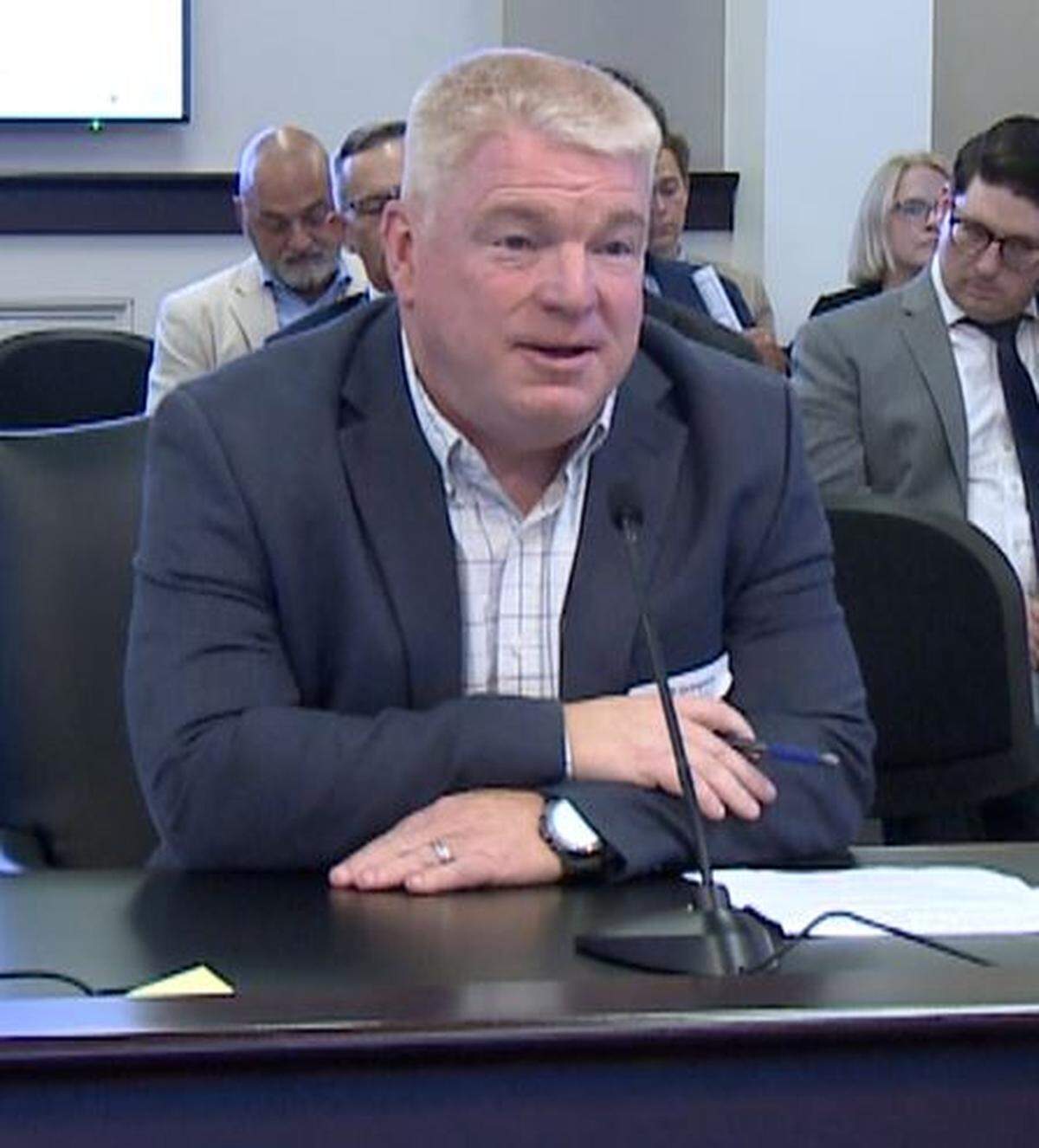
In fact, the mayor said, his own 24-year-old son, who earns a good income selling insurance, still lives at home because he can’t afford a place of his own.
“Supply and demand will tell you that if you’ve got more demand than you’ve got supply, you can charge more for it,” Gregory said. “It’s been overwhelming at times.”
It’s not just Elizabethtown. Shelby County, population 48,000, is getting a huge factory to make lithium ion cell batteries, with nearly 1,600 jobs, state officials announced last week. The jobs are welcome, but the county already needed an estimated 1,870 new rental and owner-occupied homes just to meet current housing demands, according to one study.
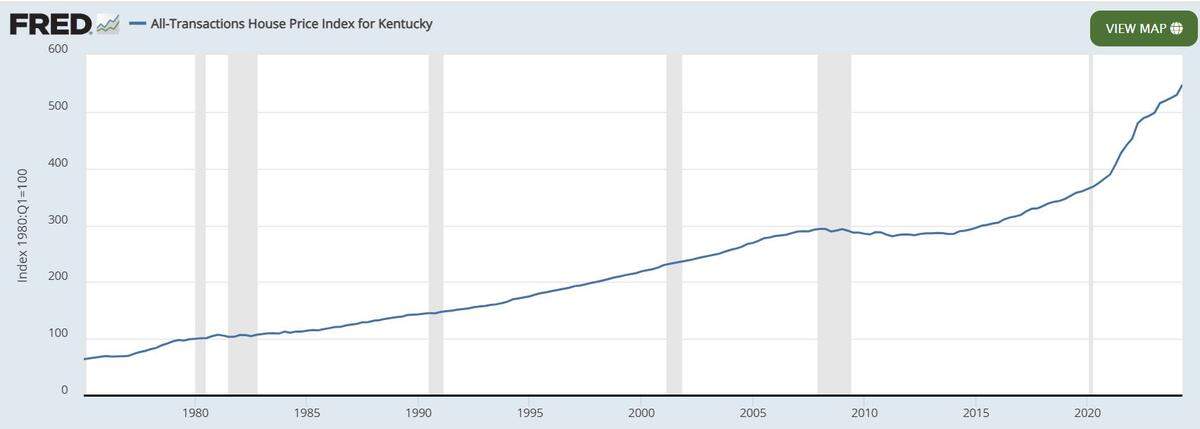
There simply aren’t enough houses and apartments across Kentucky for everyone who wants to live and work here. As a result, housing prices have exploded beyond a lot of people’s ability to pay. Home ownership rates are falling. In urban and rural parts of Kentucky, homelessness is rising.
That’s why the legislature had a 10-member Housing Task Force meet from June through November. Lawmakers asked government officials, homeless advocates, and business and construction industry leaders to testify about the state’s housing shortage and recommend solutions for the 2025 General Assembly when it convenes in January.
Housing is not one of the partisan issues that bitterly divides the legislature, said state Sen. Jimmy Higdon, a task force member.
“I think there’s a lot of common ground on this one,” Higdon, R-Lebanon, told the Herald-Leader after the final hearing Nov. 12. “Everybody realizes there’s a serious issue here, and everybody realizes that government has to be involved to some degree.”
A Democrat on the task force, state Rep. Lindsey Burke of Lexington, said she agreed with that sentiment.
“There is no silver bullet to this problem. We’re going to have to have a whole slate of changes,” Burke said. “And we can’t begin to do it soon enough.”
Kentucky’s missing houses
Among the task force’s conclusions:
▪ This year, Kentucky is 206,207 housing units short of what it needs for its population of more than 4.5 million people, according to a study by the Kentucky Housing Corp., a quasi-governmental agency that invests in affordable housing. That housing shortfall is projected to reach 287,000 units in five years under present trends.
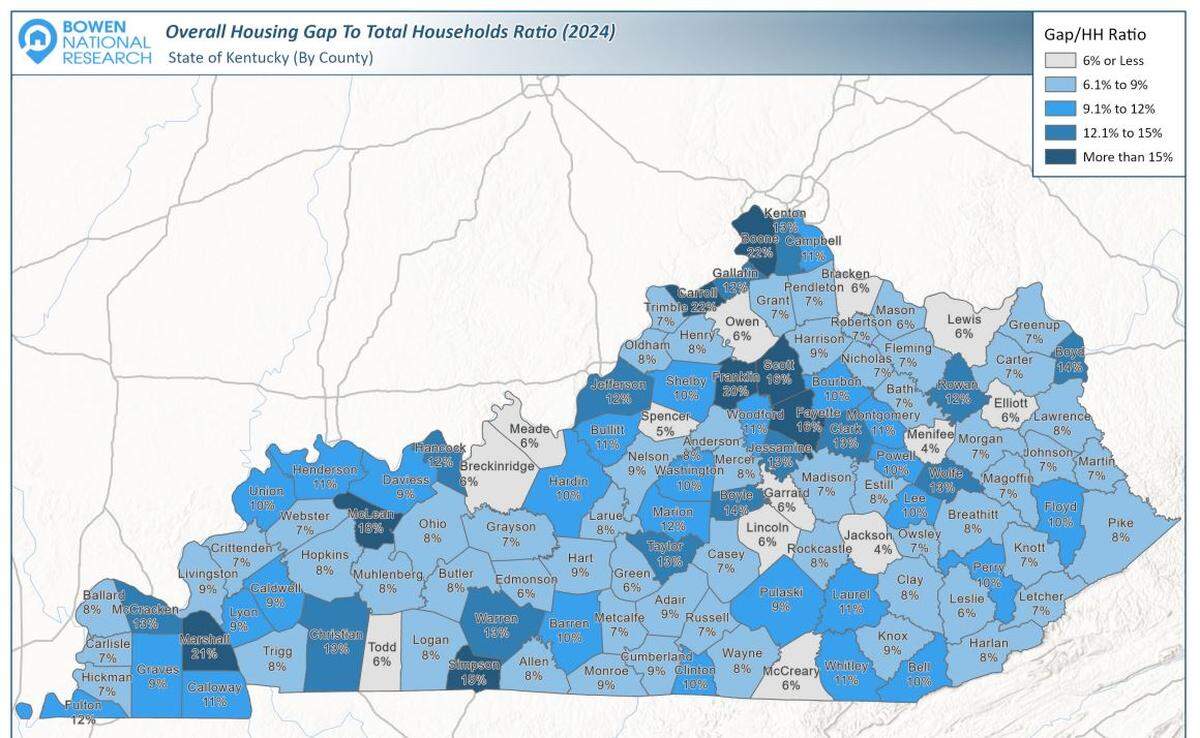
▪ Much of the shortfall — more than 90,000 housing units — is in the cities of Louisville, Lexington, Bowling Green and the suburban Northern Kentucky counties of Boone and Kenton, according to the study. Elizabethtown’s Hardin County also ranks near the top of the list with a deficit of 4,574 housing units.
▪ Nearly 5,000 homes were damaged or destroyed in the 2021 Western Kentucky tornadoes and the 2022 Eastern Kentucky floods. While that’s a relatively small part of the statewide housing deficit, it had a “significant out-sized impact” on the affected real-estate markets, mostly remote, rural counties, according to the study.
▪ Reflecting the concerns of Elizabethtown, 90% of local leaders in Kentucky said their communities don’t have enough housing available to absorb an unexpected economic development project that brought 1,000 new jobs, according to a study by the Kentucky Chamber of Commerce.
▪ In most Kentucky counties, at least half of the workforce drives to their job from their home in a different county, according to the Kentucky Housing Corp. study. For Lexington’s Fayette County, for example, 53% of the 191,235 people in the workforce commute from other counties.
In surveys, about 40% of commuters told the study’s authors they would move closer to their jobs if they could find affordable housing.
Causes of housing shortage
Business leaders told the Housing Task Force that several problems led to the state’s housing crunch, as well as the larger national housing deficit.
The 2008 financial crisis — fueled by skyrocketing and then crashing real-estate prices — discouraged home building for years. Construction firms shut down. The average number of building permits issued for single- or multi-family homes in Kentucky per year between 2008 and 2022 was 10,973, a nearly 50% drop from the same period before 2008.
In recent years, home building also faced headwinds from inflation, which makes timber, concrete and other materials more expensive, and rising interest rates that drive up the cost of borrowing for would-be buyers.
The cost to build a starter home in Kentucky now ranges between $260,000 and $400,000, which is outside the reach of low-income families. At the same time, federal funding for affordable housing programs in Kentucky has been stagnant for years.
And builders complained that they face resistance from planning and zoning officials and neighborhood groups, especially when they try to add affordable housing or higher density projects in established communities — what’s sometimes derisively called the Not In My Back Yard, or NIMBY, backlash.
Dealing with plan reviews, permit fees, inspections and other bureaucratic oversight delays construction and adds as much as 25% to the cost of a new home, the Chamber of Commerce said.
Much of Kentucky’s missing home supply is in “middle housing,” business leaders said, like townhomes, multiplex apartment buildings and other dense housing that usually is cheaper and accommodates more people than single-family homes on quarter-acre lots. But this sort of project often triggers protests when it’s planned near a traditional residential neighborhood, builders said.
“Manufactured housing,” or prefabricated homes that are built off-site and trucked to a vacant lot, are one affordable option. (Once known as mobile homes, they are now generally better made.) But they’re barred from some communities by zoning rules, the Kentucky Manufactured Housing Institute told the task force.
Fixing the problem
Lawmakers were told that other states have adopted their own version of the federal Low-Income Housing Tax Credit. These state credits, combined with the federal credits, subsidize private investment in affordable housing projects, providing places with relatively low rent.
Apart from that, Ohio has launched a $50 million, four-year Single-Family Tax Credit program aimed at making homes with at least two bedrooms and one-and-a-half bathrooms affordable for working families. Ohio also runs the Welcome Home Ohio program, with $150 million made available to land banks and local governments that purchase and rehabilitate old properties or build new ones.
Lexington Mayor Linda Gorton suggested to lawmakers that, like Ohio, Kentucky invest in state revolving loan funds for affordable housing projects; offer affordable housing tax credits to developers; and work with local governments to set up land banks that can acquire land for affordable housing projects.
Perhaps not surprisingly, the task force heard recommendations from industry groups that said they — as well as home buyers — would benefit from state tax breaks or state tax incentives aimed in their direction, including the Homebuilders Association of Kentucky and the Kentucky Manufactured Housing Institute.
For example, repealing the state’s 6% sales tax on manufactured housing would make the homes even more affordable, the industry group said, and it would more fairly treat them like other forms of housing in Kentucky.
Higdon, the state senator from Lebanon, told the Herald-Leader that he knows several members of the task force are preparing housing bills for the 2025 legislative session that begins in January.
One bill that Higdon plans to sponsor would make it easier for faith-based organizations and religious institutions that want to provide affordable rental housing on their properties. Based on a proposal by U.S. Sen. Sherrod Brown, D-Ohio, it could offer these hosts technical help, financial grants and assistance dealing with local governments.
Higdson said he got the idea from speaking with Sister Joy Jensen of The Sisters of Loretto, a Catholic religious institute in Marion County.
The Sisters have a couple of units in their infirmary building, which they call The Living Center, that they would like to make available to the public as affordable housing, Jensen told the Herald-Leader.
Land in the area costs $10,000 to $15,000 an acre, she said.
“Kentucky is really suffering a shortage of housing for everyone, but especially for low-income housing,” Jensen said.
The two-year state budget likely won’t be reopened during the upcoming session, and Republican super-majorities in the House and Senate appear committed to further income tax cuts, so it’s not clear how much money Kentucky can put on the table for new housing initiatives.
But Kentuckians should know that housing is one of the legislature’s priorities this winter, Higdon said.
“We’re 200,000 households behind as it is,” the senator said. “You gotta start somewhere. Maybe it’s helping the churches provide affordable housing, maybe it’s tiny houses, maybe it’s a program for first-time home buyers. You gotta do something. They’re not gonna fall out of the sky.”