
Exit Interview: Damon Thayer on Trump becoming ‘normal Republican,’ future plans & more
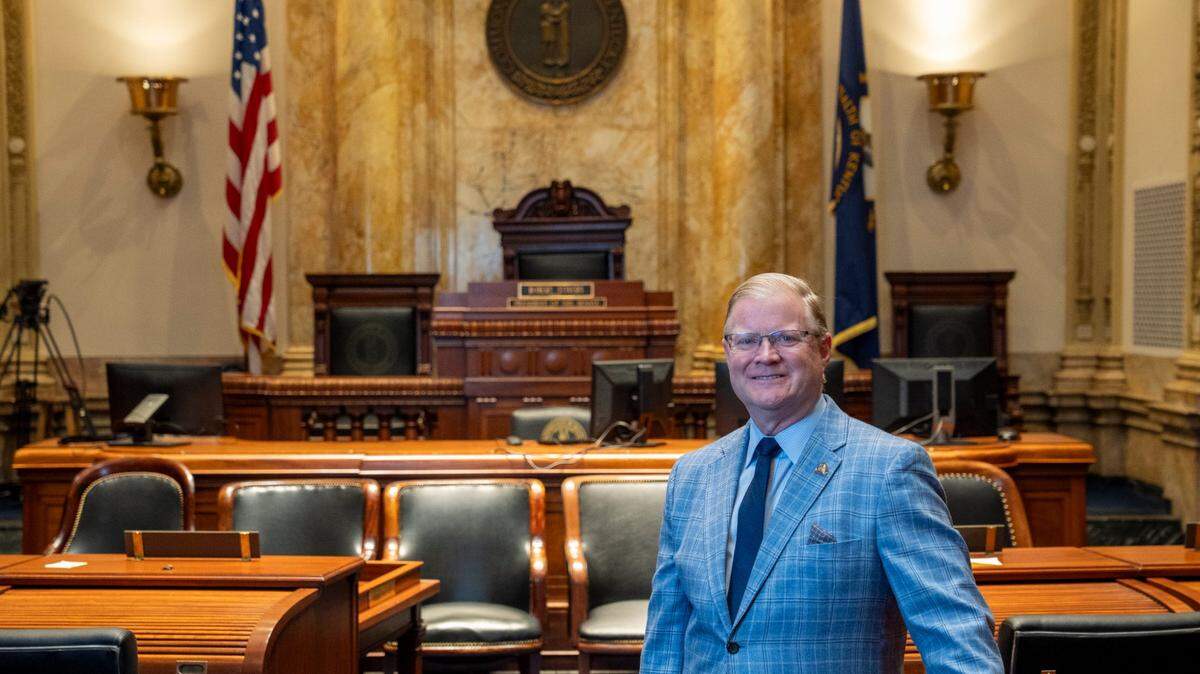
Damon Thayer is not camera shy.
If you’ve followed Kentucky politics over the past decade, you probably know the longtime Senate Majority Floor Leader from Georgetown.
Initially a spokesperson by trade, Thayer has become the unofficial public face of state Republican policymaking. “Right to work” legislation, pension reform attempts, tax cuts, reshaping the horse racing industry, sports betting, bourbon policy, medical marijuana hesitance and then passage, local Lexington parking rules and more.
He’s taken heat — and credit — for most of those policies. Known for his pugnacious and quippy style, Thayer has referred to himself as the “tip of the spear” for Frankfort Republicans.
Thayer has also been a part of several Republican electoral victories, and some losses, in recent years. As a candidate recruiter, political action committee influencer — he’s served on the board of the powerful state-level group GOPAC — and campaign surrogate, Thayer’s been one of the most active and consequential political forces in shaping the state’s four-fifths GOP majorities in the state legislature.
He’s taken a few victory laps since announcing he wasn’t going to run for reelection late last year.
But now, he’s got the 2024 elections in hindsight. And there are some takeaways.
“A Trump, MAGA Republican is now the definition of ‘normal,’” he said.
He’s got some ideas about who can ride that wave into the governor’s mansion — the electoral race that’s most eluded the GOP — come 2027 when Democratic Gov. Andy Beshear can’t run again.
Thayer said he sees Rep. James Comer, R-Ky., and multimillionaire businessman Nate Morris as initial frontrunners for governor. Secretary of State Michael Adams? Not so much, he says.
And where is Thayer himself going?
He has something to say about that, too.
Answers have been edited for space and clarity.
Herald-Leader: When it comes to the presidential result, obviously, Kentucky is conservative, but we moved about five points toward Trump compared to 2020. What do you think explains that shift?
Damon Thayer: I could see it coming in polling that we did in a couple of our Senate races during the summer. We poll-tested how Trump was doing in our districts, and when I looked at the poll in Chris McDaniel’s district and Trump was in a really strong position, I knew that something was happening. He was polling much better up there in the Northern Kentucky suburbs with women than he did four years ago.
I just think that people were willing to forego the personal feeling toward him and express their frustration with the inflation, economy and immigration. When they compared his four years as president to the four years of Biden and Harris, they made a decision based on those factors.
H-L: Tip O’Neill once said that all politics is local. But when you look at Kentucky’s state legislative results, races really only differ from presidential results in a couple districts. Everything else is a few points here, a few points there. Is that just the way of things in our increasingly connected world?
DT: One thing I’ve learned being in Kentucky politics since 1995 is that most people don’t know who their state legislator is. We’re always cognizant of where the presidential candidates are in both parties. How the president is doing has a great effect on these races. In 2018, during Trump’s first midterm, we had to really fight and scrap and claw in about four state legislative districts. We knew during the summer that the mood toward Republicans had turned negative, especially in the suburbs.
H-L: What, in your opinion, does the national GOP need to do to fend off a midterm slump and hold onto its trifecta?
DT: My hope is that we can make Trump’s 2026 more like Biden’s 2022 and less like Trump’s 2018. I think what happens in the first 100 days is critical, and I think Trump and his team have to deliver on some of the promises on immigration, energy and therefore, inflation. A lot of what happens with inflation is driven by energy costs because it takes energy to get goods and services to the market. I think stopping the tax cuts from automatically reverting to higher levels in 2026 is going to be really important, as is getting the Keystone Pipeline going again, and natural gas production, oil production up so gas prices can go down and families start to see it in their wallets.
H-L: Previously, you’ve taken some heat in certain GOP circles for the “normal Republican” line in reference to Republicans you’d support in the primary. Has your definition of what a normal Republican is changed since then, and is Donald Trump, to you, a “normal Republican?”
DT: Well, I think he is. Honestly, my reference to “normal Republican” had very little to do with President Trump. It had more to do with what was going on in Kentucky. Over the course of the last nine years, I think that President Trump has changed the look and face of the Republican Party. When you look at the results in the primaries — three presidential races that have taken place in that time — a Trump, MAGA Republican is now the definition of “normal.” I still count myself a Reagan conservative, and my positions still align a lot with what President Trump hopes to do — not everything, but most of it.
H-L: I’m going to read you a list of priorities from a story on your first regular election victory in 2004 and I want to hear your response — if you consider yourself the same person, or if you agree or disagree on anything. Here’s the quote: “Thayer said he is against raising taxes to deal with the state’s budget problems, and vowed to post the 10 Commandments in public schools. He also said he was for a constitutional amendment that would allow the legislature to cap medical malpractice damages.”
DT: Let’s take them one-by-one. On the tax issue, we’ve delivered. I voted against the Democrats’ tax increase that they passed through the house back in 2010-2011. I think on taxes, I’m in the same place. The results have been pretty good for Kentucky, especially during this time of rising costs. We’ve let Kentuckians, via these tax cuts, keep a couple billion dollars over the past several years in their wallets. On the 10 Commandments, I think that’s settled law. I think the 10 Commandments are allowed to be placed in our classrooms, and I still think it’s a pretty good set of rules to live by. On med-mal, that was a big issue back then, and we really pushed for it. But as we’ve learned, it’s very difficult to change the constitution. I’ll be honest, that issue has pretty much petered out over the last 10 years. Very few people have talked to me about it; even my own doctor, who used to talk to me about it all the time, hasn’t mentioned it to me in a long time.
H-L: The one thing that’s kind of eluded Republicans’ grasp, at least for more than one term, is the governor’s chair. Do you think it’s inevitable that Republicans take it back in 2027, or do you expect Democrats will put up a strong candidate?
DT: It’s something we really have to work for, because it’s a different electorate in these off years. I still contend that our governor’s races should be moved to even numbered years for a whole host of reasons, not the least of which is letting more people decide who our governor is. But yes, having said that, I think the Republican nominee for governor in 2027 is odds-on favored to be elected, and if they do a good job, being the first two-term Republican governor. I just feel pretty strongly that that’s going to be the case.
H-L: You’ve made several hints at a desire for higher office down the road. Can you share what offices you’re seriously considering running for? Are there any that you’d rule out?
DT: I’m going to keep all my options open. I do believe it’s easier to run for a higher office if you’re not a member of the legislature. I think the recent election results prove that, Mike Harmon, being the only exception to that rule. The only statewide constitutional office I would be interested in would be governor, and I’m certainly going to keep my eye on it as the field develops. It’s still a little early to be talking about that. And you know, if there’s an open seat possibility at the federal level, I would certainly be open to those. I’m not really interested in running for any of the down ticket races in 2027.
H-L: Secretary of State is off the table, even though you’ve been involved in elections policy as a senator?
DT: I’m not interested in that job.
H-L: “Federal level,” I assume, includes both Senate and House? Congress would be the 6th Congressional District, and I think it’s fair to say there’s still a possibility of an opening there, but just to be sure: you wouldn’t run against Andy Barr?
DT: No, I would not run against any incumbent member of Congress or the U.S. Senate. And by the way, I’m a huge Andy Barr supporter. I consider him a friend, and I think he’s a model congressman.
H-L: Who do you think runs for Senate in 2026?
DT: Well, until he says he’s not, Mitch McConnell. I haven’t heard him say that he’s not running and, until he makes a decision about his political future — and he’s still got a little bit of time to do that — I don’t think it’s appropriate for anybody to be talking about running for that seat.
H-L: Well, I guess it’s appropriate then to talk a little bit about governor. In that case, I think a lot of people are kind of reading the tea leaves and seeing folks like U.S. Rep. James Comer, R-Ky., and Michael Adams as other potential politicians to run. If that’s the field, is that a field that you’d be comfortable with jumping in?
DT: I think Congressman Comer would be a very strong candidate. I also think you should add Nate Morris (a former GOP operative who founded Lexington-based waste industry company Rubicon) to that list. I know Nate harbors an ambition to run for a big office someday. I don’t know if it’s U.S. Senate or governor, but he showed up at the Boone County Republican Christmas party. That’s a signal that somebody’s interested in running for something bigger.
I don’t think Michael Adams is a strong candidate for governor, but I think certainly Congressman Comer and Nate Morris fit the description of being strong candidates. Whether I run or not depends on what the field looks like, what the political environment is. Guys like Nate and Jamie, they’re both friends of mine.
H-L: Why is Adams not a strong candidate?
DT: The big thing for me is, back in 2020, he told (House Speaker David) Osborne and (Senate President Robert) Stivers and me what his plan was to run the elections during pandemic, and then he went in and agreed to something different with Beshear. I just haven’t trusted him since then. And I just think he’s a bit Beshear-like in that he comes across as a bit of a lightweight who’s always preening for attention. That and he really isn’t much loved by the Republican base.
(When contacted by the Herald-Leader, Adams responded with the following: “As Kentucky’s top vote-getter, I’ve found that Kentuckians prefer candidates who they like and respect. Republicans have learned the hard way, twice, that we need to nominate someone with wide appeal if we want to take back the governorship.”)
H-L: Do you want to weigh in on whether you think Lt. Gov. Jacqueline Coleman or former House Democrats leader Rocky Adkins would be formidable candidates?
DT: I think either one of them would be defeated by a good Republican candidate. Honestly, I just think Andy Beshear is an anomaly. He was very fortunate that he narrowly defeated Rocky in that primary, and then he narrowly defeated a heavily damaged Matt Bevin. Then he had a couple of unpredictable circumstances with the pandemic and two natural disasters that allowed him to popularize his persona unlike any governor in recent Kentucky history.
The other thing you’ve got to remember for whoever the nominee is in 2026 for the Senate — well, let me back up because I don’t want to conjecture on the Mitch situation. So, with the governor’s race, the President of the United States is going to be Donald Trump, and he’s very likely to come in here and campaign for who the Republican nominee for governor is, and it’s an open seat. The dynamics are going to be very different than they were in 2019 or 2023 when you had incumbents on the ballot both times.
H-L: You publicly supported Sen. Julie Raque Adams, R-Louisville, to replace you in leadership, and that didn’t happen. Did that come as a disappointment, and why do you think she didn’t ultimately get that role?
DT: Well, I was disappointed. Julie’s one of my closest friends, and I thought it was a great opportunity to put a strong woman who is experienced in leadership from Kentucky’s largest city in a key leadership role, but I didn’t have a vote, and the caucus decided to go another way. I’ve congratulated Senator (Max) Wise, and I think he’s well prepared for the job. I wish him the best, and I’m here as a resource if he needs me.
H-L: If you had to pinpoint your greatest political achievement, what would you say that is?
DT: Overall, it’s taking the Senate Republican caucus to 31 members. You know, turning that state map really red. But there are a couple of races that really stand out for me. My reelection in 2004, I was the No. 1 target of the Democrats. They spent about $250,000 — a lot of money in a state legislative race — and I ended up getting 56% of the vote.
H-L: If you had to pinpoint your greatest legislative achievement outside of elections, what would you say that is?
DT: Collectively as Republican super majorities, I would say the tax cuts would be No. 1. The passage of the “Right to Work” bill is a close second.
Personally, it would be Senate Bill 2 in 2013 — reform of the state and city county pension systems — was my first year as Floor Leader. There was a Democrat in the governor’s mansion, Democrats controlled the House, and It was a really big bipartisan deal to pass that. I can remember being in Steve Beshear’s office negotiating the final details, and you know, to be able to put those pension systems on a positive financial trajectory is my biggest personal victory in terms of it affecting the most number of people.
H-L: One question I have to ask, because you hear some things here and there about it: you were heavily involved in HHR passage (slot-like machines only allowed at horse tracks and their affiliate campuses), and you have these ties to the horse industry as a consultant. When you were floor leader during the passage of HHR legalization, were you under any contract with a company that would benefit from that legalization?
DT: I did not have any any Kentucky clients at that time, nor do I now.
H-L: That doesn’t include a client who is technically not based in Kentucky but still has interests or operations with HHR-related establishments or machines?
DT: I have had no Kentucky-based clients during the passage of any of the horse racing-related legislation over the last five, four years.
H-L: Had to ask. It was my last chance.
DT: Sure, it’s a legitimate question. And by the way, it would have been legal for me to do so, because under Kentucky law a legislator in a citizen legislature may vote on issues affecting an industry or sector he or she works in, as long as the bill isn’t just for that sector.
H-L: One more follow up: When you say you had no Kentucky-based clients, does that mean that none of the clients were headquartered in Kentucky, or does it mean, definitively, that none of the clients had interests in machines or in the industry that benefited from the passage of that bill?
DT: I have no Kentucky-based clients, nor did I work on any Kentucky horse racing business, nor have I for a long, long time. I used to, in the late teens, consult for Kentucky Downs under its previous ownership. But when it was sold, I voluntarily dropped Kentucky Downs as a client because I knew that the sports betting issue was coming. I didn’t know HHR was was going to present itself as an issue, to be honest. I voluntarily dropped out, even though, legally, I could have stayed. I have an opinion from the Ethics Commission that I could have stayed as a consultant, but I did not because I saw the sports betting issue coming along and being politically difficult. It was legally and ethically proper, but I knew that politically it would be difficult, and I wanted to be able to advocate with a clean conscience.
H-L: There’s obviously a change in leadership. How are you seeing the legislative body change? And what does that mean for Kentuckians when it comes to policy that affects their daily lives?
DT: You still have the same House Speaker and the same Senate President, and I don’t think people really understand how strongly they affect the policy direction of both caucuses. All legislators and leadership positions are technically created equal, but those two positions, being constitutional officers, they hit different and they’re stronger. I’m still seeing from President Stivers and Speaker Osborne a strong desire to continue to cut taxes and eliminate the personal income tax. I think there will be a DEI (diversity, equity and inclusion) bill passed. Hopefully the House will be a little more willing to negotiate with the Senate on a final bill. It’s been interesting to note that some of the universities have adopted, in a very proactive move, a DEI policy that, I think, will pass the legislature. I think the nation spoke on these kind of “woke,” politically correct policies.
The vaping issue, I think they’re going to continue to challenge the legislature. We passed the bill getting tough on retailers selling vape products of individuals under 21, but I think the enforcement of that is going to continue to be an issue. I think the legislature is going to continue to have an emphasis on socially conservative issues. But I also think that under the leadership of the speaker and the president, there’ll be a strong emphasis on economic issues as well. I think the nation spoke on energy issues, and I think there will be impetus to continue to have a strong energy portfolio at the state level.
H-L: Speaking of social issues, is a rape and incest exceptions bill to the state’s abortion ban dead on arrival? Or do you perceive that as having a shot?
DT: We didn’t have the votes to pass it last year. After the election results? I don’t see that changing. You know, the president of the United States was just elected with a platform on exceptions, but I just don’t see that changing in Kentucky unless there’s some sort of legal action that would be an impetus to change the existing law.
This story was originally published December 16, 2024 at 5:00 AM.