Supreme Court hears transgender-rights case. What could that mean for Kentucky’s law?
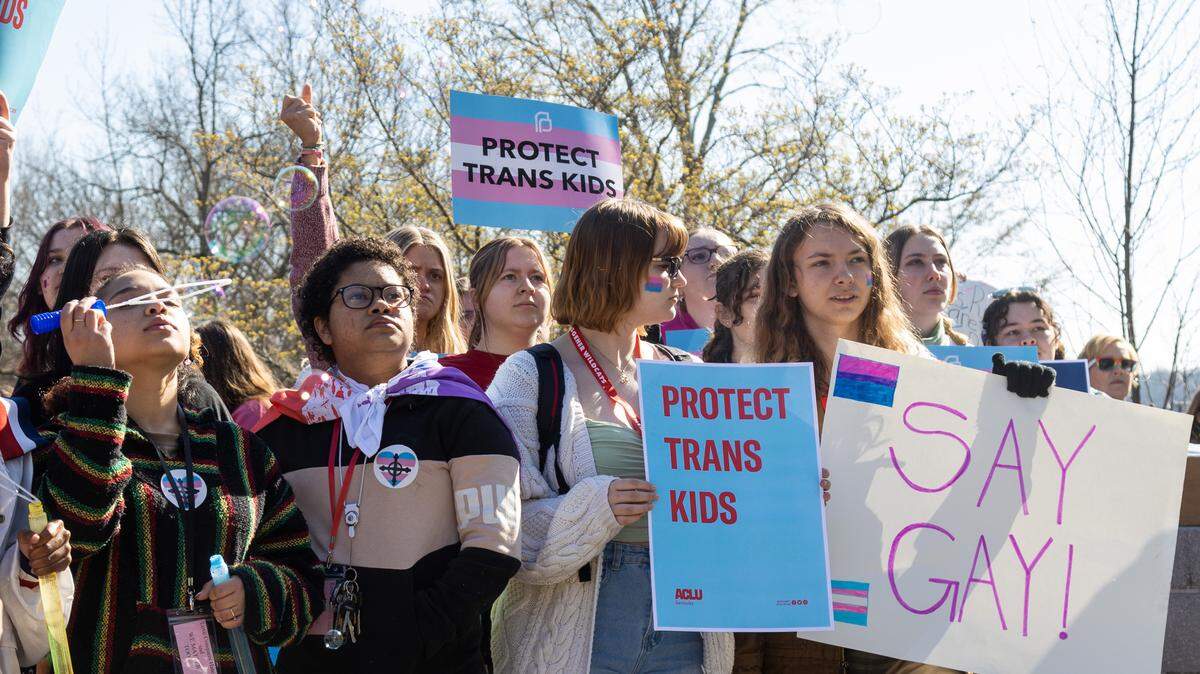
The Supreme Court on Wednesday heard oral arguments in a Tennessee case that, like a near-identical case in Kentucky, alleges that a statewide law banning gender-affirming medical care for transgender youth is unconstitutional.
The high court’s ruling will directly impact the fate of Kentucky’s ban.
Kentucky’s ban, like Tennessee’s, prohibits health care providers from prescribing, dispensing or administering puberty blockers and hormone treatments for the purpose of affirming a trans minor’s identity. The law also blocks gender-affirming surgeries for this population, which are rare among adolescents. Kentucky’s lawsuit only challenges the banning of gender-affirming medication, not surgeries.
“Our primary argument is that this statute, on its face, says you can’t have medications inconsistent with sex,” U.S. Solicitor General Elizabeth Prelogar said in her argument against the ban Wednesday morning.
“No matter what you think about transgender discrimination generally, that’s a sex-based line. It’s no different than saying you can’t dress inconsistent with your sex.”
Tennessee Solicitor General Matt Rice disagreed with that characterization, saying the law, instead, was about prohibiting drugs based on their intended “medical purpose for which the drug is used,” rather than dictated by sex — a point the liberal justices took issue with — and such medical purposes are “risky” and “unproven,” he said.
The law’s “application turns entirely on medical purpose, not a patient’s sex. That is not sex discrimination,” Rice added.
“But you’re still depending on sex to identify who can get it and who can’t” access gender-affirming medication, Justice Sonia Sotomayer said, cutting Rice off.
It’s the first time the nation’s high court has agreed to review this issue, and its decision will have far-reaching impacts. Twenty-six states with Republican-controlled legislatures, including Kentucky, have passed laws banning trans youth from accessing this type of healthcare. Nearly all of those laws were passed in the last four years, and more than half are facing legal challenges.
The main question posed to the high court’s justices is whether Tennessee’s law — and others like it — discriminates on the basis of sex, as lawyers for the plaintiffs allege it does under the Equal Protection Clause of the 14th Amendment.
“Someone assigned female at birth, for example, cannot receive puberty blockers or testosterone to live as a male, but someone assigned male at birth can,” lawyers for the Tennessee plaintiffs wrote in a filing.
If justices agree, it will demand a form of judicial review known as “heightened scrutiny.” If justices decide it does not violate the Equal Protection Clause, that legal precedent will likely mean laws across the country like this can remain in place.
The court’s three liberal justices seemed to clearly side with the Tennessee plaintiffs. Five conservative justices expressed varying degrees of skepticism to lawyers for the Tennessee plaintiffs. Justice Neil Gorsuch did not speak at all during oral arguments.
Justice Brett Kavanaugh said, even though there are documented benefits to providing gender-affirming medication to trans youth, there are still some who decide to de-transition later in life.
“You say there are benefits to allowing these treatments, but there are also harms, at least the state says so . . . the physical and psychological effects on those who later change their minds and want to de-transition,” Kavanaugh said. “How do we as a court choose which set of risks are more serious, in deciding whether to constitutionalize this whole area?”
Kentucky’s ban
The Republican-controlled General Assembly voted to pass Kentucky’s version of this ban, Senate Bill 150, into law in March of 2023, over Gov. Andy Beshear’s veto. Around the same time, Tennessee codified a similar ban.
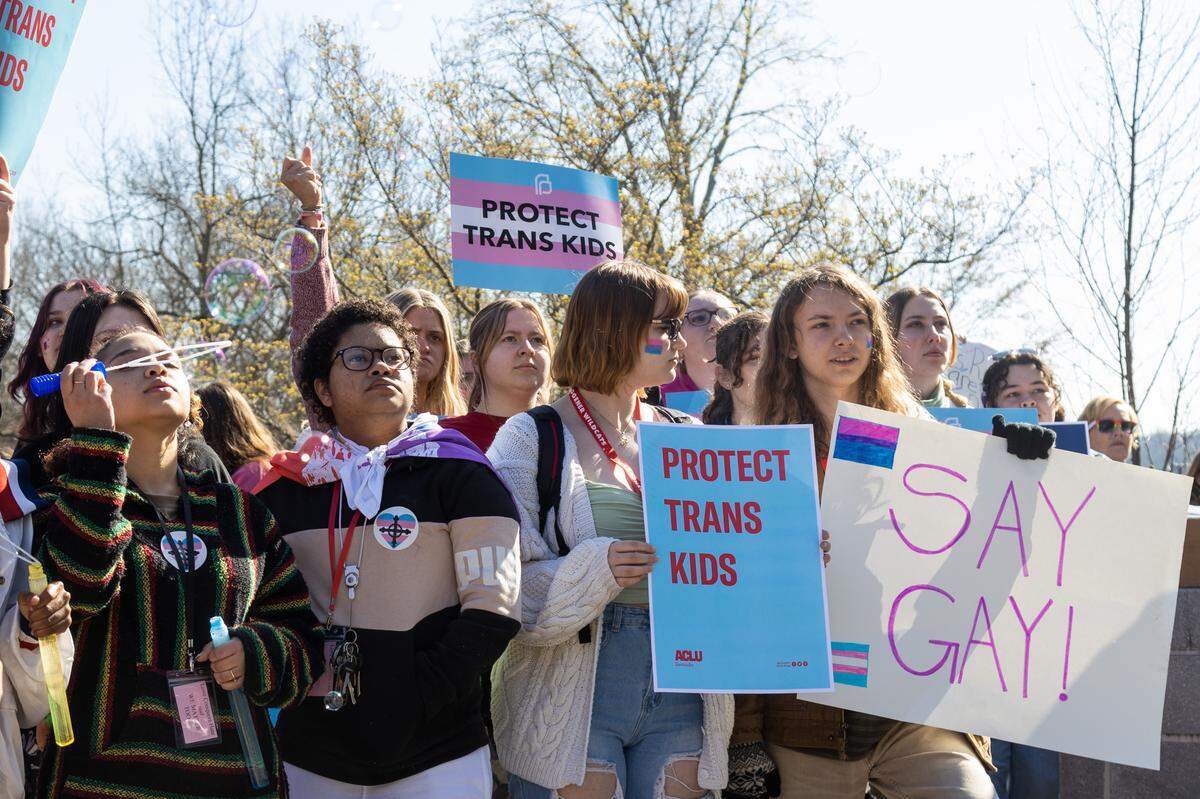
Lower courts granted requests from plaintiffs in both states — three families in Tennessee and six families in Kentucky — temporarily blocking both bans from enforcement.
Republican attorneys generals in both states then appealed, bringing both cases before the Sixth Circuit Court of Appeals. A three-judge panel on that appellate court consolidated the cases before undoing lower court decisions in both cases, once again allowing the laws to be enforced.
Last November, Kentucky and Tennessee plaintiffs appealed to the nation’s highest court for relief. In April, President Joe Biden’s administration, as an intervenor, asked for Tennessee’s case, specifically, to be reviewed and reversed. This appeal is the case justices heard oral arguments for on Wednesday.
“By depriving transgender adolescents of essential medical care recommended by their treating professionals based on decades of research, these bans inflict irreparable harm on transgender youth and their families,” the six Kentucky families wrote in an amicus brief supporting the Tennessee plaintiffs.
The ruling, expected by June, will directly impact Kentucky’s case and the state’s law, since their decision could kick the decision back to the Sixth Circuit appellate court, where the Kentucky and Tennessee cases were consolidated and ruled upon.
Justice Sonia Sotomayor asked Chase Strangio, arguing on behalf of the Tennessee plaintiffs, “I assume, if you win in this proceeding, what you’re asking for us to reverse is the Sixth Circuit conclusion that rational basis review applied, correct?”
“That’s correct,” Strangio said.
If justices reverse the Sixth Circuit’s decision, it could immediately block Kentucky’s ban, said Corey Shapiro, legal counsel for the American Civil Liberties Union of Kentucky and attorney for the Kentucky plaintiffs.
“It will directly impact Kentucky if, for example, the court said the Sixth Circuit got it wrong,” Shapiro said this week.
In that case, if the high court kicks the case back to the appellate court to determine whether it survives heightened scrutiny, “the Sixth Circuit would be looking at whether the Kentucky law survives and whether the Tennessee law survives.”
In other words, Shapiro said, “Our case is potentially more impacted than any other state’s, other than Tennessee’s.”
What the amicus briefs say
Gender-affirming medical care bans are part of a broader effort, mostly in GOP-controlled states, to restrict the rights of trans people. Kentucky lawmakers in 2022 barred trans girls from playing in K-12 girls’ sports.
Another aspect of Senate Bill 150 from 2023 is that it banned students from using the bathroom and locker room facilities matching their gender identity while at school.
That law also forbids schools from requiring teachers to use a student’s pronouns if those pronouns “do not conform to a student’s biological sex, as indicated on the student’s original, unedited birth certificate,” according to the law — an aspect of the law that’s being sued separately by a group of Fayette County families.
To be trans, or to experience gender dysphoria, is a clinical condition that causes distress because of an incongruence between a person’s gender identity and their sex assigned at birth, more than 20 medical associations and groups explained in their amicus brief in support of the families who brought Tennessee’s lawsuit. Those groups include the American Medical Association, the American College of Physicians and the American Academy of Pediatrics.
“The widely accepted recommendation of the medical community, including that of the respected professional organizations participating here . . . is that the well-accepted protocol for treating gender dysphoria is ‘gender-affirming care,’” they wrote.
Tennessee’s “health care ban disregards this medical evidence by precluding health care providers from providing adolescent patients with treatments for gender dysphoria in accordance with the well-accepted protocol.”
Plaintiffs in Kentucky’s case agreed, and made the case that both state bans discriminate based on sex.
“There can be no reasonable dispute that the impact of the bans falls exclusively on transgender youth. The Kentucky and Tennessee laws permit the very same medications — puberty blockers and hormone therapy — to be provided to minors who are not transgender, prohibiting them only when transgender adolescents need them,” they wrote.
Tennessee’s law, like Kentucky’s, “categorically prohibits an entire class of care for transgender adolescents yet leaves the same medications entirely unrestricted when used for any other purpose,” lawyers for the plaintiffs argue, ”and makes no attempt to regulate a host of other treatments that implicate the state’s asserted interests to an equal or greater degree,” lawyers for the Tennessee plaintiffs wrote.
Lawyers in both cases are building their rationale on a decision made by the court four years ago, in Bostock v. Clayton County, in which conservative Justice Neil Gorsuch said it was “impossible” to “discriminate against a person for being homosexual or transgender without discriminating against that individual based on sex.”
This conclusion, lawyers for the Kentucky plaintiffs wrote, “applies equally to claims brought under the Equal Protection Clause. Sex-based discrimination is sex-based discrimination, regardless of whether the discrimination comes from a private employer or the state.”
The Kentucky Family Foundation, a conservative Christian lobbying group in Kentucky that supported Senate Bill 150, also co-filed an amicus brief with the Family Action Council of Tennessee in support of the bans in both states.
In that brief, they argue that the law doesn’t discriminate on the basis of sex because being trans isn’t a legitimate identity.
“The contest in this case thus raises questions as to whether there is a human nature, whether male and female are objective conditions of identity that state law may recognize,” they wrote, “and whether the state may protect vulnerable children within its borders from the medical manipulation of persons’ sexed bodies in furtherance of a denial of any given human nature.”
In a statement after oral arguments, Family Foundation Executive Director David Walls said, “for all of human history, the truth that the human person is objectively and profoundly male or female has been the cornerstone of all civilizations. We pray the court’s decision will recognize the harms perpetrated upon children in the name of ‘gender-affirming’ care, and that they would rightly allow for Kentucky, Tennessee and other states to protect our most vulnerable fellow image-bearers from lifelong harm.”
This story may be updated.
This story was originally published December 4, 2024 at 1:26 PM.