Woman cited for ‘unlawful camping’ while going into labor challenges KY anti-crime law
A woman cited by Louisville police for unlawful camping while she was homeless and in labor under an Interstate 65 overpass has filed a constitutional challenge against the state’s new Safer Kentucky Act.
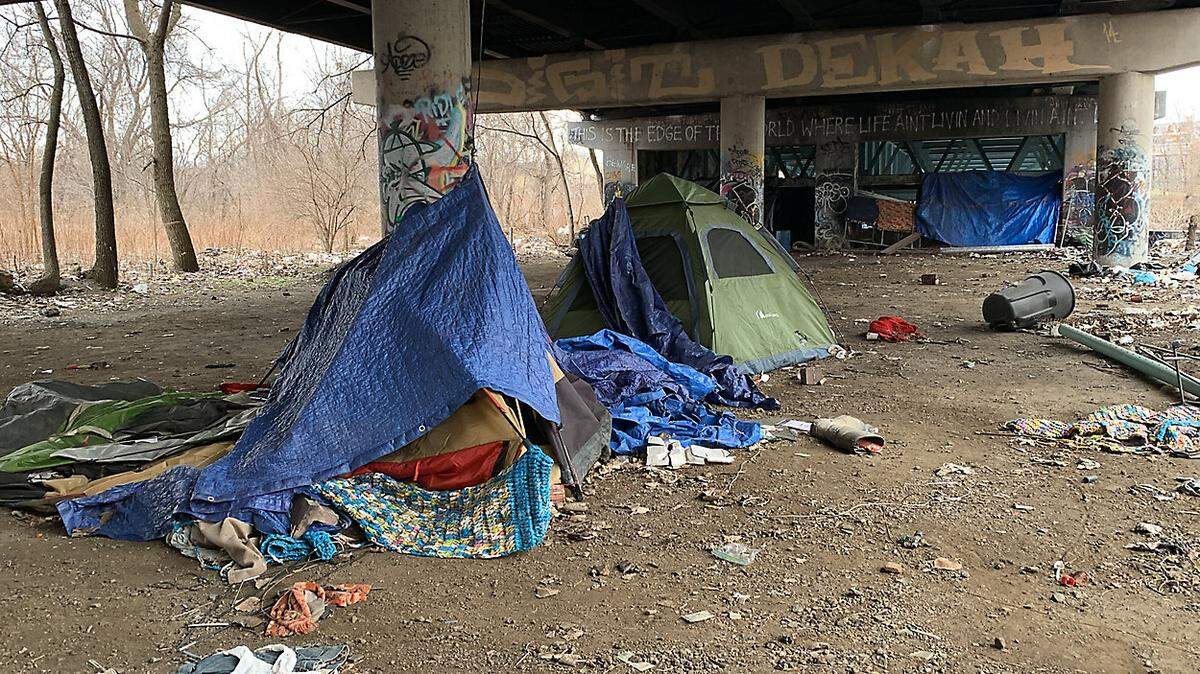
The sweeping anti-crime law, passed a year ago as House Bill 5 by the Kentucky General Assembly, outlaws sleeping and camping in many public and private places as part of a controversial law enforcement crackdown on homelessness.
Violations of the ban can result in fines and jail time.
But the woman claims the law violates several parts of the U.S. and Kentucky constitutions, including vagueness, by failing to provide defendants with fair notice and permitting arbitrary enforcement; infringing on the right to travel by banishing those without shelter from the state of Kentucky; violating due process rights; creating a separate class of people who are treated differently; and levying excessive penalties.
The U.S. Supreme Court upheld the right of governments to enforce camping bans in a decision last June.
“Homelessness is complex. Its causes are many. So may be the public policy responses required to address it,” the high court ruled in a 6-to-3 decision upholding an Oregon camping ban.
Public defenders for 34-year-old Samantha Crabtree on Jan. 17 filed a motion to dismiss the citation against her in Jefferson District Court.
“Without a house or vehicle ... it is impossible to comply with the letter of this law,” her attorneys wrote.
“The treatment of Ms. Crabtree in this case is egregious, but it is unsurprising. The explicit criminalization of not just sleeping outdoors, but also the mere intent to sleep or ‘camp,’ which is defined broadly enough to encompass sitting on a mattress, encourages exactly this sort of cruel and arbitrary enforcement,” they wrote.
“It is an unconstitutional exercise of the state’s police power. The statute itself provides little, if any, guidance, as to what separates innocent behavior from criminal behavior,” they added.
“The Commonwealth does not have any legitimate governmental interest in its enforcement as written, and the statute, because of its breadth, effectively amounts to the unconstitutional punishment of those who are too poor to afford a home.”
The U.S. Supreme Court last summer specifically found that public camping bans don’t violate the Eighth Amendment’s prohibition on cruel and unusual punishment, said attorney Ryan J. Dischinger of the state Department of Public Advocacy office in Louisville, who represents Crabtree.
But Crabtree’s motion to dismiss draws on several other federal and state constitutional protections left untouched by the Supreme Court’s decision, Dischinger said Wednesday in a phone interview.
“The Kentucky courts have the ability to provide more protection to the citizens than the federal Constitution does,” Dischinger said.
Crabtree and her newborn baby are now living safely in a shelter, he added.
Jefferson County Attorney Mike O’Connell’s office, which is prosecuting Crabtree, did not return Herald-Leader calls.
Kentucky Attorney General Russell Coleman’s office, which is responsible for defending state laws when they’re challenged, referred questions to O’Connell’s office. House Republican lawmakers who sponsored the anti-crime law declined through a spokeswoman to comment.
A Jan. 29 pretrial conference has been scheduled before Judge Karen Faulkner on the Jefferson District Court “specialty docket” for unlawful camping cases, according to court records.
Crabtree and her husband lived in an RV until the city of Louisville impounded it, her attorneys wrote in the motion. She tried to explain that to Louisville Metro Police Lt. Caleb Stewart when he approached her at a downtown intersection under an Interstate 65 overpass.
That’s where she was resting on a mattress to ease her early labor pains, the attorneys wrote.
Crabtree’s husband had left to call for an ambulance, her attorneys wrote.
Stewart didn’t believe that Crabtree was preparing to give birth, according to comments he made on his body camera footage of the encounter, her attorneys wrote.
Stewart claimed on the video that Crabtree “pulled this kind of stuff before,” and that when she got caught “breaking some kind of law,” she would “make up an outlandish story,” her attorneys wrote.
Stewart issued Crabtree a citation, which could carry a fine up to $250. She gave birth later that day.
Louisville Public Media first reported Dec. 19 on the citation being issued to Crabtree while she was in early labor, awaiting medical assistance.
In an interview with WAVE 3 in Louisville, Metro Police Chief Paul Humphrey said in January that “knowing what we know now, I think everybody, including Lt. Stewart, would have done that differently. ... That was an error that was made, based on sound reasoning,” because police officers often are lied to by people trying to avoid criminal charges.
In this case, Humphrey added, Crabtree actually was pregnant and going into labor.