
KY legislative lobbying shatters record, topped $28 million in 2024. Why is spending up?
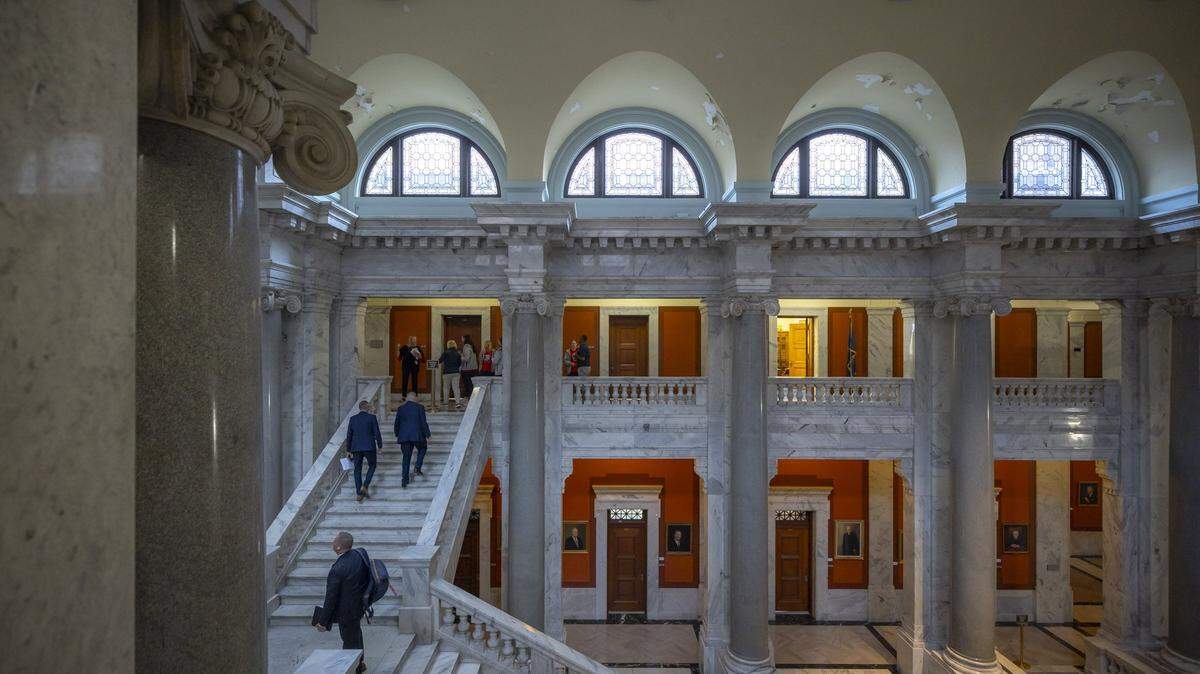
Companies and other groups looking to influence the Kentucky state legislature are spending more and more to try to influence the decisions made and the laws passed in Frankfort.
In 2024, companies and other organizations spent almost $28.2 million on lobbying efforts. That’s up from 2023’s record of $25.5 million.
It wasn’t just a few big names at the top, either.
A total of 502 groups — large and small, private and public, nonprofit and profit-seeking — spent at least $20,000 on lobbying the GOP-led state legislature over the course of the year, according to records filed to the Kentucky Legislative Ethics Commission.
What’s causing the continued jump in spending?
According to those in and around Frankfort, more organizations are learning just how important the state legislature is.
Combine that with the growing cost of doing business in general, the increase in size of the government and the Republican caucuses’ penchant for ignoring Democratic Gov. Andy Beshear, and you get a system that’s grown steadily over the last three years.
“Why is everything going up and we have record spending? Well, the stakes get bigger every year,” former Republican state legislator Adam Koenig said.
“With a dysfunctional Washington, D.C., more and more things happen at the state level every year.”
Last year, one of the more contentious discussions within the Republican caucuses centered around reform of the certificate of need process, which libertarian-leaning Republicans argued violates free market principles while proponents say it’s a lifeline for rural hospitals.
Nine of the top 25 lobbying spenders were related to healthcare, led by the Kentucky Hospital Association, which spent more than $298,000 on lobbying. The group was a major opponent of House Bill 204, which would have reformed the Certificate of Need process.
The hospital association’s total is second in the state only to the Kentucky Chamber of Commerce, the routine leader, which spent just over $461,000.
Another major lobbying power is the energy industry.
Kentucky’s largest private power provider Kentucky Utilities/Louisville Gas & Electric regularly sits near the top of the list of biggest spenders. Last year was no different as it spent $235,000 and was the No. 3 spender behind the Kentucky Hospital Association.
Three other energy groups were in the top 20, with Northern Kentucky powerhouse Duke Energy spending almost $173,000, the Kentucky Association of Electric Cooperatives dropping $146,000 and East Kentucky Power Cooperative spending roughly $128,000.
John Schaaf, former executive director of the Kentucky Legislative Ethics Commission, said that extensive studies point to the benefits of lobbying for companies and other groups hoping to make an impact on the direction of the state legislature.
But that’s become even more prominent with the growing independence of the legislature, he said.
“In the old days, when the governor had much more power than the legislature, all the power was on the first floor (of the capitol). Since the legislature started to take on more power in the 1970s, you’ve seen more lobbyists gravitate toward the chambers,” Schaaf said.
That’s an observation shared by current contract lobbyist and attorney Trey Grayson, who served two terms as secretary of state and later led Harvard University’s Institute of Politics.
He’s seen the tides turn toward the legislature, and towards Republicans like himself, over the course of his political career. In 2017, the GOP took total control over the state legislature when it flipped the state House; and since Beshear took office in 2019, Republicans have increasingly sidelined his role in forming policy and shaping budgets.
“The Kentucky General Assembly is where it’s at,” Grayson said. “It’s the public policy leader in the state. If you want something funded, if you want some policy changed, then you’re going through the legislature.
“We can spend a lot of time talking about whether that’s good or bad, but it doesn’t change the fact.”
Another area where there are many opinions on “good” versus “bad”: lobbyists themselves.
“When you tell somebody you’re a lobbyist, they think you’re gross or corrupt or evil,” Grayson said. “It’s so bad that when somebody asks me what I do, I say I’m an attorney at Frost Brown Todd. I don’t say I’m a lobbyist.”
But Koenig, who is soon to become a lobbyist himself, said they’re necessary for legislators who often lack expertise in certain areas. Legislators, he said, are forced to “be a mile wide and an inch deep” in their knowledge of the myriad policy issues facing the state.
And the groups they represent could include more constituencies than you might think.
A lot of people will say “hey, I’m not represented,” well, you’d be surprised how often you are. Well, I’m a Realtor. We have lobbyists. If you’re a state retiree, you have a lobbyist. All these different job and interest groups have lobbyists,” Koenig said.
Grayson urges citizens to spend some time in Frankfort and get familiar with the process themselves. They’d become more aware of all the groups represented by the lobbying corps, as well as their various causes, he said.
“I always tell people to try and come to Frankfort to see what it’s all about … because lobbyists are evil when they represent somebody or something that you don’t like, but they’re awesome when they represent your side or your cause.”
While lobbying has proven lucrative for several companies, it’s also a lucrative trade for many lobbyists in the state. A majority of the highest-paid lobbyists are what’s called “contract lobbyists,” meaning they work for a firm that represents multiple clients.
Sixty-seven lobbyists made six-figure salaries last year in their efforts to sway the state legislature. Of those, 23 made more than $300,000.
Patrick Jennings, the top lobbyist at Commonwealth Alliances, made the most of any legislative lobbyist at $975,000.
John McCarthy, a longtime lobbyist and National Committeeman for the Republican Party of Kentucky, brought in nearly $796,000.
When including income from lobbying the executive branch — which is less lucrative but still growing — many of the state’s top lobbyists made more than one million dollars last year.
Here’s a list of the top 50 lobbyists in the state and how much money they made lobbying the legislature in 2024, according to Legislative Ethics Commission records.
Patrick Jennings – Commonwealth Alliances – $975,237.70.
John McCarthy – McCarthy Strategic Solutions – $795,552.70.
Stephen Huffman – HCM Government Relations – $773,800.
Bob Babbage – Babbage Cofounder – $738,940.
Sean Cutter – MMLK Government Solutions – $711,173.80.
Jason Bentley – MMLK Government Solutions – $653,889.80.
Ronald Pryor – Capitol Solutions – $646,186.
Kelley Abell – The Rotunda Group – $630,374.30.
Katherine Hall – Commonwealth Alliances – $624,593.40.
Chris Nolan – MMLK Government Solutions – $623,053.80.
James Higdon – MMLK Government Solutions – $615,255.30.
Jason Underwood – Capitol Strategies – $516,600.
Laura Owens – JYB3 Group – $506,000.
Amy Wickliffe – McCarthy Strategic Solutions – $501,358.20.
Mike Biagi – The Rotunda Group – $461,541.
Stephanie Stumbo – Commonwealth Alliances – $400,800.
Trey Grayson – Frost Brown Todd – $384,358.20.
John Cooper – Capital Link – $383,687.20.
Marc Wilson – Top Shelf Lobby – $364,632.80.
Steve Robertson – Frost Brown Todd – $345,178.20.
Rebecca Hartsough – Babbage Cofounder – $325,500.
Timothy Corrigan – The Rotunda Group – $304,372.
Collin Johnson – Commonwealth Alliances – $301,680.10.
Richie Sanders – Capital Link – $294,000.
Julia Crigler – Commonwealth Alliances – $292,767.30.
Leigh Thacker – Top Shelf Lobby – $289,860.30.
Jason Baird – The Limestone Group – $275,491.
Kevin Payton – Top Shelf Lobby – $270,359.40.
Julie Babbage-Laungani – Babbage Cofounder – $267,950.
Sherman Brown – McCarthy Strategic Solutions – $260,177.70.
Dustin Miller – Government Strategies – $259,012.50.
Russ Woodward – Capital Link – $251,840.30.
Ethan Witt – Cornerstone Government Affairs – $245,425.
Tom Underwood (John T) – The Rotunda Group – $242,822.30.
Bart Baldwin – Bart Baldwin Consulting – $237,807.50.
Rusty Cress – Dinsmore – $237,150.
Karen Thomas-Lentz – Commonwealth Alliances – $224,481.70.
Jeffery Busick – McCarthy Strategic Solutions – $215,798.70.
Gus Herbert – Frost Brown Todd – $202,948.80.
John Y Brown III – JYB3 Group – $202,417.
Marie Cull – Cull & Hayden PSC – $186,107.30.
Elizabeth Southard – JYB3 Group – $182,750.
Ellen Williams – MMLK Government Solutions – $168,000.20.
Rachel Bayens – Government Strategies – $162,295.50.
David Whitehouse – Whitehouse Group – $161,640.
Kate Shanks – Kentucky Chamber of Commerce – $157,792.30.
Wes Southworth – Capital Link – $141,366.
Karen Kelly – Cornerstone Government Affairs – $139,075.
Jeff Harper – McCarthy Strategic Solutions – $138,090.
Sarah Bowling – Cornerstone Government Affairs – $125,750.