GOP bills would end gender transition care in KY prisons, codify ‘Women’s Bill of Rights’
A Kentucky Republican has filed a bill barring state correctional facilities from paying for and providing hormone therapy to transgender inmates.
Majority Whip Mike Wilson, R-Bowling Green, filed Senate Bill 2 Thursday to “prohibit the funding of cross-sex hormones and also transgender surgery for our inmates.”
The bill is in response to many Republicans learning in December that the state Department of Corrections had internally promulgated its own regulations, as it’s statutorily allowed to do, for how to treat and care for its 67 trans inmates, who make up 0.5% of Kentucky’s total incarcerated population.
Those standards include providing gender-affirming health care if a doctor deems it medically necessary, which were in keeping with federal guidelines. The department has since said it is drafting new regulations that won’t allow the corrections department to fund surgical interventions for trans people in state custody.
But the new rules will continue allowing the department to dispense gender-affirming medication, like hormones, to trans inmates if it’s doctor-recommended, which is what Wilson’s bill seeks to stop.
Wilson said that there are 467 incarcerated Kentuckians receiving some kind of hormone therapy, but only 67 are receiving cross-sex hormones.
No gender-affirming surgeries have been or will be provided in Kentucky, an attorney for the Justice and Public Safety Cabinet told a Government Contract Review Committee in January.
“I don’t know about you, Mr. President, but I don’t believe our citizens would want their taxpayer dollars being used for those purposes for those that are in prison that are inmates,” Wilson said Thursday. “My gosh, there’s something we need to do to make sure this isn’t happening.”
Senate Bill 2 would ban any government funds from being used in a “cosmetic service or elective procedure,” which the bill defines as gender reassignment surgery or the use of cross-sex hormones “in amounts greater than would normally be produced endogenously in a healthy person of the same age and sex.”
There is a specific carve-out in the bill for the administration of cross-sex hormones in cases where a doctor determines immediate cessation would be harmful to the patient. In that case, the bill directs providers to “systematically reduce” and eventually eliminate the patient’s use of the drug.
Senate President Robert Stivers, R-Manchester, said he fully expects the Senate, a 38-member body that is dominated by a 31-member GOP caucus, to pass the bill. He also criticized the Beshear administration’s handling of the issue.
“(Beshear) started a whole new program, not by regulation but by memo,” Stivers said. “And we know, at this time, 67 people are receiving transgender treatment — not treatments where hormones are used for other procedures or ailments. This is 67 people (that) he just decided, and they’ve done it by memo, not letting it be known in the public domain.”
Wilson announced his bill after Sen. Karen Berg, D-Louisville, addressed comments made by another member of Senate Majority leadership the day before, praising President Donald Trump’s executive order banning trans women athletes from competing in women’s sports.
The National Collegiate Athletics Association announced Thursday it would follow the order.
Senate Majority Caucus Chair Robby Mills, who championed a 2022 bill booting trans girls from competing on middle- and high-school girls’ sports teams, praised Trump’s order on the Senate floor Wednesday as a “victory for fairness, opportunity and the integrity of women’s sports. We are reaffirming what should’ve never been in question.”
Mills remarks earned him applause from members of his party.
Berg, whose trans son, Henry Berg-Brousseau, 24, died by suicide in December 2022, said Thursday she wanted to “put into perspective” the level of effort the GOP is investing in this issue compared with actual number of trans athletes.
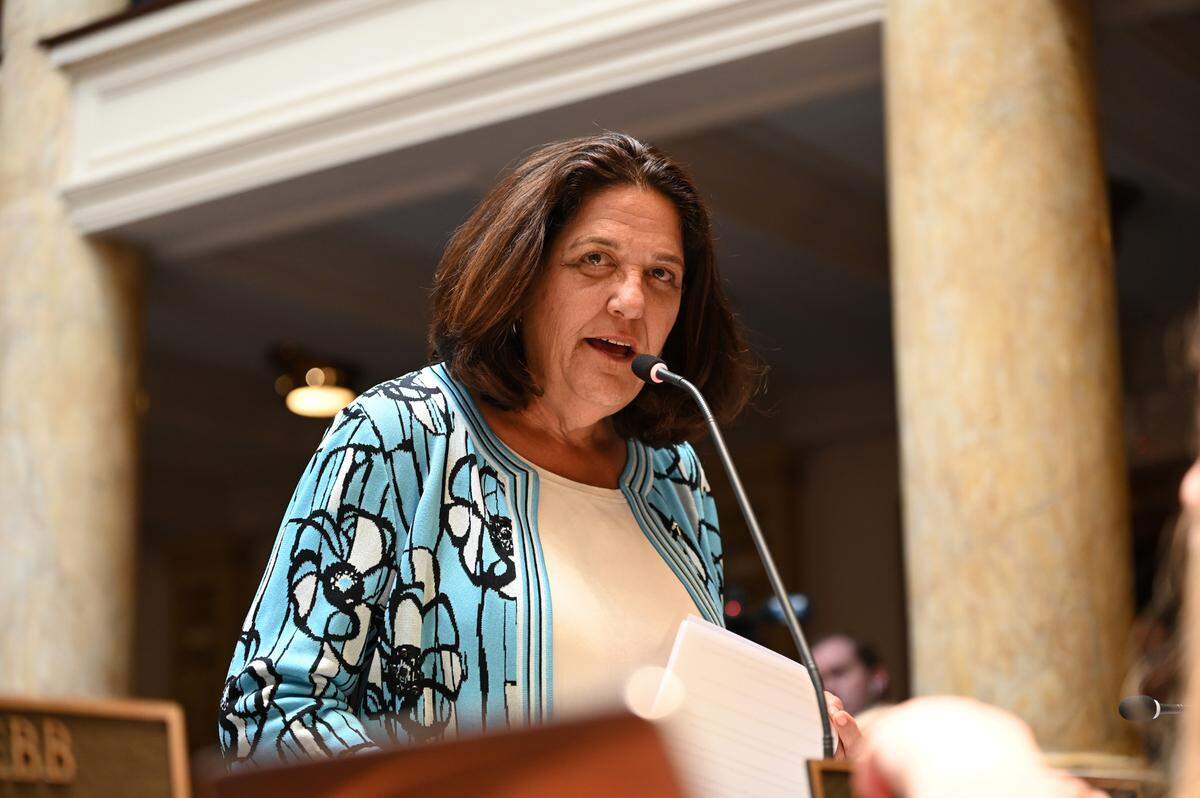
Across the country, there are more than 500,000 athletes competing in the NCAA, and “less than 10 of those athletes identify as transgender. That would be 0.002% of all college athletes in this country,” Berg said.
“On the other hand, we here in Kentucky, out of 1.1 million children, we have 640,000 on Medicaid.”
Berg emerged as one of the fiercest opponents of 2023’s Senate Bill 150, which, among other things, banned gender-affirming care for trans minors in Kentucky.
“I want to make sure the people in this room who applauded yesterday to understand that we have put time, money, energy and effort in this Senate to demonize the smallest, smallest group in this country, when we have 57% of our children in this state in enough poverty to qualify for Medicaid,” Berg added, nearly shouting.
“Let’s talk about the real problems in this state.”
After Berg spoke, Sen. Lindsey Tichenor, R-Smithfield, rose to say she commended “our president for taking the steps he did to protect girls and women and sports.”
Tichenor filed a “Kentucky Women’s Bill of Rights” on Thursday — Senate Bill 116 — that includes definitions for “male” and “female” based on biological sex.
“The fact that we even have one male competing against females to take away their ability to succeed . . . it needs to come to a stop and I’m thankful it has,” Tichenor said.
The question of whether banning transgender women from spaces for women, instead directing them to facilities for men, has been a hotly contested one in recent years. Tichenor’s bill would allow the government to do that.
The bill explicitly allows the state to distinguish between the sexes with respect to prisons and other detention centers, athletics, living facilities, locker rooms, bathrooms, domestic violence shelters and rape crisis centers without violating anti-discrimination mandates.
This story was originally published February 6, 2025 at 4:59 PM.