Republican bill to restrict gender-affirming care for transgender inmates clears KY Senate
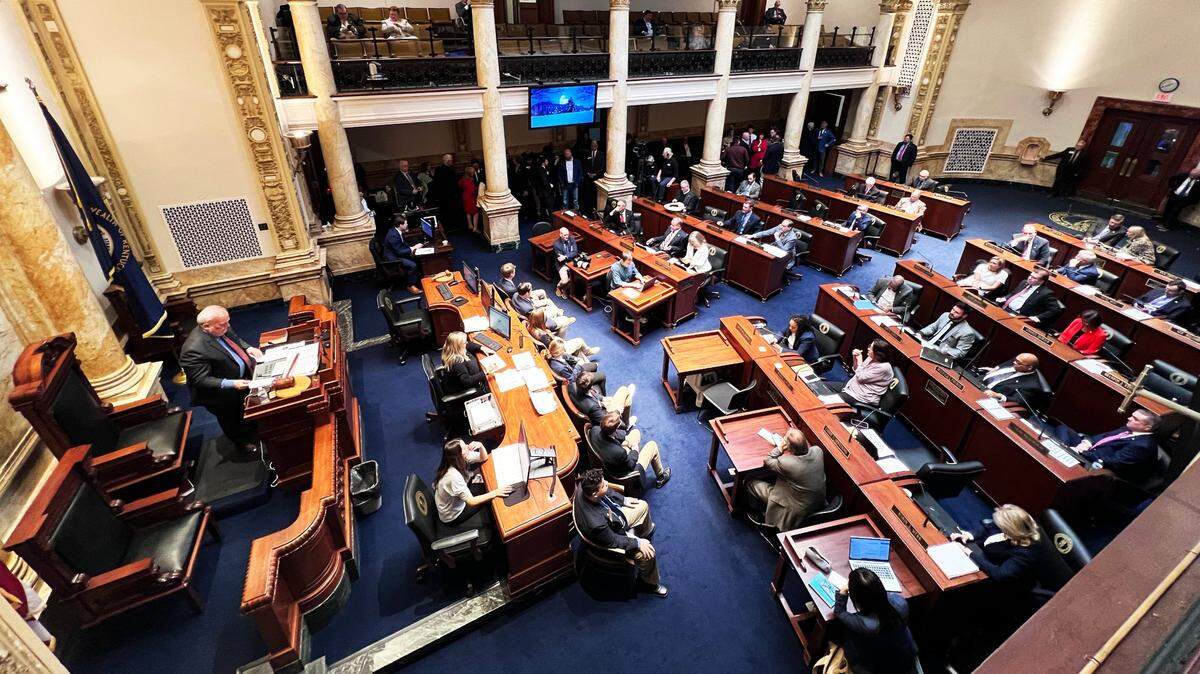
The Kentucky Senate has given the green light to a priority bill to prohibit Kentucky’s jails and prisons from paying for and providing hormone therapy to transgender inmates.
“We are called to make sure that our taxpayer dollars are spent in ways that benefit the Commonwealth of Kentucky,” Senate Majority Whip Mike Wilson, R-Bowling Green, said. “In my opinion, and I’m sure the opinion of many other folks in the Commonwealth, those are not services that benefit the Commonwealth of Kentucky or the citizens of Kentucky.”
Republicans agreed with this logic, advancing Senate Bill 2 largely along party lines, 31-6. Sen. Robin Webb, D-Grayson, voted with Republicans.
The bill now moves to the House, which has a similar version of the bill in Rep. Kim Moser’s House Bill 5.
Opposing Democrats called the bill “fear-mongering,” a “witch-hunt,” blatantly “unconstitutional” — a finding that multiple courts across the country have upheld — and characterized it as a solution in search of a problem.
Wilson’s bill, for instance, blocks the Kentucky Department of Corrections from providing gender-affirming surgeries to trans inmates. But though those guidelines existed for a time, legal counsel with the department testified under oath last month before an Government Contract Review Committee that those surgeries have never occurred in jails or prisons in Kentucky.
The department does, however, provide gender-affirming medication to that population when it’s doctor-recommended, just as the department does with other prescription medications. At that time, there were 67 trans inmates receiving gender-affirming medication — roughly 0.5% of the total statewide incarcerated population.
But Wilson, lead sponsor of the GOP priority bill, has undercut the validity of this type of health care, calling it “elective.” Before a Judiciary Committee meeting last week, he implied the department was lying about not having paid for or provided gender-affirming surgeries.
Sen. Karen Berg, D-Louisville, re-stated this to Wilson on the Senate floor Tuesday.
“I want to make sure the constituents of this state understand clearly and unequivocally: we have never used taxpayer dollars to do gender-reassignment surgery of any sort on an inmate here, nor does anybody have plans to do so,” Berg said.
She also characterized her colleagues on the other side of the aisle as trying to score political points by “picking on” a small subset of Kentucky’s population.
“The question is ‘why are we doing this,’ and honestly the answer is very clear,” Berg said. “We have people in this state who think they can get people to support them by picking on the smallest group of people and continuing to do it over and over again.”
Wilson said the department “stated that none have received sex-change surgeries, however that does not mean they couldn’t, because in their policies they stated they were offering those.”

But the department’s policy in question — Wilson’s reason for filing the bill — did not say the department was providing surgeries. The previous guidelines provided a road map for how staff should respond to such a request from a trans inmate, but characterized surgical intervention almost as a last resort.
The guidelines in question, which the department has since withdrawn as it drafts new regulations — it’s currently adhering to 2018-era guidelines until the new rules are promulgated — outlined an involved step-by-step assessment and care process if an inmate requests a “transgender specific surgery.”
Those steps included an assessment by a mental health provider; a review of the inmate’s current treatment plan; if a provider deemed more medical intervention was needed, recommending the “least invasive treatment options available.”
If more treatment was still needed after those steps were taken, the department would review the request and set the inmate up to be assessed by an endocrinologist. Only if “all possible avenues to alleviate the (gender) dysphoria have been attempted” and still more medical intervention was needed, that assessment would get kicked to an Administrative Review Team, who would then make the “final determination on whether transgender-specific surgery for an inmate be initiated.”
Even though this process existed and the department adhered to it for a time, no gender-affirming surgeries were provided, department staff have repeatedly said.
Sen. Phillip Wheeler, R-Pikeville, said he was voting for the bill because of the existence of the surgery approval process.
“I trust the governor and his words, at least to the extent that he proposed these regulations in a regulatory committee, that, in fact, it’s his intention to carry out these procedures,” Wheeler said. “I don’t know why you would propose regulation that you have no intention to carry out.”
The existence of these guidelines came to the attention of most lawmakers in December, when the department sought advice from the General Assembly on whether it was required to pay for and provide these surgeries in the future. It was a question that stemmed from a need to be in compliance with the federal Prison Rape Elimination Act, as well as “several” federal court rulings that found state jails and prisons who refused to provide gender-affirming medical care to trans inmates were in violation of the 8th Amendment’s prohibition on cruel and unusual punishment.
As such, the department sought an official opinion from Republican Attorney General Russell Coleman on whether it was required to provide surgeries.
“The case law suggests blanket bans on providing treatment deemed medically necessary to inmates with gender dysphoria, or refusing to provide such treatment, give rise to claims for violation of the Eighth Amendment’s prohibition on cruel and unusual punishment,” Kentucky Department of Corrections Commissioner Cookie Crews wrote to Coleman in that Dec. 6 letter.
“Given these cases, the department seeks an opinion on whether the department is required to provide and cover the cost of gender reassignment surgery for a transgender state inmate in a state prison when a medical professional or panel of medical professionals has deemed the surgery medically necessary for the state inmate,” Crews added.
In response, Coleman said the department was not obligated to provide such surgeries. The department heeded that ruling, withdrew that portion of the initial regulations and is in the process of drafting more permanent guidelines.
Republicans have characterized the issue at hand, and need for the bill, as a response to the department’s procedural snafu, and because it was willing to use taxpayer dollars at pay for this type of health care in the first place.
“This bill did not appear in a vacuum,” said Paris Republican Sen. Stephen West, who chairs the Government Contract Review Committee. “It came to our attention the Department of Corrections intended to pay for gender-reassignment surgery” and cross-sex hormones.
On top of that, the department was carrying out this guidance via “memo” and not “authorized regulations,” which West said is “not the proper procedure.”
Wilson said his bill is needed to ensure the department doesn’t offer these surgeries and other related health care “under the cover of darkness, which they had done in the beginning.”
This story was originally published February 19, 2025 at 5:00 AM.