Complaint alleges KY legislative committee violated open meetings law on anti-DEI bill
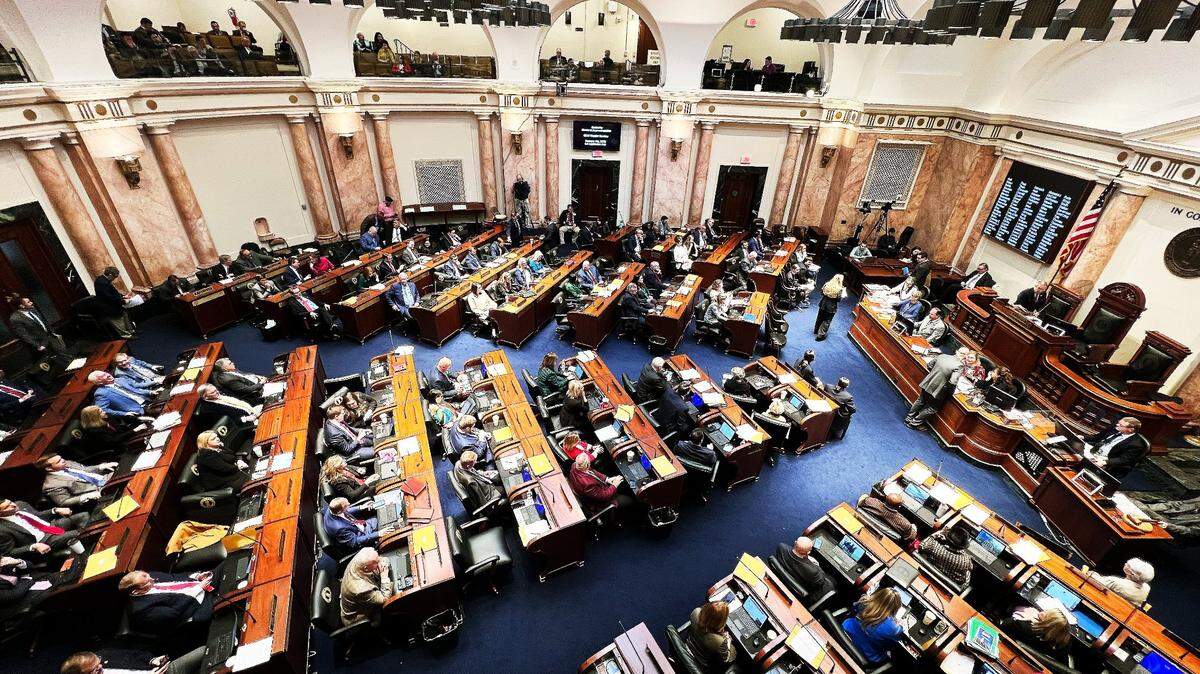
The passage of the Kentucky legislature’s anti-diversity, equity and inclusion bill has been delayed, but not stopped, due to a procedural open meetings issue highlighted by an opponent.
In a letter to legislative leadership, University of Louisville graduate student James Orlick highlighted a potential open meetings violation that occurred during the House Standing Committee on Postsecondary Education’s contentious March 4 meeting.
During that meeting, Republicans advanced one of their priority bills this session, House Bill 4, to dismantle diversity, equity and inclusion initiatives at public colleges and universities. The committee chairman, Rep. James Tipton, R-Taylorsville, held a vote on a title amendment to the bill after he adjourned the meeting.
Orlick wrote in the letter that Tipton violated Kentucky’s open meetings law for holding the vote after the meeting’s adjournment.
The same day Orlick’s letter was submitted, the bill did not get a planned vote in the Senate.
House Speaker David Osborne of Prospect said Tuesday that the House would have to bring it back over for another vote after the Senate approves it.
“It was a hectic meeting, so the chair didn’t realize that he needed to not just reconvene members, and should have reconvened the whole thing,” Osborne said. “I wish somebody had caught it before it happened.”
He implied the oversight is not likely to derail the bill’s trajectory. House Bill 4 was on the Senate’s Orders of the Day on Tuesday, but it was passed over. A Senate leadership spokeswoman said the reason was because of a “technical floor title change.”
Osborne said the title amendment doesn’t affect the content of the bill, but since it was “not properly before the body when we adopted it,” it now means an “extra step” has to be taken in the Senate when the bill comes up for a vote from the full body.
The post-adjournment vote, called for by Tipton, was caught on a video recorded by the Kentucky Lantern, James Orlick notes in his March 11 complaint obtained by the Herald-Leader. Orlick spoke in opposition to the bill that day.
Voting on a title amendment to a bill that’s presented for the first time publicly in committee, while seemingly inconsequential, is still a “constitutionally mandated step in the process of statutory enactment,” Orlick wrote.
At the March 4 meeting, following a lengthy presentation from the bill’s sponsors and questions from other committee members, Tipton allowed only four members of the public to speak on the bill — all were opposed — though several had signed up to do so.
After Tipton audibly adjourned the meeting, some members of the audience began shouting to lawmakers their frustrations over the bill. One woman had to be escorted out by security, the video shows.
“As attendees were removed by security staff and the State Police, (Tipton) could be heard asking, ‘How many members do we have here?’” the complaint says. “And seconds later, ‘We need to do a title amendment. We need to do a motion on the title amendment.’”
An impromptu motion on a title amendment was then made and a vote on the title amendment quickly taken, with some members of the committee already gone from the room.
Orlick alleges Tipton violated the Open Meeting’s Law for voting on a measure after a meeting was clearly adjourned — re-adjourning the meeting would’ve required proper notice to the public — because a quorum was not present.
“The motion made and vote taken after adjournment were therefore of no legal effect,” Orlick writes in his complaint.
“Certainly the titling of a bill — when it’s done, who does it, what formalities must be observed, what are the consequence of reconfiguring the steps in the bill making process — can’t be entirely dismissed,” Amye Bensenhaver, co-founder of the Kentucky Open Government Coalition, told the Herald-Leader.
The point is, she said, the General Assembly and its standing committees are “subject to the open meetings law,” and this committee “violated the law by taking action after adjournment.”
Kentucky law requires them to respond within three business days of the complaint’s filing, which was March 11. “If their response is legally deficient, an appeal may follow.”
Though the committee was voting on an amendment to the title of the bill, rather than the content of the bill itself, “how consequential or inconsequential it is may be an issue the courts decide,” Bensenhaver added.
This story may be updated.