
Some in GOP push to gerrymander out Kentucky’s lone Democrat. Can they do it?

Two powerful Kentucky Republicans suggested this week that Kentucky could move to get rid of its only Democrat representative in Congress.
That came on the heels of Gov. Andy Beshear, during an interview with a Democratic influencer on his podcast this week, lauding the efforts of California Gov. Gavin Newsom.
Newsom has pushed to gerrymander his own state’s map to add Democratic representation in response to GOP-led Texas’ plans to gerrymander theirs at the request of President Donald Trump.
“I wish none of this was happening, but if Texas goes forward, I think that Gavin Newsom is doing the exact right thing in California. If these are the new rules, everybody’s got to play by them,” Beshear said.
That triggered talk in Kentucky: Should Republicans follow what’s happening in Texas?
Republican commentator and Kentuckian Scott Jennings argued on X Thursday night that Beshear’s comments lauding California gave Kentucky Republicans the “green light.”
“Looks like we have the GREEN LIGHT in KY and Beshear will sign it into law, maybe? A 6-0 map is easily drawn,” Jennings wrote, thanking Beshear.
Kentucky’s Congressional District map is currently drawn to favor a 5-1 GOP majority, with only Louisville Rep. Morgan McGarvey’s district winnable for Democrats.
House Majority Whip Jason Nemes, R-Middletown, who played a key role in the last redistricting effort hat took place, responded to the same post featuring Beshear’s comments with an emoji expressing intrigue.
“Interesting comments from the governor,” Nemes told the Herald-Leader in a short statement Friday.
A spokesperson for McGarvey did not offer comment Friday; neither did a spokesperson for state Senate leadership, which would need to back such a move for it to pass.
Earlier this month, a spokesperson for Senate GOP leadership said that redistricting the commonwealth’s Congressional map was a “nonstarter.”
“With the next session being a 60-day budget session, I would give the odds of that happening somewhere around a zero percent chance,” spokesperson Dustin Isaacs said.
Of note is McGarvey’s stature in Frankfort, particularly in the Senate. McGarvey built a reputation of bipartisanship in his decade-plus of service in the Kentucky Senate and made several friends on both sides of the aisle during that time.
Rep. James Comer, who represents the 1st Congressional District, was the only one of Kentucky’s six-member Congressional delegation to respond to a request for comment on the gerrymandering possibility as of Friday afternoon.
The sitting members of Congress of the same party as the state legislature are usually allowed significant input during each redistricting cycle.
Comer’s new district drawn in 2022, snaking from West Kentucky along the state’s southern border, reaching all the way into Franklin County where his family lives, was a subject of criticism at the time.
“I haven’t really thought about it,” Comer said via a spokesperson on mid-decade redistricting.
Kentucky Democratic Party Executive Director Morgan Eaves mentioned Comer’s district in her statement defending California’s response to Texas.
“The Republican supermajority in Kentucky has already engaged in extreme political gerrymandering where families in Fulton County are represented by the same congressman as families in Franklin County. What Texas is doing is bad for democracy, and it requires a Democratic response,” Eaves wrote.
State Rep. T.J. Roberts, R-Burlington, entered the fray Friday, saying in a post on X he is “contemplating options” to redraw the maps this session.
Kentucky’s map as it exists over-represents Republicans in its 5-1 Congressional delegation. There are currently 1,584,000 registered Republicans in the state to 1,389,000 Democrats, with a growing number of Independents and third-party registrants.
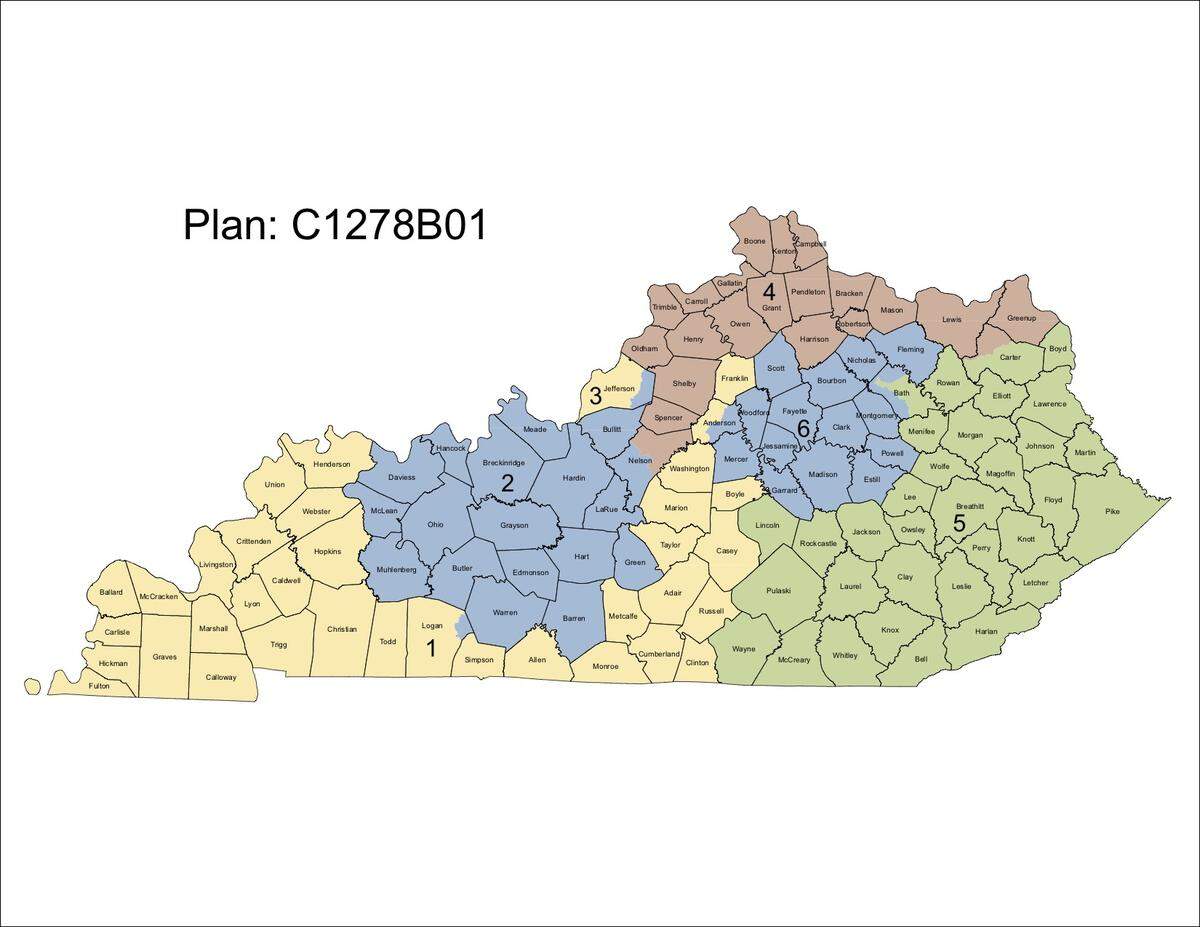
Democrats easily outnumber Republicans in McGarvey’s 3rd Congressional District, 314,000 to 170,000, and slightly outnumber the GOP in Rep. Andy Barr’s 6th Congressional District, 243,000 to 240,000.
The other four districts are predominantly Republican.
Barr’s district, which leans Republican in federal elections but has been won by Beshear twice, is considered the only competitive Congressional district in the state.
The state’s electorate has heavily favored Republicans in recent cycles, picking Trump by 30 points, 26 points and then 30 points in the past three presidential elections, respectively. The state has also elected Republicans to the U.S. Senate by around 20 points during the past two cycles.
Beshear has been the notable exception, eking out a win over former Gov. Matt Bevin in 2019 and then cruising to a five-point victory over former Attorney General Daniel Cameron in 2023.
Of the three prominent GOP candidates for U.S. Senate running for an open seat in 2026, Lexington tech entrepreneur Nate Morris and former attorney general Daniel Cameron expressed support for gerrymandering the map to make it 6-0.
“Hell, yeah,” Morris’ spokesperson said.
Barr, who is also running, did not respond to a request for comment by Friday afternoon.
The process, political problems
While experts agree that a map erasing a safe Democratic seat from the state’s Congressional map is possible, there are logistical issues around the timing and practical issues for the state’s political standing.
For one, the filing deadline for candidates seeking office in 2026 is Jan. 9, just three days after the state legislature is set to gavel in. Lawmakers would likely have to pass legislation both changing the filing period and the maps in a short amount of time after they gavel in Jan. 6.
Though bills traditionally require three days of readings in each chamber, leadership has fast-tracked bills to circumvent this process in the past.
But even then, the governor can sit on a bill for 10 days — excluding Sundays — before acting on it. If he vetoes legislation, the General Assembly would need to override his veto with a simple majority vote in both chambers.
Given that the Jan. 9 deadline would pass before the new maps would be enacted, the legislature would likely need to reopen the filing period for the 2026 election after it initially closed.
For nervous members of the state legislature, many of whom look over their shoulder for surprise challengers near the deadline, this may not be the easiest sell.
Experts who testified for both sides of the 2022 gerrymandering case, where the Kentucky Democratic Party sued over Congressional and state House maps, said a 6-0 map would be easy to draw but be impractical for the state’s interests.
University of Kentucky political science professor Stephen Voss testified for Cameron’s team when he was attorney general, which successfully defended the House and Congressional district maps.
He told the Herald-Leader that redistricting McGarvey out would likely hurt Kentucky, particularly in the event that any legislative chamber in Washington or the White House, all currently controlled by the GOP, flip to the Democrats.
“If you’re solely thinking of the state’s interests, then having a Democrat is better than not having one. That gives your state access to rooms where you otherwise might be absent,” Voss said.
The only obvious benefits, he said, would be for national Republicans adding one seat and for whichever Republican would replace McGarvey.
Voss said that the legality of Republicans carving up the map could hinge on a case currently before the Supreme Court of the United States, where self-identified “non-Black” voters are challenging the drawing of maps based on race.
That could come into play with Louisville’s Jefferson County, Kentucky’s largest county which is about 21% Black, he said.
Devin Caughey, a political science professor at the Massachusetts Institute of Technology and expert witness for the Kentucky Democratic Party in the 2022 suit, said that a 6-0 Republican gerrymander would be “relatively safe” for Republicans to pursue if they wanted to.
He added that he thinks gerrymandering in general is bad for democracy.
“There are lots of things that politicians can do that aren’t explicitly illegal that are to their political advantage — everything from blocking wholesale nominees to the Supreme Court or other nominations,” Caughey said.
“But people have held back, historically, because they knew it would lead to this spiral that’s bad for everyone in the end.”
This story was originally published August 22, 2025 at 2:17 PM.