
KY revenues miss mark to cut income tax, Beshear says budget shortfall possible
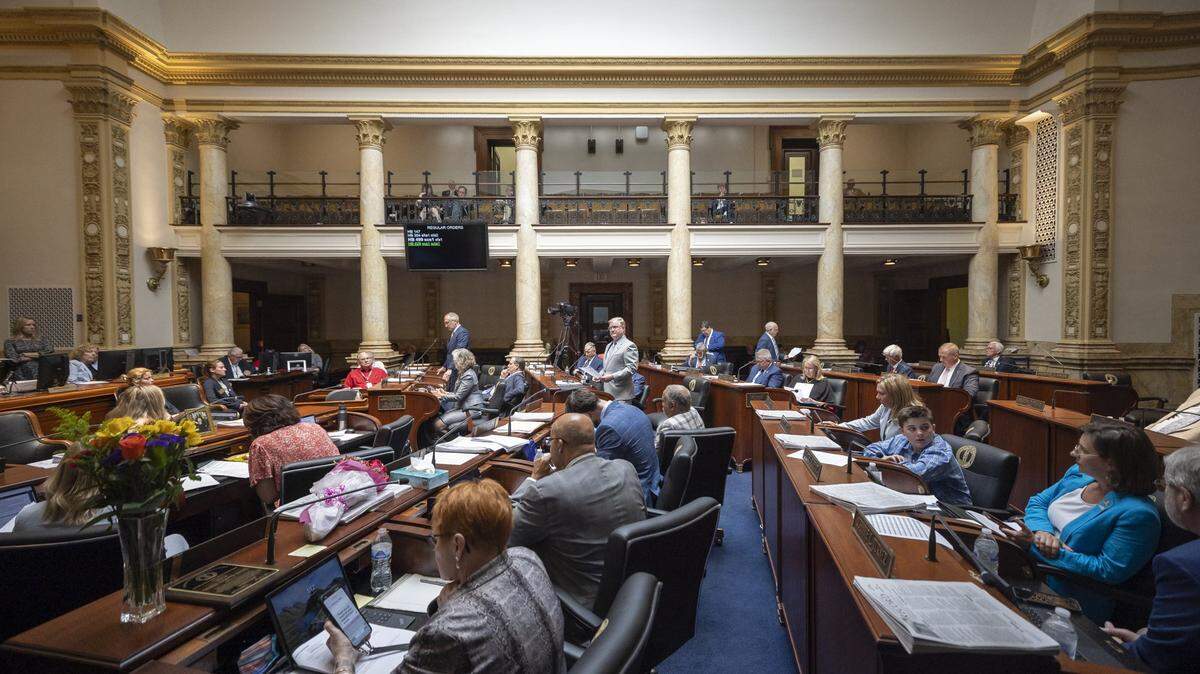
Kentucky tax revenues fell just shy of the mark set to cut taxes by another half-percent as Gov. Andy Beshear also warned this week of a state revenue shortfall.
The state fell just $7.5 million in revenue short of the mark it needed to “trigger” a tax cut from 3.5% to 3% in 2027, based on the formula set by the GOP-led legislature in its effort to reduce the state’s income tax, according to Senate Appropriations Chair Chris McDaniel, R-Ryland Heights.
That $7.5 million is a drop in the bucket compared to last fiscal year’s $15.7 billion in revenue.
Still, McDaniel said he didn’t foresee that the legislature would ignore the trigger system and move forward with a cut.
“I struggle to see us saying ‘it’s close enough,’ just because we gave ourselves particular targets that we wanted. The disciplined approach has served us well, and I don’t think I necessarily see us wanting to get away from that,” McDaniel said.
While the triggers weren’t hit this year, they were met one year ago, allowing the General Assembly to pass a tax cut from 4% to 3.5% on Jan. 1. The triggers factor in the size of the state’s Budget Reserve Trust Fund and the pace of revenues into the state’s General Fund, which is fueled largely by the sales and income taxes.
Beshear added at a weekly press conference Thursday that revenues are expected to decrease enough to cause a shortfall, blaming both economic uncertainty caused by President Donald Trump’s tariffs levied against imported goods as well as the state tax cut set to take place Jan. 1.
A shortfall occurs when actual revenues received are lower than projected revenues.
Revenues for the current fiscal year, which runs from July 1, 2025, to June 30, 2026, are set to drop $359 million due to the income tax cut.
“There is concern that there will be a shortfall this year in total revenue collected. There are two reasons for this: First, federal tariffs and the uncertainty surrounding these tariffs are directly impacting our spending and our economic activity. Second, the cut to the income tax rate is going to cost the Commonwealth $359 million for this fiscal year,” Beshear said.
Beshear said that he’s asked State Budget Director John Hicks to convene the Consensus Forecasting Group, a group of economists that make state budgetary projections, on Sept. 16 to to update the forecast this fiscal year.
The governor has been a fierce opponent of the tariffs imposed by the Trump administration, speaking against them in several national media outlets. Beshear has not been shy about a potential run for the Democratic presidential nomination in 2028, though he’s said he won’t make a decision until the close of the 2026 elections.
Beshear himself was a proponent of the personal income tax cut from 4% to 3.5%, though he’d opposed earlier cuts.
McDaniel expressed confusion at Beshear’s insistence to convene the Consensus Forecasting Group ahead of schedule and didn’t agree with the governor’s harsher outlook.
“There’s no economist right now whatsoever that can tell you what any of these impacts are going to be. Because, A: they’re still being adjudicated in the courts. And B: the executive branch hasn’t finished negotiating. Once those two things happen, businesses have to start making their decisions about what they’re actually going to do. So until you have all of those things happening, you just can’t get to a point of certainty on these things,” McDaniel said.
If the revenue situation were the same one year from now, it’s likely that the state would have hit a different trigger to cut the income tax by a smaller percentage thanks to a law passed tweaking the formula during the 2025 legislative session.
Starting in the 2027 legislative session, the General Assembly will be able to cut the personal income tax rate by increments of .25% instead of the half-percent it’s allowed to now. By 2029, under the new law, the legislature can cut taxes by as little as .1% if certain smaller triggers are hit.
The legislature had also previously changed its rules to lower the income tax rate by exempting $2.7 billion in one-time spending from being considered in the formula.
The Kentucky Center for Economic Policy, a progressive think tank, has long opposed cuts to the state’s personal income tax, warning that such a shortfall — and, eventually, cuts to services — was inevitable.
The center’s executive director, Jason Bailey, called news that the state would miss the trigger “a small sigh of relief” for those who rely on state programs like public schools, but the expected shortfall as proof positive that the previous income tax cuts have caused harm.
“Kentucky began this tax-cutting experiment at a unique moment in history. Federal COVID stimulus spurred huge increases in state tax revenue while pandemic-induced inflation made those increases seem bigger than they actually were,” Bailey wrote. “That period, where there seemed to be ‘extra money,’ has now ended. Making huge permanent tax cuts based on temporary conditions was always a losing bet.”
Even if the shortfall is confirmed, it’s possible the legislature wouldn’t need to cut spending. For one, the Budget Reserve Trust Funds — also known as the “rainy day fund” — is expected to have about $3.7 billion at the end of this fiscal year.
McDaniel emphasized that the Republican-led Senate won’t stray from its conservative principles in crafting the state’s two-year budget next year.
When asked if the legislature might replace funding cut from the federal government for organizations like Kentucky Educational Television, which just cut 22% of its staff because of federal cuts, McDaniel said those groups shouldn’t expect the state to step in.
“There has not been much discussion, but I think that everybody ought to keep in their mind that if they were relying on federal funding, they should not count on state funding back filling it. They will have to figure their way out of it, because, honestly, the state general fund, depending on what all happens, can’t absorb all of this,” McDaniel said.
One area that does need to be addressed, he said, is the low-income food assistance program SNAP. The recently passed “One Big Beautiful Bill,” the marquee budget legislation supported by Congressional Republicans and Trump, shifted administrative costs and costs related to error rates onto the states.
“We’re going to have to pick up the administrative costs, and we’re going to have to eat the error rates on it. There’s no mechanism other than for us to do it,” McDaniel said.
This story was originally published September 5, 2025 at 2:03 PM.