Teachers in 40 Kentucky school districts got no raise this year, report says
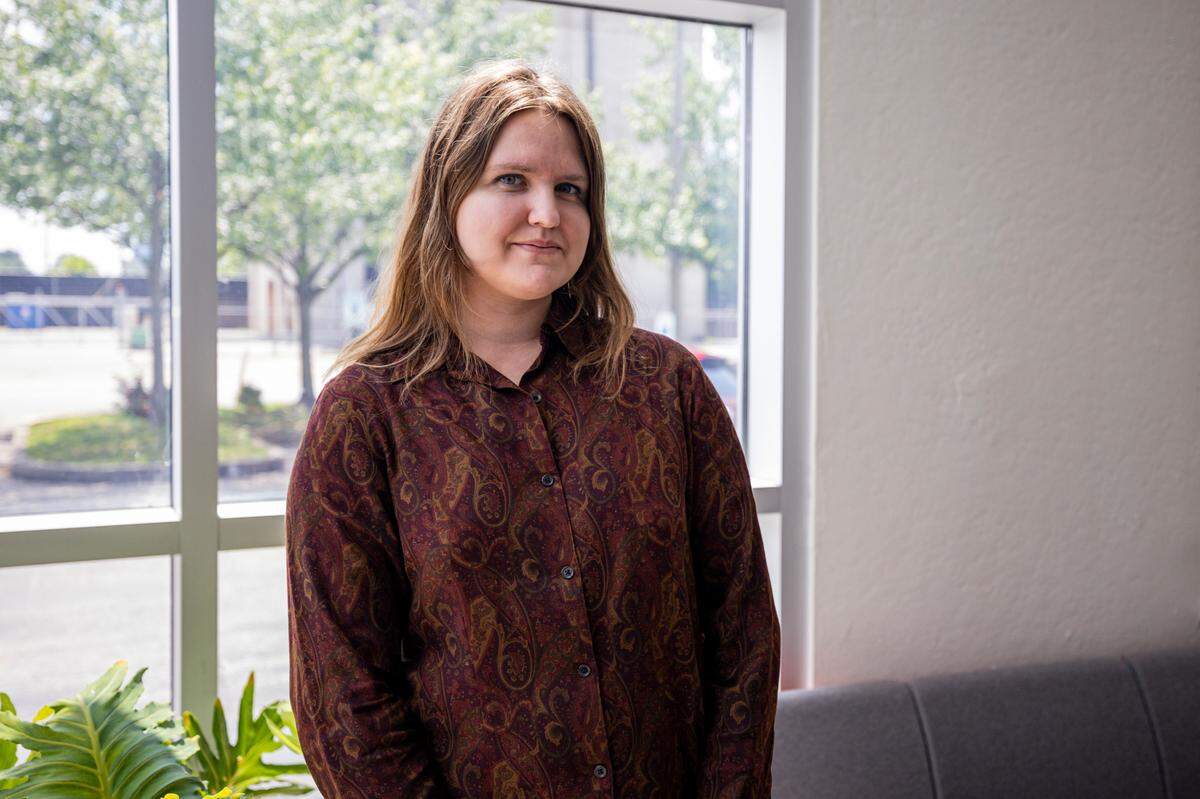
Greta Gilbert, a music teacher of 20 years, spent the end of her summer break preparing her classroom at Adams Middle School in Floyd County for the new year.
She used earnings from several side jobs — technology coordinator and academic coach at the school, as well as music director at a local church — to freshen her classroom with an electric neon treble clef, a fixed saxophone, new music stands and a wireless microphone, so her voice can reach her 40-student classes.
She paid for those expenses out of pocket despite working in one of 40 Kentucky school districts where teachers received no raises this year, according to an August report from the Kentucky Department of Education.
She’d like to live up to the careers her mother and grandmother had as teachers in the same Eastern Kentucky district, and she doesn’t mind spending some money to do it. But she wishes the state would help, too.
“There needs to be a state-mandated raise for all school employees, like Gov. (Andy) Beshear has proposed a few times,” Gilbert said.
Beshear has tried unsuccessfully in recent years to raise teacher pay. During his first gubernatorial campaign in 2019, he promised to raise salaries by $2,000. In late 2023, ahead of the 2024 General Assembly budgeting process, he proposed an 11% pay raise.
The Republican-dominated legislature has not backed the two-term Democrat’s proposals.
The annual KDE report showed that teacher raises in Kentucky this year were inconsistent by district and mostly below the rate of inflation — 2.9% for the year ending in August — according to an analysis from the Kentucky Center for Economic Policy. A spokesperson for Beshear’s office said he remains “education first” but did not comment on plans for this year’s budget proposal.
Fifty-five of Kentucky’s 171 school districts gave teachers raises smaller than 2%, according to the Kentucky Center for Economic Policy analysis. Forty-two gave raises between 2.01% and 3%, and 34 gave raises of more than 3%.
Teaching advocates are urging the state to step in and increase funding for school districts, including for teacher salaries.
Maddie Shepard, president of the Jefferson County Teachers Association, pointed to voters’ overwhelming 2024 rejection of Constitutional Amendment 2, which would have allowed state funds to go to non-public schools, as proof of Kentucky residents’ support for public schools and teachers.
“Voters all said that in 2024, we want our school systems to be great,” Shepard said. “It is a shared responsibility. It absolutely is the responsibility of the local county, and it is the responsibility of the state.”
Shepard joined a group of educators in early September to ask the state for a $718 million boost to the Kentucky education budget next year. She said the funds could be applied to adjust inflationary pressures on a wide range of needs, including teacher salaries and equipment like buses and Chromebooks.
Jason Bailey, executive director of the Kentucky Center for Economic Policy, said the state budget last earmarked raises for educators across Kentucky in 2008. He also noted voters’ rejection of Amendment 2.
“The voters spoke loud and clear on the constitutional amendment last year. They want their public schools to be the priority,” Bailey said.
Education Committee Chair Sen. Steve West, R-Paris, said he’d consider adjusting the state’s funding formula to give more money to poorer school districts next session. But he cautioned that more money doesn’t necessarily make for better schools.
“You need a high-quality teacher, and you need a smaller class size. If you do those two things, you get down the road a pretty good distance, and just because you have more money doesn’t guarantee either one of those things,” West said.
Gilbert knows firsthand how economic investments could improve her teaching and her life. Though she’s worked in the district for years, she’s watched newer teachers shuffle in and out as the state’s teacher shortage rises.
According to a report from Kentucky Legislature’s Office of Education Accountability, 10.9% of teachers who worked in Kentucky in 2022 did not return to teach in the commonwealth the following year, marking an increase from a decade prior. Factors cited in the report included inadequate funding that led to low pay and poor working conditions.
Rep. Lisa Willner, D-Louisville, who is on House committees for both K-12 and postsecondary education, said handing educational control over to local school boards still has challenges. She pointed to the law passed in 2021 that made it easier to recall district tax hikes, which are one of the few ways for local districts to raise teacher salaries themselves.
She said she plans to push for boosting the state’s education budget next session, and she pointed to several other industries, like bourbon and horseracing, that face no difficulties obtaining tax breaks from the Legislature.
“We seem to have plenty of funding to give tax breaks to extremely wealthy industries and corporations, and the fact that we’re not appropriately funding our schools, providing enough funding for teacher raises, is to the detriment of our entire state,” Willner said.
If Gilbert, the Floyd County music teacher, moved two hours away to Fayette County, she’d make $20,000 more, according to the salary schedule for someone with her experience and graduate school credentials.
It’s a nice idea, she said. She wouldn’t have to work extra jobs at the school and in the community. Fewer groceries would go on the credit card, and she’d have more free time.
But with children and family roots tying her to the area, she wishes the state would help. Other professions, she said, don’t have to buy their own supplies.
“We get more desperate every year,” Gilbert said.
This story was originally published October 2, 2025 at 5:00 AM.