Grossberg tries again to dismiss ethics case, block access to medical records
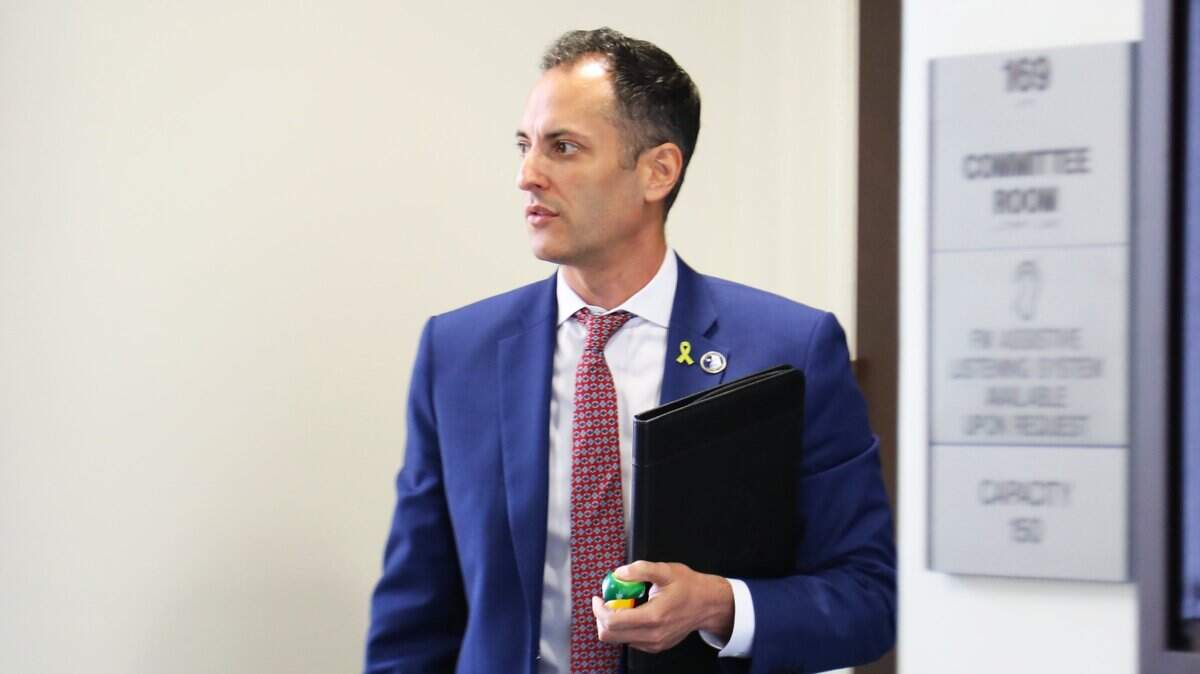
Embattled state Rep. Daniel Grossberg is attempting for a fourth time to have ethics charges against him dismissed.
The Louisville Democrat’s first three tries were unsuccessful. Along with his latest attempt, filed in October, Grossberg also seeks to block his medical records from being included in the evidence considered in the Kentucky Legislative Ethics Commission’s ongoing investigation.
A commission representative said they will consider Grossberg’s motions at the Dec. 2 meeting.
Grossberg had previously filed two other motions to dismiss with the commission earlier this year, as well as a lawsuit in Franklin Circuit Court in July. A federal lawsuit teased by Grossberg and his legal team this summer had not been filed as of Nov. 24.
Some of Grossberg’s actions being investigated by the commission were first publicized in 2024 in the Herald-Leader, which detailed in a series of stories a pattern of inappropriate interactions with women and his lifetime ban from a Louisville strip club for trying to touch a dancer on stage.
The commission found probable cause in July that Grossberg violated the state ethics code on three different counts, and the commission is planning a public hearing on the matter in the near future.
Grossberg has denied any impropriety.
Those counts include intimidation of the Louisville strip club that banned him for life; attempts to solicit a donation from a Subway restaurant owner in exchange for a benefit; and his 2023 conduct toward Emma Curtis, now a Lexington city councilwoman, who says the behavior was sexual harassment.
Grossberg’s counsel, Frankfort attorney Anna Whites and Louisville litigator Thomas “T” Clay, wrote in their motion to dismiss that key exculpatory evidence is missing, Grossberg lacked proper training, the evidence against him is not adequately substantiated, and bias against him has clouded the investigation.
The commission’s investigator, attorney Robert Jenkins, responded that their motion was “replete with shock and awe allegations of no value” to the three violations. It improperly attempts to reframe the case by injecting claims of bias, unrelated allegations, and accusations of misconduct by complainants, Jenkins wrote.
Dispute over Grossberg medical records, diagnoses
The Herald-Leader reported extensively on Grossberg’s conduct toward women in 2024, including his encounter with Curtis, who alleges Grossberg had several alcoholic drinks and asked sexual question after he invited her to his office one evening after a legislative committee meeting.
The Herald-Leader also reported on controversy around Grossberg’s behavior in college and the incident that led to his lifetime ban from a Louisville strip club.
In addition to his motion to dismiss, Grossberg and his attorneys filed a motion to quash attempts by the commission’s counsel to get his mental health and medical records.
In addressing the Curtis incident and other reporting about his behavior toward women, Grossberg and Whites have cited his neurodiversity, including ADHD, placement on the autism spectrum and Tourette syndrome.
Jenkins said the reports provided by Grossberg were inconsistent — with Tourette syndrome not appearing until later, among other things — and that some reports were unsigned and authored by a doctor who hadn’t had an active medical license since 2019.
Grossberg’s reluctance to turn over his full medical records could throw those statements about his diagnoses in doubt, Jenkins said.
Whites responded during the commission’s Nov. 18 meeting that the reports were sufficient and that “you should rely on your elected officials when they testify about a very difficult, personal thing to say.”
“The community of people across the commonwealth who suffer from those conditions is so grateful that somebody who is successful at a high level can admit, ‘Hey, I have terrible ADHD, I have Tourette’s, I have neurodiversity conditions, and it impacts my life, and I’m working on that.’ That’s what he said,” White said. “I don’t think we need to question it further than that, and we certainly don’t need to delve into decades of mental health records.”
The next step is a public adjudicatory hearing. That hearing, which can function like a jury trial, complete with testimony, discovery, and opening and closing arguments, was initially set for Dec. 2, but has been postponed, according to commission staff. No official date has been set.
In addition to Grossberg’s motions to dismiss and quash, Jenkins filed two of his own: a motion to compel release of Grossberg’s medical records and what’s called a motion “in limine,” which seeks to set parameters for evidence that can be considered during a proceeding.
Jenkins sought to exclude evidence related to motivations of the complainants.
Jenkins said at the Nov. 18 legislative ethics commission meeting that he’d call in as many as 30 witnesses if motivations were an issue because he’d “bring in everybody” who brought complaints about Grossberg to the commission. He also sought to exclude claims of discrimination against Grossberg and allegedly biased media coverage.
In a document filed to the commission bemoaning coverage in the Kentucky press, Whites and Clay falsely claim that a Herald-Leader reporter is a “close friend” of Curtis.
Grossberg’s team argues that the exclusions would strip him of meaningful defense, because motivations of the complainants tie to their credibility, and the environment fostered by Democratic leaders at the time is relevant to his own actions.
In his own motion in limine, Grossberg sought to redact full pages of deposition transcripts with former House Democratic leaders Rachel Roberts and Cherlynn Stevenson where either of them “references, names or defames any other state legislator or former state legislator.” The motion accuses them of “viciously attacking” sitting legislators and even accusing colleagues of crimes.
Jenkins responded curtly: “There is almost no truthful statement in that paragraph.”
What was said in the motions, at the meeting
The Legislative Ethics Commission meeting on Nov. 18 occasionally got testy as Whites and Jenkins both defended their many motions.
One of Whites’ key points was that Grossberg believes his training was inadequate, and the culture of the Democratic caucus was so lenient that he would not have known any better than to have an interaction like the one described by Curtis.
Whites mentioned that leaders said in depositions they’d occasionally have drinks in their offices, that campaign checks were exchanged in offices and that a leader “texted her feet to various married men.”
Jenkins said Grossberg still should have known better.
“She speaks of legislators not being trained how to act. I believe we all pretty much know it’s not a good idea to have five to eight shots of alcohol and ask someone in their office about their sexual habits, about their sexual organs,” Jenkins said.
Whites said Grossberg did not have as many alcoholic drinks as has been claimed. In the meeting, she said he would bring the shot glass to prove it at the public hearing.
“I think Mr. Grossberg was clear it was a half-size shot glass, if that. He will produce it at the hearing — and that’s, you know, four to six drinks over four or five hours. He’s gonna bring the shot glass,” Whites said.
Grossberg is also seeing an addiction specialist in Louisville, according to the records his team provided. Last September, after the Herald-Leader’s reporting on the Louisville strip club that banned Grossberg over his conduct, the lawmaker told News Radio 840 WHAS in Louisville he was “in treatment to help reduce my impulsive behavior going forward.”
Whites and Grossberg have repeatedly blamed Grossberg’s actions on a series of medical disorders, including in a September 2024 Herald-Leader op-ed penned by Whites.
In the piece, Whites criticized fellow Democratic lawmakers who initially requested an ethics investigation and the women who’d spoken out against Grossberg as needing “training in understanding and working with peers with ADHD, Autism Spectrum Disorders and other neurodiverse behaviors.”
She added that her client was “receiving training and coaching in understanding social cues and workplace behavior from trained professionals.”
As part of the commission’s investigation, Jenkins subpoenaed Grossberg’s medical records confirming those diagnoses and proof of treatment. But Whites and Grossberg attempted to block that effort, saying the records aren’t necessary and part of an ongoing effort to “ignore or disparage the diagnoses, and to pressure and harass” Grossberg.
“It is public knowledge that persons with ADHD, Tourettes and Autism Spectrum Disorders may act in a way that is mildly unusual or lacking in understanding of social cues,” Whites wrote. “Rep. Grossberg has provided documentation from both his treating therapist and physician who diagnosed him 20 years ago and has treated him ever since as to all diagnoses and symptoms.
“Those actions are clearly present in the description of him and his actions. It does not take medical or clinical expertise to see those symptoms,” Whites added, citing the reality TV show “Baylen Out Loud,” which follows a young woman living with Tourette syndrome, as one of the reasons Grossberg’s medical records should not be turned over.
Jenkins didn’t mince words in his responses.
“The first report we had made reference to ADHD and neurodiversity. The second report we had a year later mentions Tourette’s,” Jenkins told Whites at the meeting. “There’s been considerable discussion about autism. Nobody’s talked about autism on the medical records. The records in and of themselves are contradictory.”
In his 10-page written response, Jenkins said Grossberg “is incorrect” in arguing that “his health care information is not relevant” to the commission’s investigation.
“The health care conditions at issue are ADHD, neurodiversity, Tourette’s and autism. There is no medical record discussing autism, although (Grossberg’s) counsel has repeatedly referenced it. There has been no discussion of Tourette’s until (Grossberg) submitted a medical record dated Oct. 15, 2025 . . . (and) there is no current treatment record of any health care provider for the ADHD or neurodiversity,” he wrote.
Jenkins broadly cast doubt on Grossberg’s claimed diagnoses and ongoing treatment. He called one of Whites’ claims that Grossberg has turned over medical records showing continued treatment for any of his diagnoses “almost entirely 100%, categorically false.”
Additionally, one of the doctors Grossberg and Whites have said is treating him has not had an active medical license in Kentucky since 2019, according to the Kentucky Board of Medical Licensure.
Grossberg “squarely placed his physical and mental condition before the commission. He has also made conflicting statements about those conditions,” Jenkins added. “So, it is time to put this issue to rest: has he actually had ongoing treatment as alleged? The medical ‘records’ do not support that statement.”
Editor’s note: Lawyers for Rep. Daniel Grossberg claimed in a document filed with the Legislative Ethics Commission that Herald-Leader journalist Austin Horn and Emma Curtis, a Lexington councilwoman and Grossberg complainant, are “close” friends. Horn and Curtis attended preschool together in Kentucky, but they have not maintained a personal relationship in the past 20+ years.