
Q&A: KY Rep. Hal Rogers on work in DC, why he’s seeking reelection at 87
With 45 years in Congress and at 87 years old, Rep. Hal Rogers is proud of his longevity in Washington.
In a 40-minute interview with the Herald-Leader, Kentucky’s 5th Congressional District representative touted his accomplishments in those 4 1/2 decades, said there’s still work to be done and asserted he is in excellent health, rebuffing growing concerns that many American politicians are too old for their demanding jobs.
First elected in 1980, the Republican is dean of the U.S. House, a designation reserved for the longest continuously-serving representative of the 435 in the chamber. He has filed for re-election to a 24th term to his office in 2026. He’d be 89 when sworn in January 2027.
Seated in the House Committee on Appropriations hearing room in Washington for the interview, where his portrait hangs among dozens of past committee chairs, Rogers said his years of service are an asset to his Eastern and Southern Kentucky district.
“This place here runs on competition, but it also runs on longevity,” Rogers said.
“I sit at a big table thanks to longevity. Otherwise, I wouldn’t be there on behalf of my people. So, I welcome people inspecting my record, my qualifications, my capability, my sanity. I welcome that. But in the end, I’m able to bring things home to East Kentucky by sitting at that table.”

Rogers’ 5th Congressional District includes the vast majority of Eastern Kentucky as well as his home county of Pulaski and a few surrounding counties. Since well before Rogers’ time, the counties in his district ranked among the poorest in the country.
That hasn’t changed much, relative to the rest of the country, in recent decades. The district has the fourth-highest poverty rate of all 435 in the U.S., and the second-lowest median household income.
It ranks among the most reliant on both Medicaid and SNAP, two programs hit with significant cuts in the “One Big Beautiful Bill Act,” which Rogers supported this summer in a narrow 218-217 vote.
That was not an easy vote, Rogers said.
“Yeah, I sweated it. I’ve got a poor district,” Rogers said. “And yet, the president and our party (were) so solid for this bill, and it would do a lot of good things, but I worried about the poor people and their housing and health care.”
He said he became convinced the bill would help the district secure more projects down the road, and “we would then have plenty of time to perfect the health issues.”
The 5th Congressional District gave President Donald Trump a 64-point margin of victory in 2024, the second-highest of any district in the country.
The interview was one of few Rogers has done in the lead-up to 2026. The Herald-Leader first requested an interview with Rogers on Sep. 17. The congressman’s team pushed the interview back several times, citing the federal government shutdown, before later arranging one for Dec. 11.
Rogers speaks slowly. The congressman sometimes referenced notes during the interview, and was reminded of a couple items by a staffer, but answered most of the questions — particularly those on the district and politics — without assistance.
At 88%, Rogers’ congressional vote participation in 2024 was slightly lower than the average of 94.7%. In 2022, he was one of a few members with perfect attendance on all yea or nay roll call votes.
A Democratic opponent, Prestonsburg attorney Ned Pillersdorf, is the first member of the opposing party to run a vigorous challenge to Rogers in decades. He has made hay of what he sees as a lack of activity from Rogers, his advanced age and, most of all, Rogers’ vote for the “One Big Beautiful Bill Act.”
In all 23 of Rogers’ election cycles, only once, in 1992 after state Democrats significantly redrew his district, did an opponent come within single digits. Every other cycle has been uncontested or a 30-plus point blowout.
Rogers offered a pithy assessment of the anticipated 2026 matchup.
“Well, I think I win.”
Answers are lightly edited for length and clarity.
H-L: You’ve explained your vote on the “One Big Beautiful Bill” before, but I’m wondering, was it a difficult vote for you, given that it’s the biggest cut in spending we’ve seen to Medicaid?
Rogers: Yeah, I sweated it. I’ve got a poor district. And yet, the president and our party were so solid for this bill, and it would do a lot of good things — but I worried about the poor people, and their housing and health care. But I became convinced that this bill would help us with water and sewer projects, tourism projects, autism centers, other health care projects, curbing the drug abuse epidemic, creating new jobs. I thought the overall impact of that bill would give us a lot of things that we need, and we would then have plenty of time to perfect health issues, which I think we will.
H-L: When you say that it would help with projects, do you mean projects included in the bill, or do you mean that a “yes” vote means that projects you’re working on would be better received (by House leadership), as opposed to if you had voted no?
Rogers: Well, I think it would have helped us purify the health care aspects of the bill and perfect Medicaid and Medicare — especially Medicaid, where there’s widespread fraud, that’s now becoming evident in places like Minnesota. But we’ve got a long way to go on health care. We’re nowhere near a conclusion.
(According to the Center for Medicaid Services, the improper payment rate for Medicaid was about 5.1% from 2022 to 2024.)
H-L: When you say that, what are some of the health care changes that you’d like to see going forward – tweaks to what we saw in the bill?
Rogers: Well, I’m going to reserve judgment on those issues because they’re in flux. They’re being discussed even as we sit here.
(Two proposals to deal with expiring COVID-era subsidies to the Affordable Care Act, a Republican plan to fund health savings accounts and a Democratic-led one to extend the subsidies, failed in the Senate on Thursday.)
.jpg "IMG_0596 (1).jpg")
H-L: There are tons of rural hospitals in your district. I was born in one. And I’m sure you know, the Kentucky Hospital Association is none too happy with the final version of the bill, and they say that it could cause hospital closures. I’m curious what you make of that. Do you think they’re wrong in their projections, or do things need to change in the next few years?
Rogers: I want to be a little open-ended on it, because it’s in flux. But I helped put in the bill a $50 billion fund to support rural hospitals. That falls short, but it’s a start. I hope as we go along that we can perfect the bill. The House version of that bill would have been better for our rural hospitals, and that’s what my goal was. That was rejected in the Senate, so we’ll have to work on it as we go along, and I promise I’ll do that.
H-L: Like Medicaid, your district is uniquely reliant on SNAP funding as well, and we saw a lot of that cost get deferred to the states and general cuts. Is that something you want to see change going forward? Would you like more money restored to the SNAP program or do you agree, generally, with the cuts?
Rogers: We’ve provided...
(Rogers’ spokesperson mentioned at this time that SNAP funding was secured through the next fiscal year, ending Sep. 30, 2026. That is true of the monthly benefits that transfer to EBT cards. Administrative costs, however, are set to run out Jan. 30, setting up states to pay more.)
H-L: What’s something you hope to deliver for Eastern Kentucky, specifically, this upcoming year?
Rogers: There are several earmark projects in the works. We’ve included them in the House versions of the funding bills, and I hope that we can keep them in the final bill when it’s finally finished.
One thing I’ve found interesting: My district is not only poor, but it’s afflicted with so many different huge problems, dating all the way back to the state’s beginning. We lost the timber industry around the turn of the last century. We’ve now lost, of course, the tobacco program, which was the backbone of rural counties. We have been impacted in a huge way by the drug overdose problem, lack of jobs, the demise of the coal industry, flooding, fires and all sorts of huge problems.
As they came about in my time, I tackled them, asking local people to share in the ideas about how to solve it, and incorporating them in an organization that keeps going and going and going. Consequently, I started a movement for economic development in the mountains, the hill country and SKED — South Kentucky Economic Development — recruiting business and industry. UNITE, fighting the drug problem. It’s the biggest and only summit on overdose deaths in the country.
We, Gov. Steve Beshear and I, decided to call a summit, an economic summit for my district to talk about “what can we do in view of this new era that we’re in where we’ve lost the coal industry.” That grew into what’s called SOAR, Shaping Our Appalachian Region, which is a joint effort of Governor Steve Beshear and me to this day. They’ve got money, we’ve been able to get them money, and they’re tackling the issue of an economic development, essentially to merit activities across the whole region, and it’s opened people’s eyes. They’re willing now to look across county lines and see a friend rather than a competitor or enemy.
H-L: It’s no secret that you’re the oldest voting member of the U.S. House right now. I’m curious what you make of, in recent years, more scrutiny over politicians who are more advanced in age, largely because of the president?
Rogers: It’s a democracy we live in. And I’m the longest-serving House member, not the oldest.
(Laughs)
H-L: (I meant) voting, but I know Eleanor Holmes Norton (a non-voting member representing Washington, D.C., who is facing calls to drop out from a 2026 reelection bid) is older. Did you have any reaction when it was all in the news about President Biden’s age and his struggles with that? Did you think that was fair or not fair?
Rogers: I thought it was fair. This place here runs on competition, but also it runs on longevity.
(Points at committee chair behind him)
I sit in that chair there as a representative of my people, and I got there by hard work, and staying with it and earning points as we go. You get experience by serving in a slot, and I sit at a big table thanks to longevity. Otherwise, I wouldn’t be there on behalf of my people. So, I welcome people inspecting my record, my qualifications, my capability, my sanity. I welcome that. But in the end, I’m able to bring things home to East Kentucky by sitting at that table. I got at that table, by hard work and diligence and staying there, sitting there and making them work with you.
H-L: I don’t mean to be intrusive with this question, but I assume you’re in good health? I ask, because the President has routinely offered his own analysis of himself, and he says he’s passed physicals and mental evaluations. Have you gotten a good bill of health and have physicals all checked out?
Rogers: I am. I wouldn’t be asking for reelection if I weren’t in excellent health.
H-L: You’ve filed for this upcoming cycle. I assume you are fully committed to running for reelection? There’s no chance that you withdraw this cycle?
Rogers: No.
H-L: Is there a scenario where – not this cycle – you could see yourself not running for reelection? Do you think when the time comes you’ll be able to make that decision, or do you intend to serve for the rest of your life?
Rogers: I haven’t decided.
(Laughs)
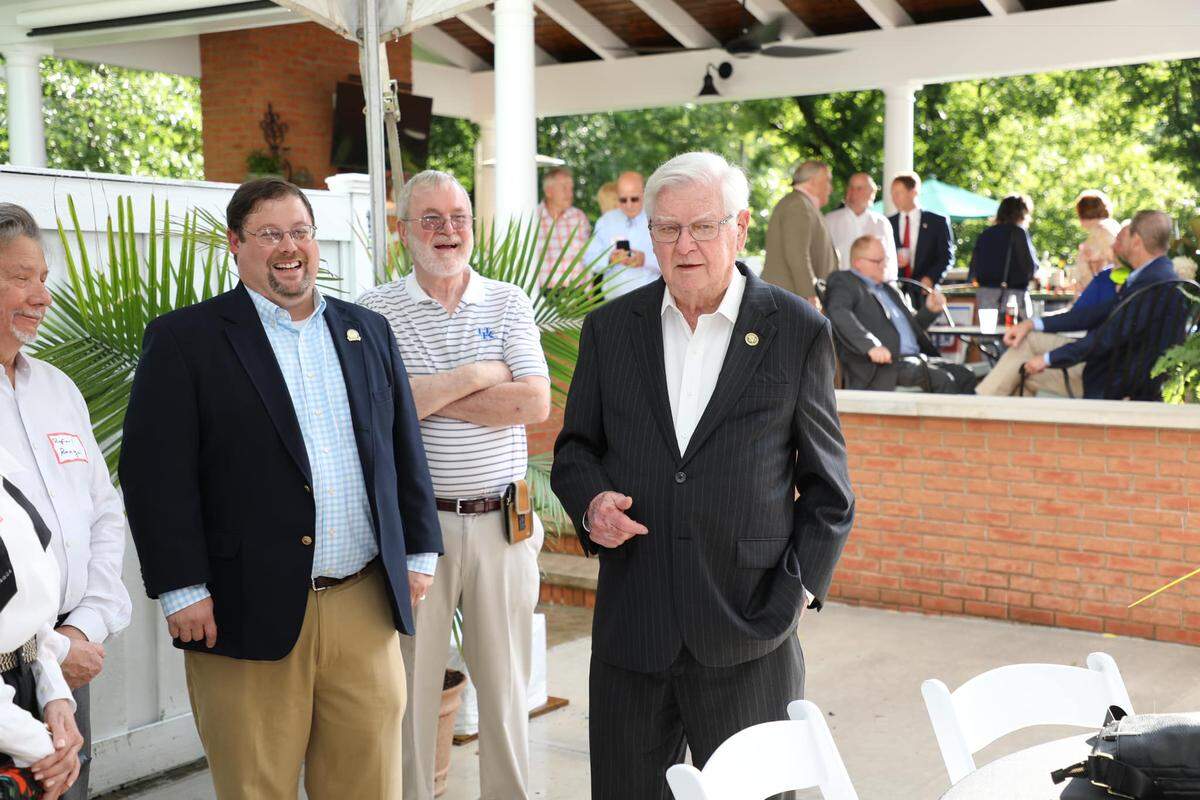
H-L: When you look back at what you’ve done, what do you want to be remembered for in Eastern Kentucky?
Rogers: I can’t do it with one term, but I’m really proud of all of them. The flood control projects on the Cumberland, which was in my old district. When I first took office in January of ‘81, I asked the (Army) Corps of Engineers to helicopter us the length of the Cumberland River, all the way from Harlan County to Cumberland falls. Those towns would flood almost every year, so I asked the corps: “Show me what you could do if you had the money toward controlling flooding?” They pointed out Pineville, Middlesboro, Barbourville, Harlan, Williamsburg, and so forth. So, we went to work, then, finding the money for one project at a time until we finally have finished. During these recent floodings in the mountains, the Cumberland did not flood — well, it flooded, but not effectively. So that’s a source of great pride: that we tamed the Cumberland.
Then, about that same time, the state legislature in redistricting gave me half, roughly, of the old 7th mountain district and three more flooding rivers. So, we’ve started now work on those rivers: Kentucky, Licking, Big Sandy, Tug Fork. We’ve got some projects on the West Virginia line, lifting homes out of the floodplain and trying to make life livable for those people. But we’re just getting started on those projects, and that’s going to take a lot of extra work over the years. I’m determined that we will tame those rivers as well.
I’m also proud of the tunnels at the Cumberland Gap. That has done more to attract and accommodate traffic than any single project that I have done.
H-L: Do you think Eastern Kentucky is where it needs to be right now? It’s improved over the years, but it’s still, relatively, a poor district, as you said — particularly the Eastern Kentucky parts of the Fifth District.
Rogers: No. It keeps getting hit with enormous impact — flooding, fire, mudslides, lack of jobs. That’s been my 46-year crusade: jobs for East Kentucky to try to keep us from losing more of our good people moving away.
Out of high school in Wayne County, 1955 I followed an older brother to Cincinnati looking for a job. There was a recession on. I was 17, and I was unable to get a job and climb out of the region, but I devoted myself then to trying to curb that problem, to try to keep more of our young, really well-educated, smart young people. We keep losing them, and my goal was to try to stop that problem. That remains so 46 years later.
H-L: There’s no silver bullet for economic development, as you know. You’ve been talking about a bunch of different things, but what’s happening right now that gives you hope about the future of Eastern Kentucky? And why should other people feel hope about the future of the region?
Rogers: I think the continued excellence in teaching and training our young people, in school and out, one. And two, I’ve been working, and I see new evidence of that work, of an attitude change in people’s minds: They’re now willing to work across county lines. That’s been, historically, a real problem for us, of being so intransigent on working with their neighbors. We’re seeing that change. I’m seeing a new feeling about the region, and what we must do, and we’re beginning to see a lot more young people stay at home and develop a business or a way to make a living that they weren’t willing to do a few years ago. So, I’m feeling some good.
H-L: if you were Emperor Hal and you could wave a magic wand and make anything happen to revitalize Eastern Kentucky, whether that’s make a bunch of roads appear with a snap of a finger, or anything else, what would you do?
Rogers: What I’m doing. I’ve put together a program called SEED, where we’ve hosted eight symposiums with federal contractors and local manufacturers. We spend so much money, zillions of dollars on federal defense, and I want to see more of those contracts, for supplies for the military, awarded to local manufacturers — and we have plenty of them.
One of the most recent successes from that program was GE’s announcement of $150 million investment in Kentucky, including a supplier in my district, Jones Plastic and engineering in Williamsburg. That’s developing some jobs. SOAR last year earned a $40 million EDA grant for their Eastern Kentucky Runway Recompete Plan to connect folks to resources and training for new jobs. We spend a lot of effort in the economic development arena, hoping to attract jobs and holding more of those good high school graduates at home. That takes a lot of my effort and time and attention.
H-L: The Letcher County prison has been an effort of yours. What makes you confident that it will get done, and it will get done soon, given that it’s been years we’ve gone through presidential administrations
Rogers: Well, it’s written in the funding bill for the Department of Prisons.
H-L: Should we look at coal as a viable jobs engine in the future, or is it time to move on given the way the numbers have gone in recent years?
Rogers: Well, the marketplace is going to decide that, and we don’t see much activity going on. If it happens, it happens only because the market provides a place for you to sell that coal. So we’ll see what develops there. I stand ready to help when we can.
H-L: What do you make of Ned Pillersdorf? It seems to be the first time in a while that a Democrat is running with any kind of vigor. What do you make of his candidacy, and how do you think the election is going to turn out?
Rogers: I’ll take the last question first.
H-L: And what’s your answer to the last question?
Rogers: Well, I think I win.