
Kentucky bill would allow doctors to decline care ‘on basis of conscience’
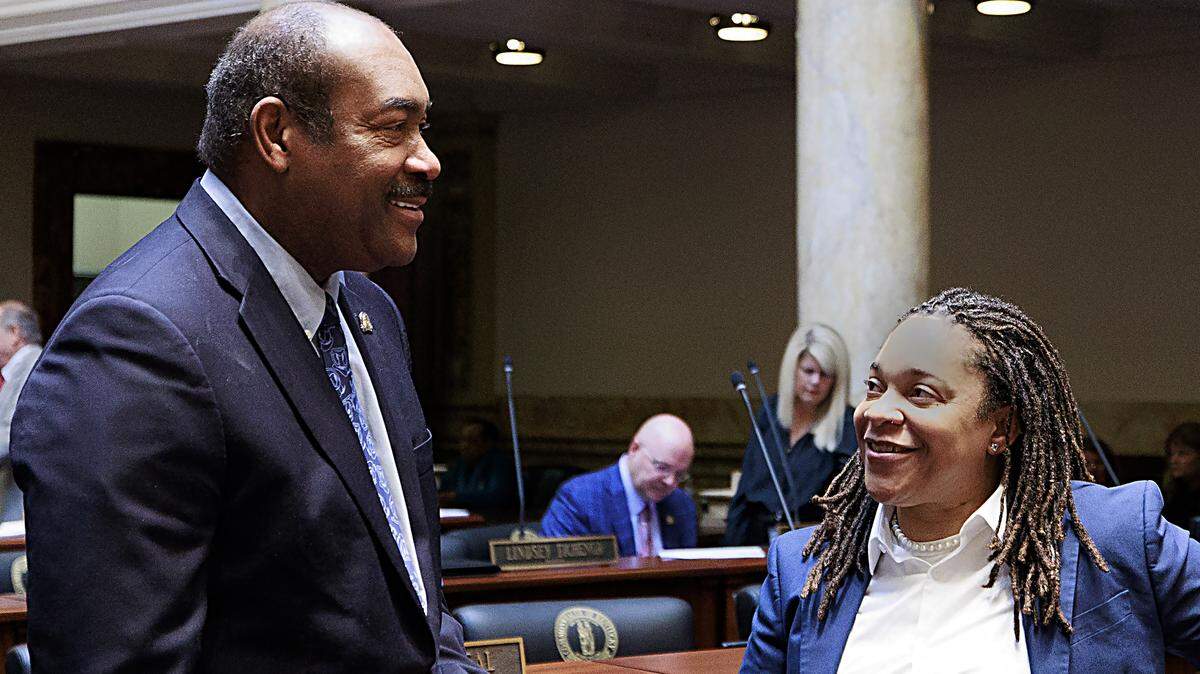
A Republican bill codifying health care providers’ “right to refuse to participate in any health care service which violates (their) conscience” passed along party lines out of a Senate committee Wednesday morning.
Senate Bill 72, pitched as a physician recruitment bill, grants providers and institutions with what sponsor Sen. Donald Douglas, R-Nicholasville, referred to as “medical conscience” rights.
In the bill, conscience is defined as “sincerely held religious, moral, or ethical principles held by a health care professional or a health care institution.” A similar bill from Douglas, who is a physician, passed the Senate last year but did not receive a vote on the House floor.
“It is a tool that says to a healthcare provider who wants to come into our Commonwealth that we welcome you for your dedication and your hard work for serving the public. Even though we’re going to continue to expect the highest level of professionalism from you, we will honor your individuality as a person and your values, just like we do everybody else,” Douglas said.
The bill includes an emergency clause, meaning it would take effect immediately upon getting the governor’s signature or the legislature overriding his veto.
Many opponents of the bill sounded the alarm that it would hurt patients of all political and cultural stripes, particularly those in the LGBTQ community, giving providers broad ability to decline care. The bill passed 8-2 out of the Senate Health Services Committee Wednesday, and now goes to the Senate.
Critics also said it shifts the paradigm of who is protected — the patient in need of care or the provider administering that care.
“This bill would, in fact, shift the protections of patients to become the protections of providers. And religiously held discrimination, or, shall we say, ‘sincerely held religious beliefs,’ is a notoriously inaccurate, hard to govern, difficult to discern method. It really does open the door to anyone saying, ‘I don’t want to, because I don’t want to.’” Kent Gilbert, lead pastor at Union Church in Berea said during the meeting.
Douglas pointed out that the bill includes an exemption for emergency medical treatment.
When pressed by Sen. Karen Berg, D-Louisville, who is also a physician, on what examples he’d cite where a provider might exercise their medical conscience right under the bill, Douglas said that he’d been in clinics where the owners change prescriptions that are written for patients, implying that he wouldn’t go along with that.
The list of health care services that could be denied by a professional under the bill include: referral; testing; diagnosis; dispensing or administering any drug, medication, or device; psychological therapy or counseling; record keeping procedures; creating medical records and notes related to treatments; prognosis and therapy.
Chris Hartman, executive director of the LGBTQ advocacy group the Fairness Alliance, said that the scope of the bill is far too broad.
“A receptionist could refuse to check in a patient wearing a MAGA hat, a custodian could refuse to clean an interracial couple’s room in the maternity ward or an unmarried mother single mother. A pharmacist could refuse to provide HIV prevention drugs. A nutritionist could refuse to serve a gay patient, and they could sue the hospital if they get moved to a different shift or if any disciplinary action is taken,” Hartman said
He added that if lawmakers are concerned with abortion, there is already a statute allowing them to opt out of that procedure, which is essentially banned under Kentucky law.
‘Patients are the ones who suffer’
Bridget Pitcock, a Louisville nurse, testified that she thinks delays in care due to the bill — with patients having to seek another provider willing to provide care — could hurt health outcomes.
“Delays don’t just affect one person. They have lifelong consequences and public health implications,” Pitcock said. “As health care providers, we take an oath to do no harm. That oath does not change based on who the patient is or what someone believes. Religious and political beliefs do not belong in the exam room. When belief overrides evidence, patients are the ones who suffer.”
Douglas said that forcing physicians to go against their beliefs to carry out care undermines trust in a well-respected profession that makes critical decisions every day. “We’re not construction workers, folks,” he said, highlighting the level of training required to become a physician.
“I’m tired of us taking our most highly trained, our most intelligent, our most dedicated people, and telling them ‘You don’t have proper morals,’ which is what we’re telling them,” Douglas said. “And we’re also telling them that ‘my morals trump yours, because I wouldn’t do the things that you’re going to do.’”
Joining Douglas in presenting the bill was Greg Chafuen, senior counsel for the conservative Christian advocacy legal group Alliance Defending Freedom. Current U.S. House Speaker Mike Johnson got his entry into politics working for Alliance Defending Freedom. Lawyers with the organization, which wrote the model for Mississippi’s anti-abortion legislation, which was challenged and eventually led to the overturning of Roe v. Wade in a 2022 U.S. Supreme Court case.
The Alliance Defending Freedom has successfully passed similar bills in Tennessee, Idaho, Montana and elsewhere.
Douglas made the point that giving providers an out from performing medical care they disagree with could improve care.
“This bill protects those who wish to follow their strongly held conscious beliefs, as long as it does not put others in danger or even interfere with the rights of others,” Douglas said. “There are always other health care providers that they can use as options, that the patient can seek — and after all, no patient wants a healthcare worker, especially a physician, to do something they’re not comfortable doing, or do something that they’re not trained to do.”
Douglas also said that opposition to the bill was informed by unwarranted “fears” and emotion. He argued that patients are responsible for most medical outcomes, not providers.
He added that providers shouldn’t be criticized for not wanting to go along with “psychosocial changes” in society.
Sen. Steve Rawlings, R-Union, said he had heard from University of Kentucky College of Medicine students concerned about “their conscience rights,” who decided to move to Florida, where a similar bill is state law.
“I don’t see this as a withholding care type of bill. This is about recruiting doctors and upholding their conscience rights,” Rawlings said.
Sen. Danny Carroll, R-Paducah, voted for the bill, but expressed a desire to narrow it.
“I struggle with the fact that I’ve not received one phone call from any physician my district,” Carroll said. “It’s not that I disagree with the moral connotations of this ... I think maybe a narrowing of this bill would be in order to address, maybe, elective procedures that would be in conflict.”