
KY considers lifting repeat residency requirement to help recruit foreign-trained doctors
This story was first published in the Kentucky Lantern.
A Republican lawmaker is proposing a partial solution to Kentucky’s doctor shortage: Let international physicians practice in their specialty area — after completing board exams — without having to repeat residency training in the United States.
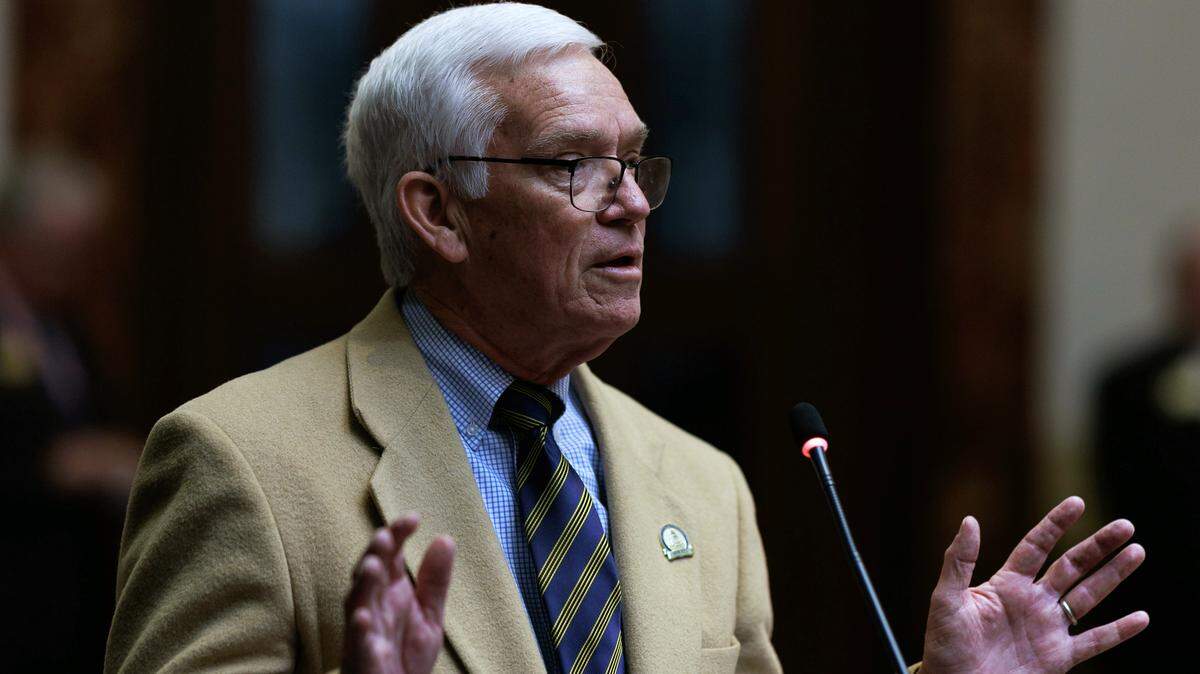
Doing so would also free up domestic residency slots and expand that training capacity, Senate Bill 137 sponsor Sen. Stephen Meredith, R-Leitchfield, told members of a health services committee Wednesday.
Adam Meier, director of health policy at the nonprofit Cicero Institute and former Republican Gov. Matt Bevin’s pick to lead the Cabinet for Health and Family Services, echoed this.
“These residency slots are finite, and so for every time we fill a residency slot with an IMG (international medical graduate) who’s already had residency, who’s already completed residency, we’re taking that slot away from a domestically trained physician who could fill that. … It does really increase the supply in a way that’s really leveraging our finite resources better,” he said.
An August 2025 report from the Legislative Research Commission found that Kentucky will have a shortage of nearly 3,000 physicians by 2030. Most — 107 of Kentucky’s 120 counties — are designated as health professional shortage areas.
In these areas, there are around 3,500 patients per provider, according to a 2024 analysis from the Cicero Institute.
This problem “is serious,” Meredith said, and it “will become more serious in the future.” Already, health care provider shortages are “quite pronounced in rural communities.”
Under SB 137, internationally trained physicians would not have to repeat residency training in their area of specialty but would have to pass board exams and be sponsored by a Kentucky employer.
The bill passed out of committee 10-1 and can go to the floor.
These physicians would have to demonstrate English proficiency, have completed medical school and residency, have worked at least five years as a licensed physician and be in good licensing standing in their origin country.
‘I have concerns’ and ‘implicit bias’
Sen. Lindsey Tichenor, R-Smithfield, the lone no vote, said she was worried about “the opportunity for developing countries — doctors coming from certain countries — that don’t have the high standard of medical licensing and the potential for false licenses to be offered.”
“I delivered a baby in a third world developing country,” Tichenor said. “My doctor was a foreigner. She was German. She did a great job. I also had some dental work done in that foreign country. They were nationals. It led to me having to have surgery in the United States. So, I have concerns about that.”
She did not specify the country to which she referred.
Meredith, a former hospital CEO, said no hospital would open itself to liability risks by sponsoring someone who wasn’t fully vetted and qualified.
“This is radically different from just filling out a job application and wanting to go to work,” he said. “Credentialing is a very structured process, and bear in mind that no provider wants to expose themselves from a professional liability standpoint, and they’re not going to take shortcuts.”
He also pushed back on the quality concerns.
“There’s as many bad American-trained physicians as there are foreign-trained physicians,” he said. “And the real litmus test comes from the actual care of the patients. You find out very quickly what they’re like.”
Sen. Keturah Herron, D-Louisville, suggested an addition to the bill “for implicit bias training or diversity training” to ensure “culture competency” among staff and to “make sure that they are not being treated unfairly or different from patients and/or their other coworkers.”
“When we’re talking about bringing folks from other countries and bringing them to our rural communities,” Herron said, “there may be some prejudice or thoughts from patients, but then also other employees.”
‘Wasting’ talent
Dr. Erica Gregonis, the chief medical officer at Baptist Health Richmond, said the growing physician shortage is “a multi-factorial problem.”
“One, we have an aging population, creating more demand,” she said. “We also have an aging physician population.”
When international physicians come to Kentucky, they currently have to redo their residency training, she said. Some will choose to not go through that “rigorous” and “redundant” process.
“We are really wasting one of our most valuable assets in this country: Fully trained physicians,” Gregonis said. “When I got done with my training, I was in my mid-30s. You think about that. We only have so long to work. If we’re asking them to repeat training that is redundant, we are wasting that very valuable asset.”
Should Kentucky make this change, it would join at least 17 other states that have enacted similar changes, according to a 2025 American Medical Association report.
This story was originally published February 25, 2026 at 4:20 PM.