KY legislature sends Gov. Beshear bill authorizing tax credits for school aid

AI-generated summary reviewed by our newsroom.
- Kentucky Senate approved HB 1 to enroll state in federal tax credit scholarship program.
- Bill directs donations to Scholarship Granting Organizations for student aid.
- Democrats warn diversion of federal funds is illegal, could weaken public services.
Kentucky’s General Assembly gave final passage on Friday to a high-priority Republican bill that would authorize federal tax credits in exchange for donations to private school scholarships.
The Republican-majority Senate voted overwhelmingly and mostly along party lines — 33-to-5 — for House Bill 1, sending it to Democratic Gov. Andy Beshear for his signature or veto. Only one Democratic senator voted for the bill: Keturah Herron of Louisville.
Beshear hasn’t revealed his plans for the bill, but he has criticized its intentions. Tax dollars should not go to private schools, despite GOP lawmakers’ repeated attempts to route public money in that direction, he said through a spokeswoman earlier this week.
“In 2024, Kentuckians overwhelmingly voted that public dollars should only go to public schools,” Beshear spokeswoman Scottie Ellis told the Herald-Leader.
“Last week, the Kentucky Supreme Court agreed in a landmark ruling,” Ellis said, referring to a decision striking down a 2022 charter school funding law. “Filing House Bill 1 hours after the ruling shows that Republican legislators refuse to listen to Kentuckians as they try to find a workaround to push their own agenda.”
If Beshear does veto the bill, the legislature’s Republican super-majorities likely could override his veto without difficulty.
Under the bill, Kentucky would join about two dozen other states enrolled in the federal Education Freedom Tax Credit Scholarship, established last year by Republican President Donald Trump.
The program allows people to receive a credit of up to $1,700 on their federal income taxes for contributions they make to Scholarship Granting Organizations, or SGOs. The SGOs use that money to provide scholarships or otherwise cover school-related costs for children attending public or private schools.
To be eligible, children must come from a household with income not greater than 300% of the area’s median gross income. In Lexington, for example, median household income is $69,479, according to the U.S. Census, so 300% of that would be $208,437.
Under the bill, Republican Secretary of State Michael Adams would be Kentucky’s “point of contact” with the U.S. Treasury to manage the state’s list of approved SGOs.
State Sen. David Givens, R-Greensburg, estimated that Kentucky could generate $400 million a year for the program, if 1% of Kentuckians who owe federal income taxes make a $1,700 donation to an SGO.
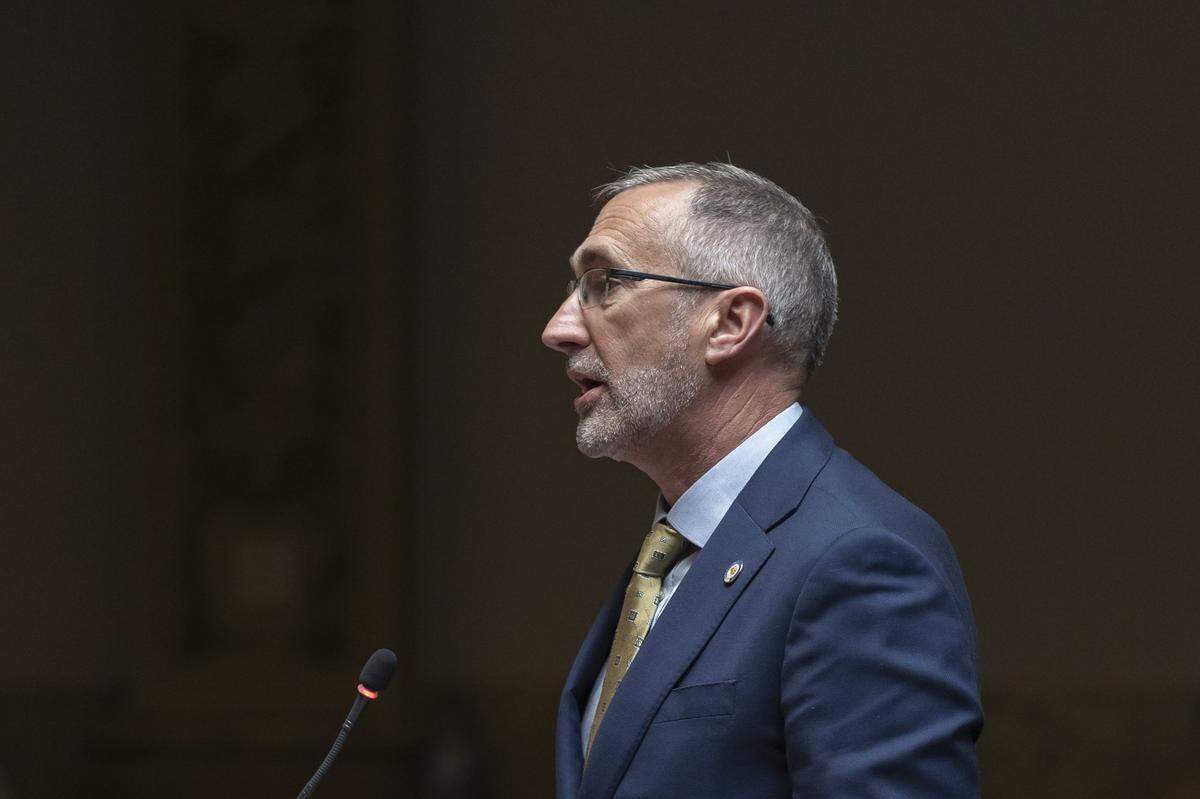
“For some families, this could mean using scholarships to pay for private school tuition at a school they choose,” Givens told his colleagues on the Senate floor Friday.
“Other students will benefit from buying the equipment or uniforms needed for a career training at a secondary school, while other families may seek a scholarship for tutoring or for after-school enrichment programs,” Givens said.
The legislature has a responsibility to help more than just public schools, Republican senators said.
“The whole deal about us, you know, only using taxpayer funds for public schools — every single one of us pays tax dollars. We all pay tax dollars. So as we all pay tax dollars, shouldn’t we have a choice of where our taxpayers dollars go for education?” asked state Sen. Mike Wilson, R-Bowling Green.
“We need to be able to educate all of our children,” Wilson said. “Not just care about public school children, but all of our children.”
The handful of Democratic senators warned against draining money from the federal government to subsidize private schools. If the legislature really wants to help Kentucky children, they said, it can put more state funding into K-12 public schools and support Beshear’s request for statewide pre-K for 4-year-olds.
The House bill will “lessen our federal budget and weaken our support for such essential programs as Social Security, Medicare, Medicaid and food stamps,” said state Sen. Reginald Thomas, D-Lexington.
Thomas warned that Kentucky’s urban “Golden Triangle” of Louisville, Lexington and Northern Kentucky would enjoy the most benefits from House Bill 1. Unlike rural counties, he said, the metro areas have established private and religious schools that easily can pivot to take advantage of a fresh revenue stream.
“This bill will create a have-and-have-not system,” Thomas said. “Certainly for those schools that are in urban areas, that have private schools and parochial schools, this is going to be a real boom for them because they already have the infrastructure set up in place to raise money, to gather funds.”
State Sen. Karen Berg, D-Louisville, said the House bill — and Trump’s tax credit program — are just the latest attempt to bypass Kentucky’s Constitution, which prohibits public money from flowing to private schools.
“This is a duplicitous way to take tax dollars and get it to private schools,” Berg said. “If this was limited to public education, I might consider it.”