
KY lawmaker wants to bar people with ‘gender identity disorders’ from being teachers

A bill has been filed by a GOP lawmaker in Kentucky’s General Assembly that would prohibit some people with “gender identity disorders” from getting a teaching license.
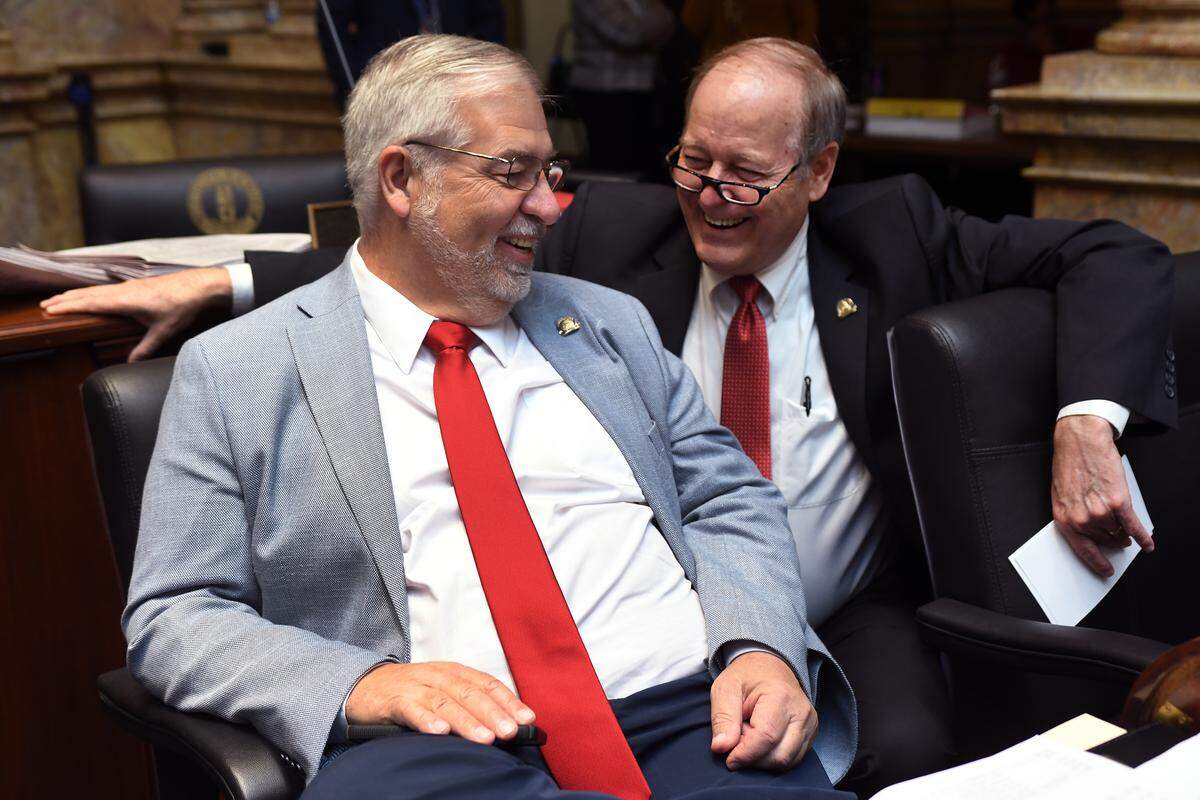
The bill is sponsored by Sen. Gex Williams, R-Verona. Senate Bill 351 would prohibit the Education Professional Standards Board from issuing or renewing a teaching license to any educator who has been treated for or diagnosed with any “disorder that is excluded from the Americans with Disabilities Act of 1990.”
The ADA has clearly-defined “disorders” that aren’t protected by the law. The list of exclusions lumps “gender identity disorders” in with a long list of other things that would make someone ineligible to get a teaching license in Kentucky: transvestism, transsexualism, pedophilia, exhibitionism, voyeurism, compulsive gambling, kleptomania, pyromania and psychoactive substance use disorders.
“Those who continue to promote such transitions and gender confusion or are themselves confused should not have teaching certificates giving them the privilege of having care, custody and control of Kentucky’s most valuable asset — our children,” Williams told the Herald-Leader Monday.
Critics of the bill, which includes several Kentucky advocacy groups, are concerned the legislation would prevent teachers from seeking medical help if they fall into these groups, and that it further singles out teachers, causing fear in the profession.
In an email, Williams said he filed SB 351 after learning about a fifth-grade student in his district who was asked to no longer address a teacher by the “Ms.” prefix, which “confused” the child. Williams said he spoke with the school district about the incident, and they “took the teacher’s side.”
That child withdrew from the school and was homeschooled afterward, Williams said. He alleged that an increase in homeschooling had been a significant problem for the school district.
“My hope for this bill is to start a discussion about making sure the classroom remains focused on educating students and promoting their well-being,” he said. “Recently another school child committed suicide in my district and gender confusion may have been involved. It is about time we take a hard look at all the contributing factors to teen suicides.”
Williams didn’t provide additional details about the incident, but suggested suicide rates among youth were much lower when the ADA was enacted.
What the bill does
Williams said there is a significant amount of misunderstanding about what the bill does, because it references disorders in existing federal law with regard to who can — and cannot — get a teaching license.
“The bill references the Americans with Disabilities Act as it was written when Congress passed the law in 1990 and not amended when they updated it in 2008,” Williams said, though he did not clarify why he’s seeking to use the 1990 legislation.
Williams said SB 351 “does not create a new list or set new standards unique to Kentucky.”
“It simply denies the privilege of a teaching certificate to those with disorders explicitly excluded from the ADA by Federal Law - using the definitions for those disorders when Congress enacted the ADA,” Williams said.
The ADA explicitly says “gender identity disorders not resulting from physical impairments, or other sexual behavior disorders” are not protected under the law. However, the ADA Project, which provides information about the act and its history, says recent court cases suggest gender dysphoria is not excluded by the ADA.
Under the bill, people who are gay or bisexual would not be prohibited from teaching, Williams said.
The bill would require certification and renewal applications to include a sworn statement that the person seeking the license has never been treated for or diagnosed with any listed disorder. It also would direct certain state medical licensing boards to promulgate administrative regulations to require licensees to diagnose the listed disorders based on the disorder definitions established in the Diagnostic and Statistical Manual of Mental Disorders (Third Edition, Revised).
The standards board would be allowed to revoke, suspend or refuse to issue or renew certification for anyone with one of the listed “disorders.”
The bill also would require the Education Professional Standards Board to investigate and respond to all complaints against a certificate holder alleging that the certificate holder exhibits easily identifiable behavioral signs or symptoms characteristic to a listed disorder.
The board would be able to compel a medical examination to evaluate whether a certificate holder meets the diagnostic criteria for a listed disorder, and require that the results be provided to the board as a condition of continued certification.
Several advocacy groups are raising alarm on KY’s SB 351
The Kentucky Psychological Association is among the groups that strongly oppose the bill, said executive director Eric Russ.
“This bill would deter teachers from seeking mental health care, require sworn perjury statements about abandoned diagnoses, and remove qualified educators based on identity rather than conduct,” he said.
Psychological science shows that LGBTQ+ youth are harmed by the absence of supportive educators, Russ said. Russ said this bill would cause serious harm to Kentucky educators, conflict with established federal law, and require licensed mental health professionals to violate accepted standards of care. It also would use outdated laws and diagnosis to deny, revoke, or refuse to renew teaching certificates using the ADA of 1990.
“Psychology, like all sciences, evolves to reflect advances in understanding of neuroscience, epidemiology, medicine, and behavioral health,” Russ said. “By anchoring this law to the outdated 1987 (version of the Diagnostic and Statistical Manual of Mental Disorders), the bill invokes classifications the profession abandoned decades ago for lack of scientific support.“
Those requirements directly conflict with the ethics code of mental health professionals, including the American Psychological Association Ethics code, while also raising serious constitutional concerns around forced medical examination, Russ said.
He said requiring Kentuckians to report one another by way of “complaints” and forcing compelled medical examinations based on “easily identifiable” signs of certain disorders also creates a concerning stigma around mental health.
The Kentucky Psychological Association also opposes this bill because it adds yet another layer of hurdles to teacher certification at exactly the wrong moment — when Kentucky schools are already struggling to recruit and retain qualified educators, he said.
Nema Brewer, a founding member of the teacher’s union 120 AFT said the GOP has chosen to “single out and terrify” teachers with this bill.
“Freedom isn’t being scared of your elected officials,” Brewer said. “Freedom is being able to exist without constantly looking over your shoulder to see who wants to do you harm. We strongly condemn SB 351 and the bigotry and cruelty that it is intended to inflict. Shame on anyone who signs on to this bill. Shame on Gex Williams, Lindsey Tichenor, and Steve Rawlings.”
Tichenor, R-Smithfield, and Rawlings, R- Burlington, are co-sponsors of the legislation. They did not immediately respond to request for comment.
Joel Wolford, President of the Kentucky Education Association, a teacher’s union, also disagreed with the bill.
“KEA supports all public school educators and works to promote and improve legislation in the general assembly that helps our schools work better. Public school educators work every day to solve problems and help move education forward. Bills like SB351 that divide and distract do not serve that important purpose,” Wolford said.
Allison Slone, founder of Kentucky Teachers in the Know, a Facebook group aimed at keeping teachers informed on important information for the profession, also was critical of the bill’s “attack” on educators.
“Mental health and legal professionals have warned some of us the bill contains loopholes that could allow people to be singled out for diagnoses now recognized and protected under the Americans with Disabilities Act,” Slone said. “Let’s be clear…when legislation targets any group of educators, it becomes an attack on all of us. If this level of scrutiny is deemed necessary for teachers, then the same standard should apply to elected officials making decisions that affect every Kentuckian.”
Chris Hartman, executive director of the Fairness Campaign, an advocacy group for the LGBTQ community in Kentucky, called SB351 “an offensive bill, so clearly steeped in discrimination.”
“It’s late in the session, when legislators who are desperate for attention file their worst, most divisive ideas, which is all SB 351 is,” Hartman said.
This story was originally published March 10, 2026 at 12:29 PM.