Kentucky Senate passes bill restricting forms of voter ID, other election changes
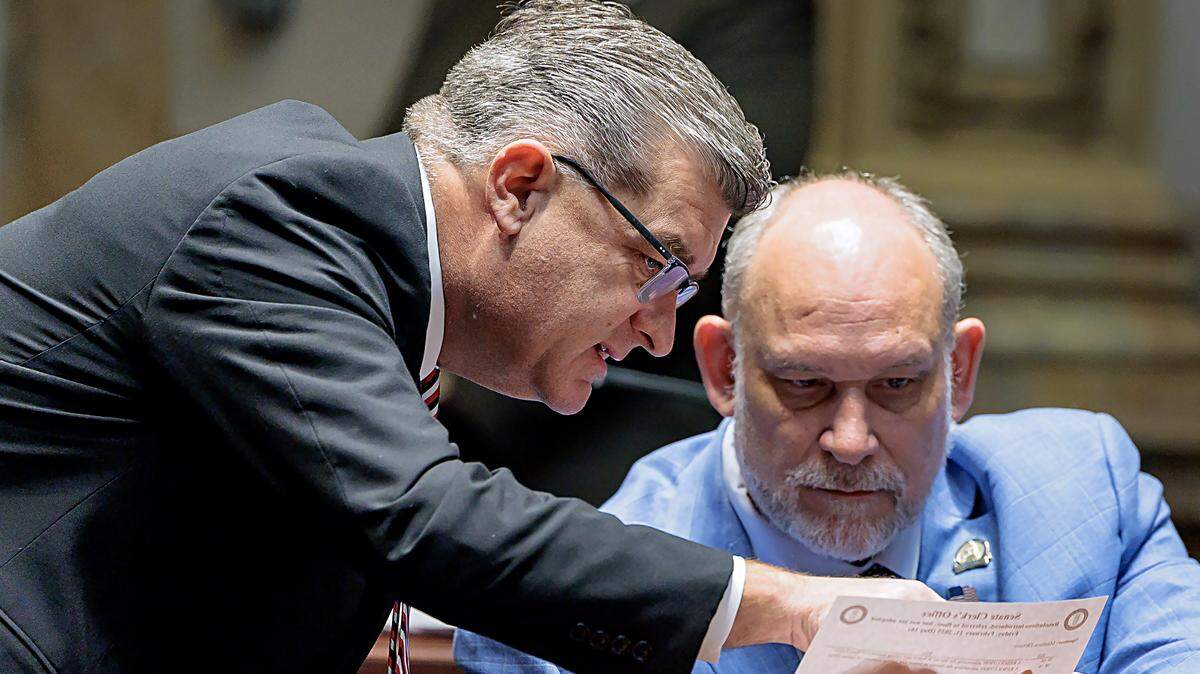
The Kentucky Senate made significant changes to a previously bipartisan House bill on election law, adding provisions that would restrict accepted voter IDs and allow private voter information to be shared with the federal government.
The bill passed the Senate floor on a 31-6 vote. All Senate Democrats voted against the bill.
HB 139, sponsored by Rep. Jennifer Decker, R-Waddy, previously just cleaned up current election statutes. But new provisions that stem from Senate Bill 154 and House Bill 534, which both make sweeping election law changes, add language that sparked controversy among lawmakers during both bills’ previous debates. The new version of HB 139 is also known as a “Christmas tree bill,” which is when lawmakers attach separate measures representing the “ornaments” on a tree.
The bill now heads back to the House to consider changes made by the Senate.
“I think all the things witheld in this bill improves our election process, which has been continuously improving for the last four or five years that we’ve been working on election law here in the Senate,” Senate Majority Caucus Chair, Robby Mills, R-Henderson, said.
Sen. Lindsey Tichenor, R-Smithfield, is the sponsor of SB 154, which would remove Social Security and food assistance cards from the list of acceptable secondary voter IDs. In 2020, Kentucky passed a law requiring voters to bring a valid photo ID at the ballot box. However, the law allows secondary forms of ID if someone signs an affidavit affirming their identity.
Senate Minority Whip Cassie Chambers Armstrong, D-Louisville, said Thursday that removing Social Security cards concerns her because many Kentuckians voted in the last election using that form of identification.
“There are likely instances of people trying to make false any kind of identification that we would put out there as a government body,” Chambers Armstrong said. “However, Social Security cards, compared to all other forms of identification, I would put them up there with passports with REAL IDs in terms of being a secure form of identification.”
While SB 154 passed the Senate, it has not been assigned to a committee in the House. That provision from SB 154 was included in HB 139’s Senate committee substitute.
Another change to the bill increases how much donors can contribute to Kentucky political campaigns and committees.
The legislation would let donors give $3,500 per election to a candidate, which falls in line with federal contribution limits. Currently, donors are limited to giving $2,200 per election. Additionally, the bill doubles the amount donors can give to state political parties and executive committees from $5,000 to $10,000.
HB 139 also has language from House Bill 534, an omnibus election bill that passed the House with divided GOP support. That language includes rules for judicial candidates and sharing voter information with the federal government.
The Senate’s version of HB 139 allows judicial candidates to share their political party affiliation and viewpoints but would keep judicial races nonpartisan.
Chambers Armstrong said that provision makes her nervous.
“I believe that it is important that the public believe(s) that our judges are not political, that they are not partisan,” she said. “We are the partisan political body. The executive (branch) is a partisan political body. Our judges who administer justice blindly should not be political actors in the system.”
Senate President Pro Tempore David Givens, R-Greensburg, said he doesn’t share those concerns.
“This doesn’t make them partisan,” Givens said. “This simply permits that candidate running for office to declare whether he or she is a Republican or a Democrat. My understanding is on the ballot, it is still a non-partisan race.”
HB 139 also permits the State Board of Elections to enter into agreements with the federal government to identify any noncitizens voting in Kentucky. It is already illegal for noncitizens to vote in Kentucky.
When HB 534, which originally had that provision, was debated on the House floor, Democrats raised concerns that sharing data could harm voters who don’t share the same views as the federal government.
Rep. DJ Johnson, R-Owensboro, the sponsor of HB 534, said that information is already available to the federal government.
“The information is already there,” Johnson said March 5. “They’re just looking for us to help them correlate it and make it a simpler process.”
Kentucky is one of the states being sued by President Donald Trump’s Department of Justice for access to Kentucky voters’ personal information. While the DOJ claims the information is needed to ensure “election integrity,” Republican Secretary of State Michael Adams says the request is a federal overreach.
The state has provided a redacted voter registration list to the DOJ, but Adams and the Board of Elections refuse to hand over personal information, including partial Social Security numbers and drivers’ license numbers.
The Kentucky Board of Elections is asking a federal court to dismiss the lawsuit.