
Got a letter from David Kloiber? KY candidate shows how he used AI to write tons of them
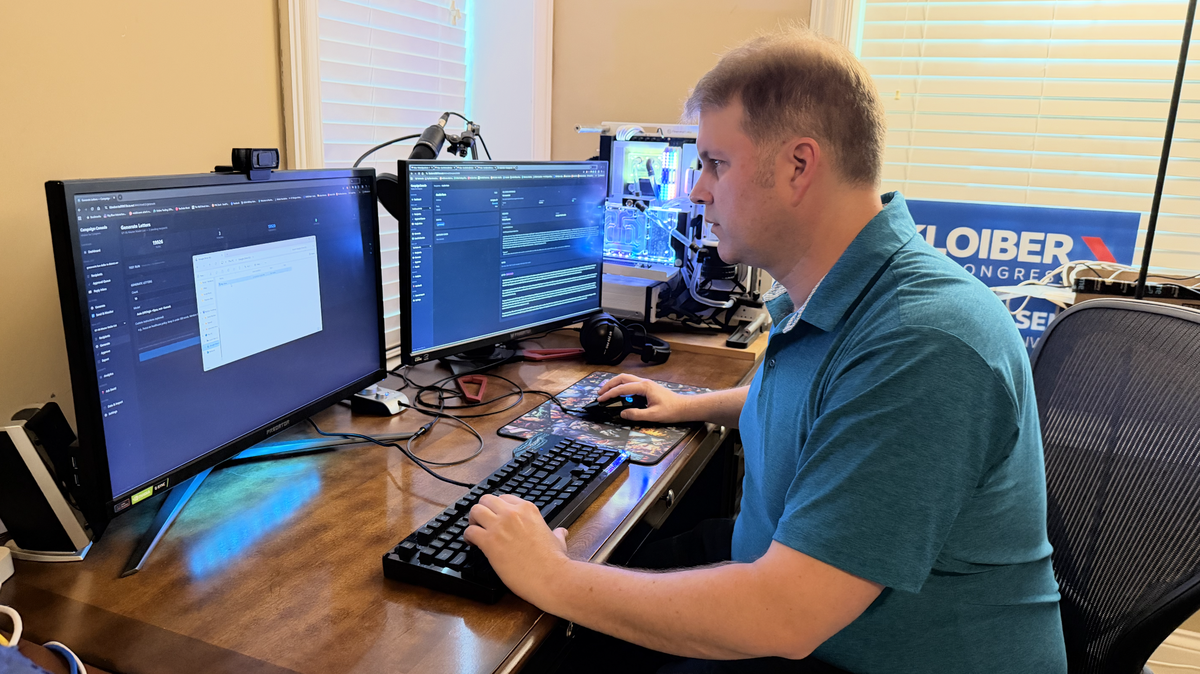
Diane Arnson Svarlien knows her work translating Euripides, the ancient Greek tragedian, is niche.
That’s why she was surprised to see it, and the program she runs providing books to families in need, mentioned in a letter to her delivered Monday from Democratic candidate for Congress David Kloiber.
“Carrying Euripides or Sophocles across two and a half thousand years and into a Lexington reader’s hands takes a discipline most people never see, and the book giveaway program you’ve built for families in this city says something about why you do it. You take what’s worth keeping, and you make sure it reaches people who can use it. That kind of attention to what actually helps a household is rare,” the letter, signed by Kloiber, reads.
Only, Kloiber didn’t write it all himself.
It was generated by an artificial intelligence-powered app built by Kloiber and a close friend. They based the app on reams of Kloiber’s own writing and speech.
Tens of thousands of Democratic voters like Svarlien got similar messages tailored to their work, their neighborhood, their voting history and tying it to one of a handful of bills he plans to file if elected to Congress.
It’s a novel bet for a campaign that has thus far lagged behind fellow Democratic contenders Cherlynn Stevenson, Erin Petrey and Zach Dembo in both fundraising and the scant public polling available.
Svarlien told the Herald-Leader her letter was “instantly recognizable” as having involved AI, even though there is no disclaimer that it uses AI. She didn’t respond negatively to it, though.
“I thought it was funny and quirky. I was kind of tickled that someone would call attention to my being a Euripides translator and also my book giveaway program. There are more creepy things that it could have said about me than the two things I’m (most) proud of,” Svarlien said.
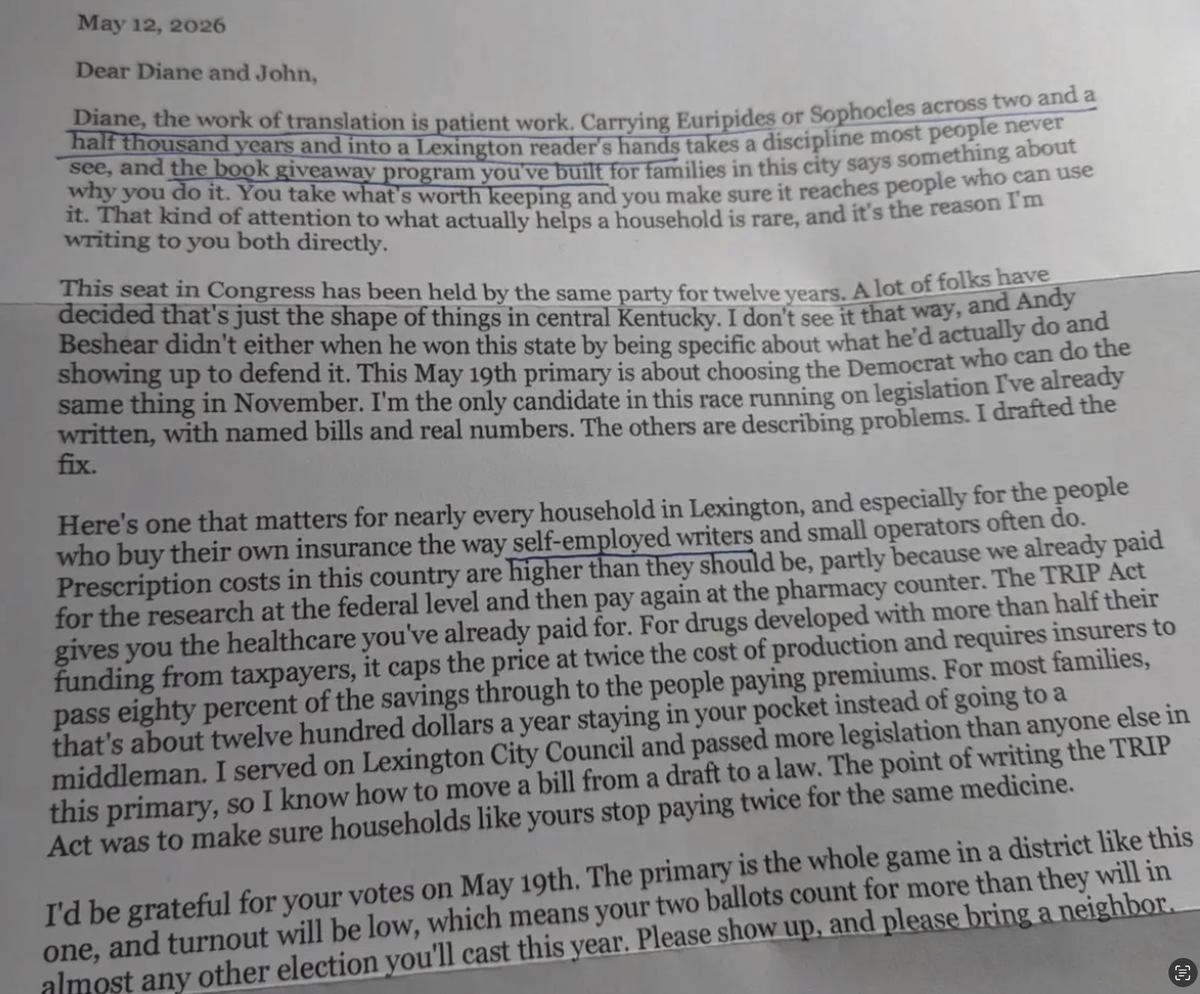
Kloiber claims it is much more personal than simply plugging a voter’s information into a chatbot.
“This is a tool that is customizing these (letters) and ordering my words to them — that is not like ChatGPT just writing them a letter. This is me writing them a letter with the help of these tools to make sure they get the words that (they’re) most responsive to, and that they will care the most about,” Kloiber told the Herald-Leader.
He and Tom Szczygielski, a friend with whom he developed the app, used software to essentially Google voters, fed the app an anonymized version of that data, then had the app personalize the message in Kloiber’s voice.
They intend to scale it to other Democratic campaigns regardless of the outcome of Kloiber’s primary. Their goal is to become certified as a vendor for Democrats, and Kloiber said he’d be open to working with whomever wins the nomination to the now-open seat held by GOP Rep. Andy Barr, who is running for U.S. Senate.
The duo’s app utilizes agentic AI, a newer form of the technology that can execute multi-step tasks.
Kloiber says the app is the first of its kind, and differs from the use of AI in other Kentucky campaigns, like a political action committee’s stereotype-laden depiction of Mexican Americans in an anti-immigration ad or another PAC’s creation of an image of President Donald Trump standing with a clearly inauthentic depiction of Barr.
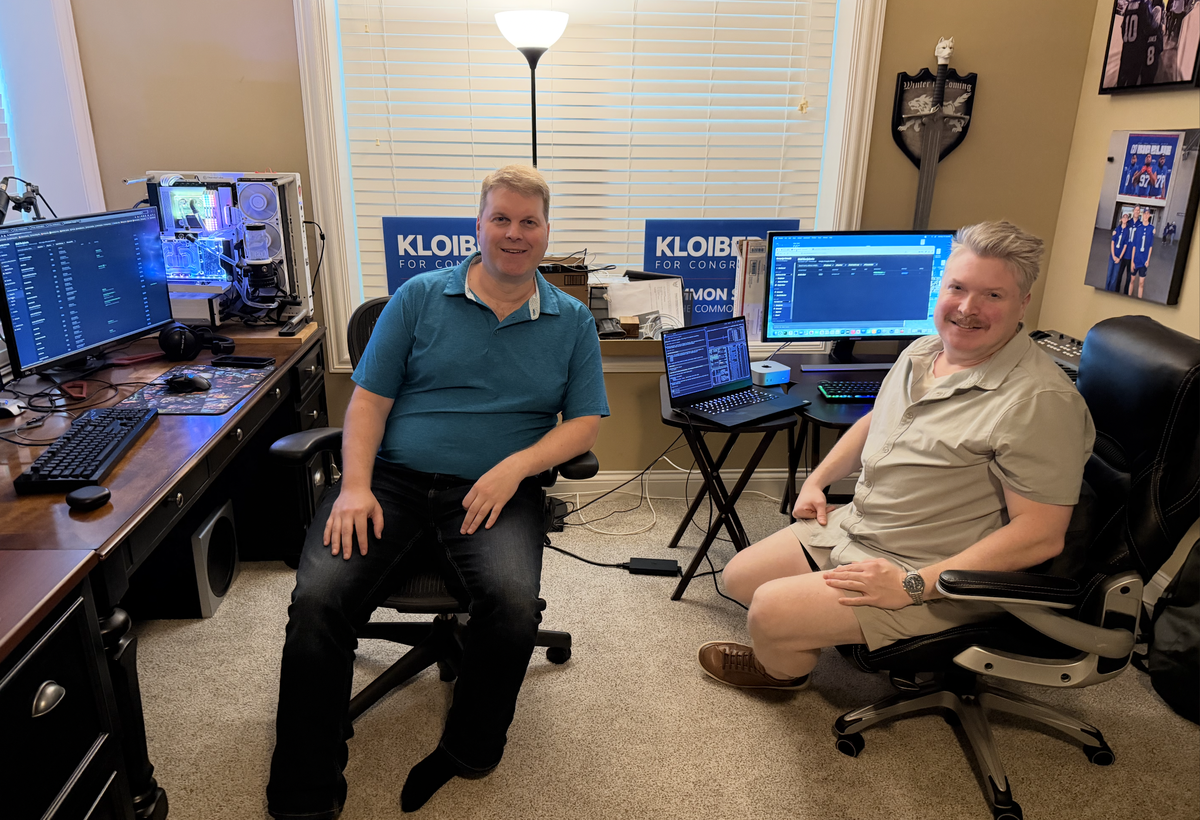
The candidate said he hopes it could prod Democratic political staff — who have been more reluctant to use AI than their Republican counterparts — into using the tool.
“I felt like it was important to show people that we can use a tool to better know each other, and we can do it in a responsible way that sets the precedent for how we should be using these things going forward ... We don’t want the Democrats to be behind technologically to the Republicans across the board,” Kloiber said.
However, politically speaking, AI is in a dismal place. Fears over its effect on the job market, its mental health implications and overall skepticism of its efficacy are widespread.
Surveys from earlier this year show more Americans say it will harm the economy than say it will help; another poll showed 79% of Americans don’t trust companies to use it responsibly.
Kloiber, on the other hand, sees it as an effective tool.
“It’s not perfect, but this is where the future is going, and you can’t put the genie back in the bottle. You just need to make sure that we are being truly progressive people and looking at how we do progress responsibly,” he said.
But do voters in this district trust Kloiber and appreciate his AI-powered messaging?
Will it work?
The mass letter campaign caught a lot of other voters’ attention. Not all of it was positive.
Mike McKinley, a Fayette County Public Schools educator, said the letter wasn’t quite accurate.
“David Kloiber, hey thanks for the AI letter thanking my wife for her service as a nurse and my service as an offensive line coach...... However, she’s never been a nurse, and I’m a public educator, so I will be supporting (Stevenson), who I’ve actually met and who knows me,” McKinley wrote in a post to Facebook.
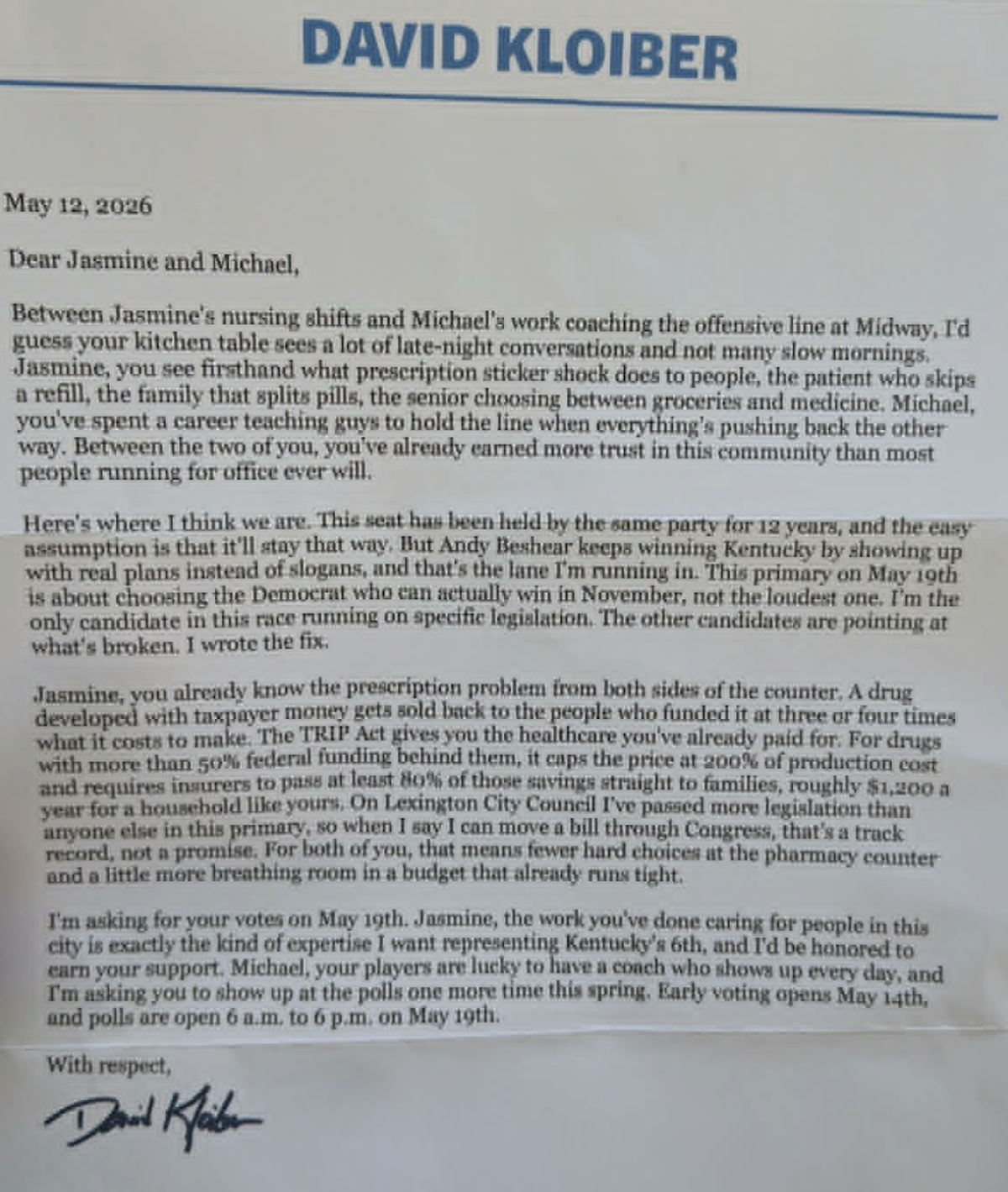
Kloiber acknowledges these complaints. He’s received a handful himself.
“There are people who are like, ‘This is creepy, ick,’” he said.
But, he pointed out, the information that he and Szczygielski use is all, essentially, available via voter files commonly purchased by political campaigns or a simple search of their name on Google.
“I’ve gone and cross-checked people who responded to us with that, and most of them got like, ‘You live on this street, and you voted in the last two primaries.’ And they’re like, ‘I can’t believe you personalized this to me. I feel like you’ve overstepped,’” Kloiber said.
Kloiber also showed the Herald-Leader emails from recipients appreciative of the letter.
One wrote that his “message stands apart from what we typically hear from legislative candidates, who tend to favor rhetoric over concrete proposals.”
Of Kloiber’s opponents, Petrey has been the most skeptical of AI, calling for a moratorium on building data centers in the state. She had an up-close view of the industry recently working for Amazon Web Services, the biggest data center operator in the world.
Petrey said she respects Kloiber, but is “disappointed” with the tactic.
“I’ve had multiple supporters reach out concerned as to how this much information is publicly available and could be used to directly target people with personal information. At a time when digital safety, predatory scams, unfettered surveillance, and questions around appropriate uses of artificial intelligence are at an all-time high, candidates for office must lead by example and earn trust by wanting to fight for their digital safety,” Petrey said.
A supporter of hers shared the letter she and her son got, personalized to their professional history. They thought it was “creepy,” she said.
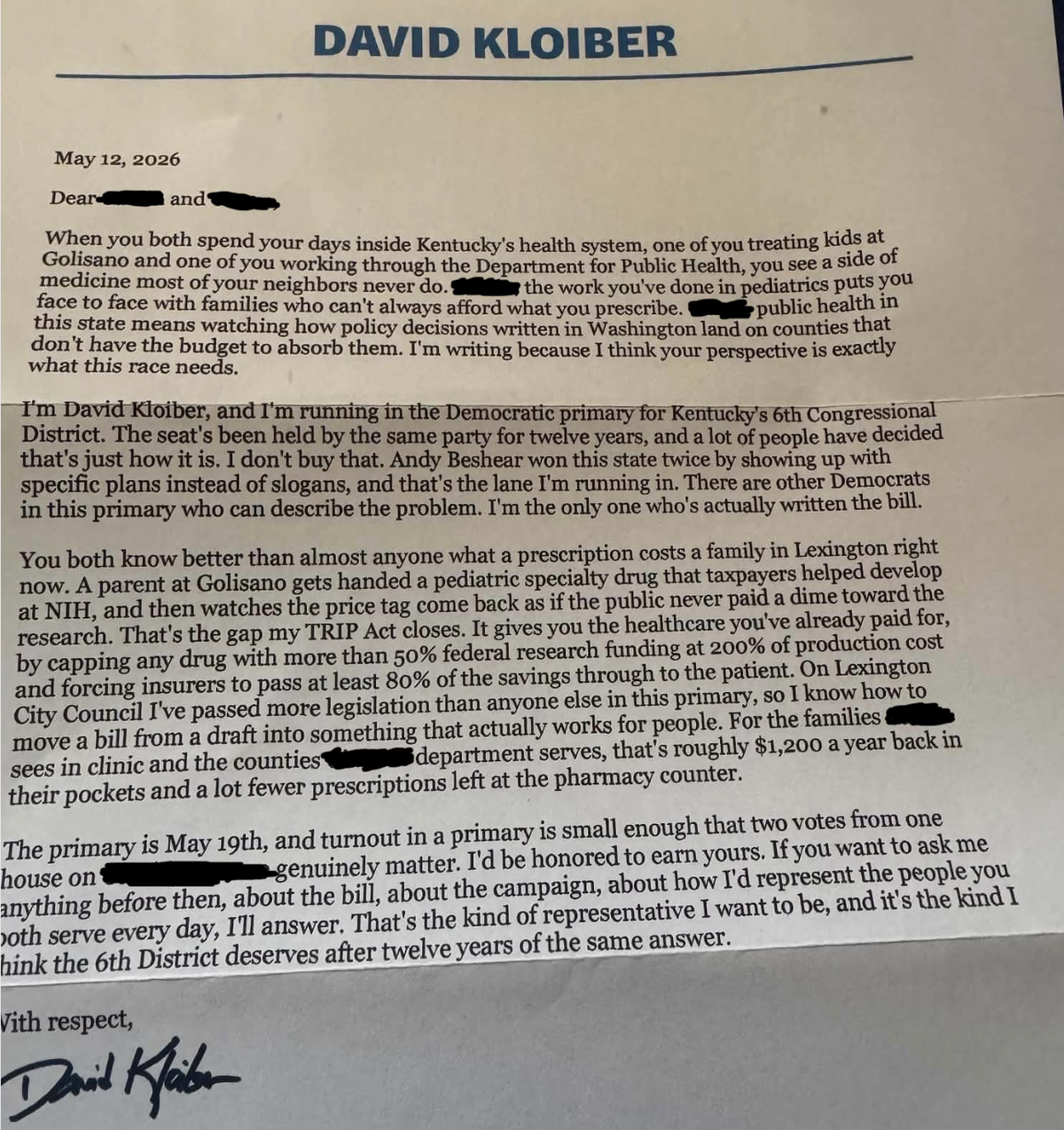
As for Svarlien, the letter did not move her toward, or away from, Kloiber.
“I think he’s kind of an underdog in this race, and it’s more between Stevenson and Dembo. So, I think I’m going to weigh those two for my vote,” she said.
How it works
Here’s how Kloiber and Szczygielski explained the workflow of the tool:
- They collect data about a voter through voter files often used by campaigns or software that searches the internet for personal details like their work history
- Occasionally the program will scrape the web for additional information to verify what it has collected
- They anonymize that personal information before sending it to the agentic AI app, assigning each voter with a number
- The AI app generates a personalized letter in Kloiber’s voice
- Their internal system reinserts names and identifying details after generation
Kloiber said the idea came from a conversation with his father, who founded Exstream Software and sold it for $720 million. Like Kloiber’s new enterprise, that company also specialized in personalization, only tailoring it to consumers by, for instance, including relevant coupons in someone’s credit card bill.
“This is just the next level of that exact same idea. It’s just taking what he did in the past and now expanding it to an end user... The kind of things he couldn’t accomplish with the technology at his disposal, we’re able to use to try and get a message out to people,” Kloiber said.
He and Szczygielski built the app using OpenClaw, an open-source project that allows people to create their own AI agents.
The candidate, who was a member of Lexington-Fayette Urban County Council before losing to Lexington Mayor Linda Gorton’s reelection effort in 2022, said they could direct the app could go back and check the letters for hallucinations, eliminate certain words and more.
Neither he nor Szczygielski checked every single letter — there were “tens of thousands” of them, Kloiber said — themselves.
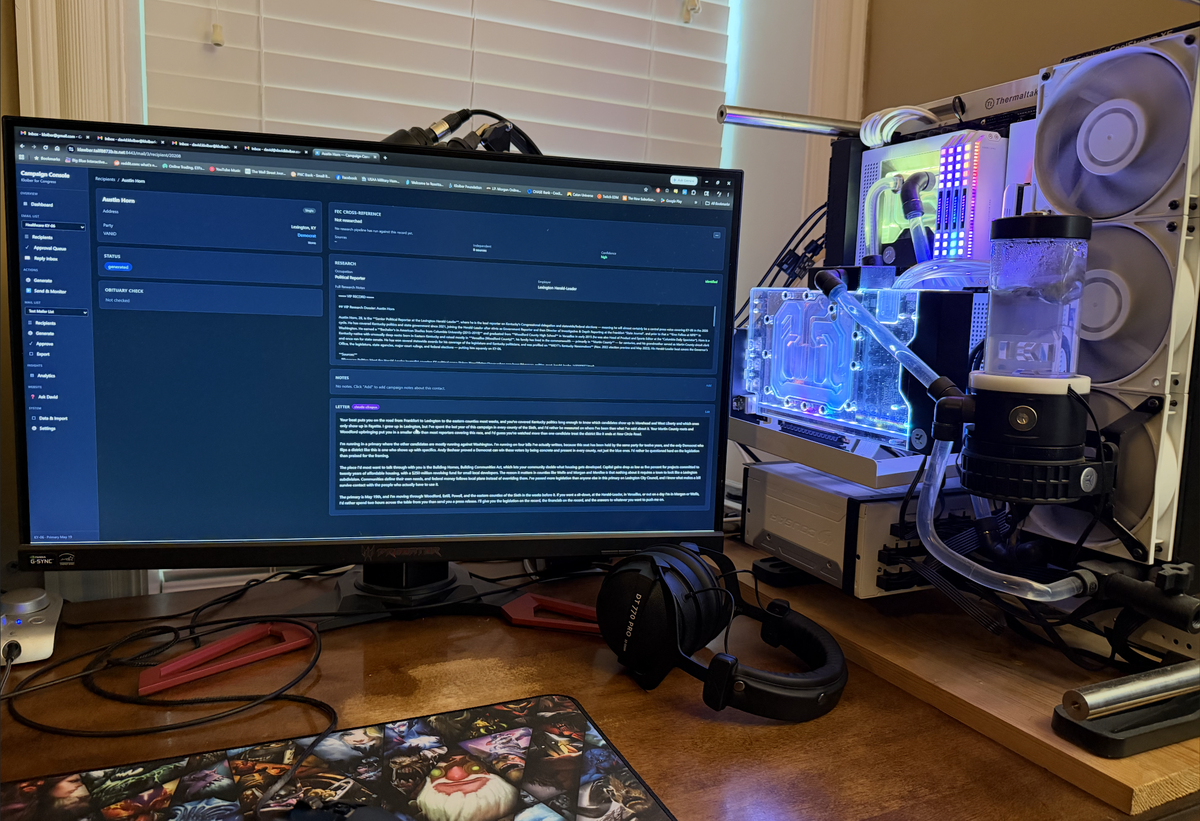
Kloiber said the computer work of generating the letters cost about $500 of energy, but that’s not counting the labor he and Szczygielski put in to personalize it and create the app. The whole letter campaign cost his campaign, which has been largely self-funded, a little under $50,000.
The pair mostly used a custom-built computer powered by the NVIDIA GeForce RTX 4090, an extremely powerful graphics card originally designed for high-end gaming, to build the app and generate the letters.
Kloiber wrote a “code of conduct” that the app is meant to follow. It emphasizes truthfulness, voter protection, data stewardship and human authority, and spells out each of those concepts to the AI.
There was discussion of putting a disclaimer on the letter that they used AI to generate the text, but they ultimately decided against it. Kloiber’s letters likely do not run afoul of the few state regulations on AI-generated material in campaigns, which are limited to manipulated audio or video mimicking a real person.
“We’re not trying to deceive voters ... We used a tool in order to generate these, which is why we’re glad that people are easily identifying it as having used these tools,” Kloiber said.
This story was originally published May 14, 2026 at 10:50 AM.