KY Supreme Court rules restructuring of ethics, fair boards unconstitutional
AI-generated summary reviewed by our newsroom.
- Kentucky Supreme Court ruled the restructuring of two boards unconstitutional.
- Court ruled transferring appointment power removed meaningful executive supervision.
- Court ruled legislators cannot serve as ex‑officio members of executive boards.
In a win for Gov. Andy Beshear, the Kentucky Supreme Court has ruled the recent restructuring of two state boards was unconstitutional.
The Kentucky Supreme Court, in a 4-3 ruling, said two bills passed by the Republican-controlled General Assembly giving other officer holders the ability to appoint members of the State Fair Board and the Executive Branch Ethics Commission were unconstitutional because it removed executive branch oversight.
In 2021, the General Assembly passed House Bill 518, which gave appointment authority to the commissioner of agriculture to eight members of the State Fair Board. The governor’s office retained the appointment authority of seven members. In addition, the General Assembly made the Senate president and House speaker ex-officio members.
The State Fair Board oversees the state fair and make decisions about the state fairgrounds.
In 2022, the General Assembly passed House Bill 334, which expanded the Executive Branch Ethics Commission from five members appointed solely by the governor to seven members. Under the new rules, the governor would make two appointments, while the attorney general, agriculture commissioner, treasurer, auditor and secretary of state would each make one appointment.
The Executive Branch Ethics Commission investigates and can charge state employees with ethics violations.
Beshear, a Democrat, challenged the General Assembly’s changes, arguing the Kentucky Constitution requires separation of powers and that the governor must retain oversight of executive branch operations.
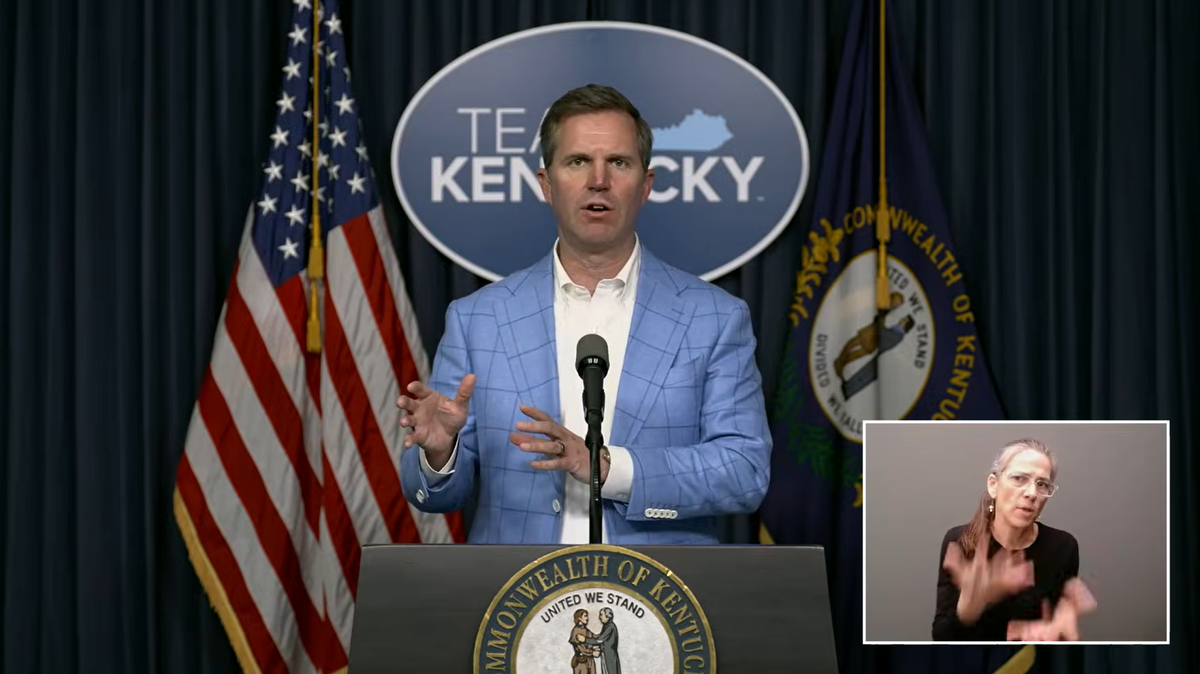
During a press conference Thursday, Beshear applauded the high court ruling, saying it was a win for the separation of powers guaranteed under the state constitution.
“The Kentucky Supreme Court made an important decision today that says that the executive branch is co-equal and that the governor is actually the governor,” Beshear said. “The legislature had taken a position that they could move any duties of a governor, or I guess of an attorney general or treasurer, and move them anywhere else. The Constitution says the governor is the chief magistrate, and you are the only officer with the duty to faithfully execute the law, and that means you need to have a level of control of executive branch activities to ensure that happens.”
The offices of House Speaker David Osborne, R-Prospect, and Kentucky Senate President Robert Stivers, R-Manchester, did not immediately return emails and phone calls seeking comment.
Justice Michelle Keller, writing for the majority, said the Kentucky Constitution allows the General Assembly to prescribe the manner of appointments, but the constitution also says the governor must maintain sufficient control to ensure accountability.
“We hold that the statutory schemes at issue exceed the Legislature’s authority because they restructure executive governance in a manner that eliminates meaningful executive supervision, in violation of Sections 27, 28, 69, and 81 of the Kentucky Constitution,” Keller wrote.
The court also ruled members of the General Assembly can not be ex-officio, or non-voting members, of executive boards.
However, the court also ruled the legislature can have some say on appointment authority.
“We do not hold that the Governor must appoint every member of every executive board; we hold only that the Legislature may not structure an executive board in a manner that will not preserve a chain of accountability through which the Governor may fulfill his or her duty to ensure faithful execution,” the court wrote.