
State plans to increase bonds to reclaim mined land
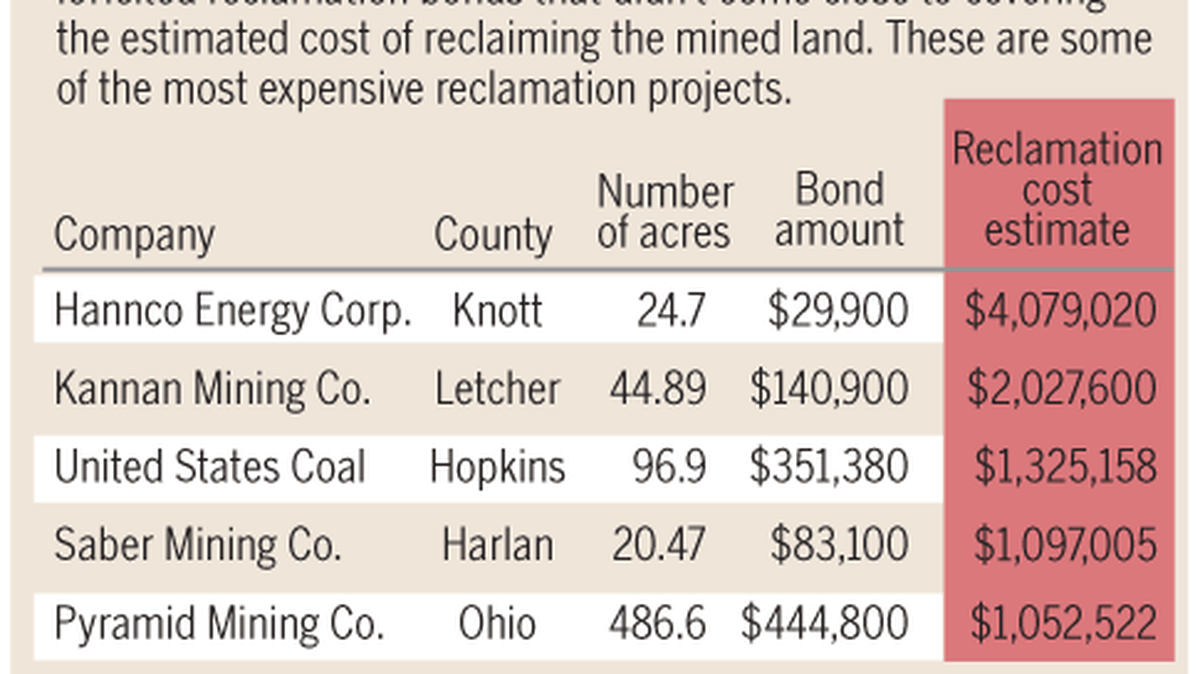
FRANKFORT — Hannco Energy Corp. filed for bankruptcy protection in 2002, leaving behind a 25-acre coal-mining operation in Knott County that will cost an estimated $4 million to restore to appropriate condition.
As the law requires, Hannco eventually forfeited its reclamation bond to pay the state for cleaning up its mess. But the bond — $29,900 — fell far short of the expected expense, putting the land's future in question. It was one of at least 32 examples in recent years of Kentucky coal operators posting bonds inadequate to reclaim mine sites after they disappeared.
Prodded by federal regulators, who last month issued a report critical of Kentucky's bonding levels for mining companies, the state Department for Natural Resources is working with the coal industry and environmentalists to update its method for calculating the amount of reclamation bonds. In the future, bonds will cost more, but how much more and under what circumstances remains the subject of negotiations.
State officials have agreed to submit a revised bond calculation method by April 1 to the U.S. Office of Surface Mining. Otherwise, OSM has advised, it will "take actions necessary to remedy the issue."
Kentucky established its current per-acre bond formula in 1982 and made some revisions in 1993, which was the last time OSM forced the issue. Costs rose for such reclamation activities as hauling rocks and dirt, grading the land, re-vegetating and restoring ponds and streams, but the bonds did not grow, state officials said Monday.
"Things cost less in 1993 than they do today," said Joe Blackburn, OSM's Lexington field office director. "One provision we're asking for in this protocol we get April 1 is that it's looked at every year or two years as inflation and fuel prices go up, so we don't find ourselves in this position again."
When coal companies successfully restore mined land to the conditions listed in their permits, their reclamation bonds are returned to them, although the process can take years to complete.
When coal companies disappear — suddenly shutting down their operations and sometimes filing for bankruptcy — their bonds are virtually all that exists to pay for the environmental damage they leave.
Reclaiming sites
If there is less money available than a full reclamation will cost, the state does what it can, said C. Michael Haines, general counsel for the Kentucky Energy and Environment Cabinet.
Occasionally, the state groups together small and mid-sized mine sites in the same area and bids them out to reclamation contractors for their combined bond amount, Haines said. Contractors "get more bang for their buck" if they don't have to move equipment far between sites, he said.
"You can establish a good permanent cover of vegetation and stop most of the water problems, and you at least won't have a site that's slip-siding away," Haines said.
Large mine sites are more problematic, Haines said. The state sometimes tries to find a successor company to step in and re-mine and reclaim the land, as it is attempting with the Hannco Energy site in Knott County, he said.
As a matter of fact, Hannco Energy already has tried to pass the property and the reclamation to another coal company that would mine the site, said Stephen Thompson, an attorney for Hannco Energy. But the second company also filed for bankruptcy, he said.
"This was not a bankruptcy filing for the purpose of shedding the company's environmental obligations," Thompson said. "Hannco did try to do the right thing, and it is still trying to do the right thing."
Homeplace 'obliterated'
Damaged mine sites hurt nearby property owners and affect people living downstream if sediment runs into the water, said Tom FitzGerald, an environmental lawyer and director of the Kentucky Resources Council. FitzGerald is a participant in the state's bond discussions.
"One of my clients' homeplace in Eastern Kentucky was mined by a coal company that went into bankruptcy," FitzGerald said. "The state did the best it could with the limited money that it had. The site eventually was stabilized. But every natural feature was, and remains, obliterated."
Some coal companies that abandon their mine sites are simply caught unprepared by economic downturns, FitzGerald said. For others, a quick exit is part of their business strategy, he said.
"These operators get into financial trouble, so they stop reclamation and devote their remaining resources to uncovering as much mineral as quickly as possible," FitzGerald said. "They no longer have any intention of reclaiming the land."
The Kentucky Coal Association recognizes that some short-lived companies act irresponsibly, which is why it's suggesting lower bonds for established coal operators with good reclamation records, said Bill Bissett, president of the industry organization.
Bissett's group is, like FitzGerald, part of the state's bond calculation discussions.
The state should balance its need for adequate bonds with the financial pressures on coal companies, particularly at a time, in a weak economy, when bonds and credit are not easily obtainable, Bissett said. There are limits on the amount of bonding capacity in the market, he said.
"This is a good reflection on the coal industry, that we're coming to the table," Bissett said.
"OSM has made some serious accusations here," Bissett said. "We're trying to determine the accuracy of those accusations and come up with a response that is appropriate but that, at the same time, won't drive any companies out of business because of the cost."
Unrealistic assumptions?
Haines, the state lawyer, said the Energy and Environment Cabinet is cooperating on the bond revisions, although, like the coal industry, it doesn't necessarily agree with everything that federal regulators wrote in their Jan. 4 report.
For example, the OSM Bonding Handbook recommends calculation methods that result in bonds "significantly higher" than Kentucky's bonds, according to the OSM report. Five Kentucky permits selected at random by OSM — four mining sites and one slurry pond — were bonded for less than 10 percent of what the handbook recommended.
However, the handbook makes some assumptions that "aren't realistic," Haines said, such as higher prevailing wages on reclamation projects and "worst-case scenarios" for every increment of the mine sites.
FitzGerald said he understands the criticism, but he wouldn't be so quick to dismiss the OSM recommendations.
"Sometimes the worst-case scenario is exactly what happens," he said.
This story was originally published February 21, 2011 at 7:18 PM with the headline "State plans to increase bonds to reclaim mined land."