
Debate features all 3 Kentucky gubernatorial candidates
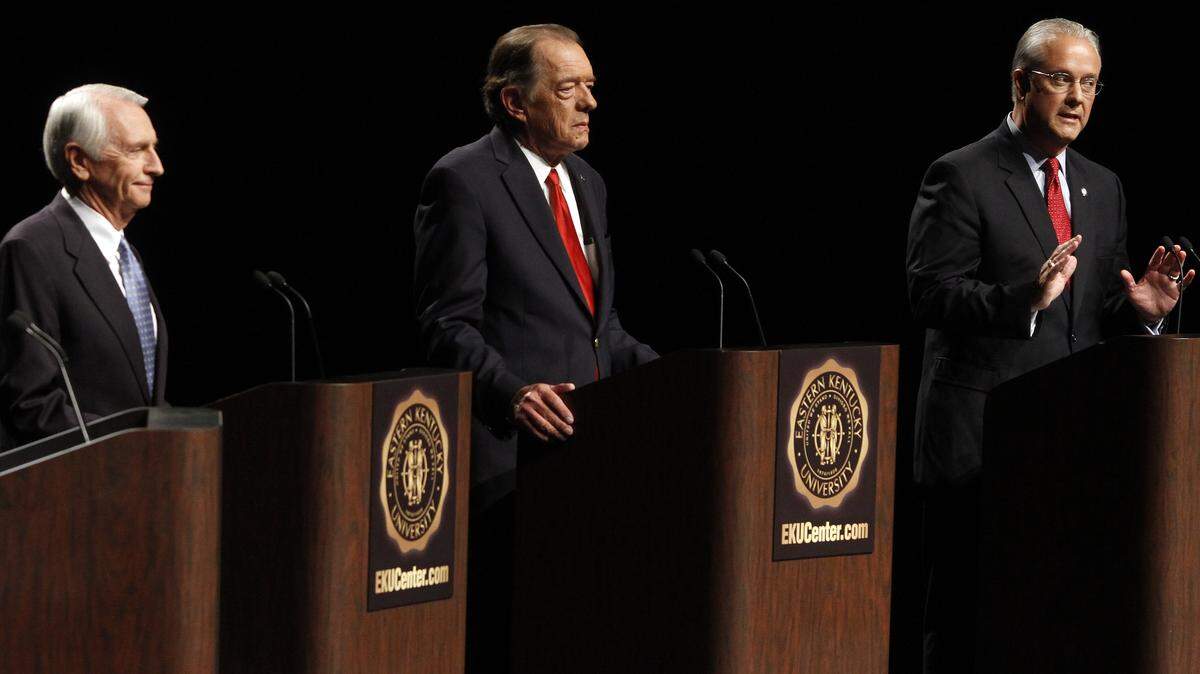
RICHMOND — Less than a month before the Nov. 8 general election, in their first debate together, the three candidates for governor sparred over jobs, the economy and gambling.
The contentious tone of the evening became evident at the beginning of the fast-paced, hourlong debate at Eastern Kentucky University's Center for the Arts when Republican David Williams and independent Gatewood Galbraith welcomed Gov. Steve Beshear, a Democrat, who has been avoiding his opponents as he holds big leads in the polls.
During opening remarks, Galbraith looked at Beshear, then turned to Williams and said, "I told you it was him."
Williams replied that the event was "a tremendous opportunity" for Kentuckians to see the three candidates together.
The debate was sponsored by the Kentucky Broadcasters Association and Kentucky League of Women Voters, and it aired live on TV and radio stations statewide.
Beshear frequently touted his tax incentive plan to create jobs. He said twice during the debate that Williams' father-in-law, businessman Terry Stephens of Russell County, has received $1 million in tax incentives for his pipe and steel company to create 25 jobs.
Williams said after the debate that the state approached Stephens about the incentives and that Stephens never asked for or received any money from the state. "He's a cheap-shot artist," Williams said of Beshear after the debate.
The Beshear campaign distributed to reporters a June 17, 2010, news release from the state Cabinet for Economic Development that said the state had approved tax incentives up to $500,000 for the company. Beshear campaign aides said the company asked for the incentives.
Williams' campaign aide, Scott Jennings, said that the 2010 announcement was premature and that the company expanded in Tennessee and Texas. He said the state asked Stephens' company to apply for the incentives, but the company decided not to take them after a thorough review.
"The assertion that they are taking $1 million is false," Jennings said.
Williams told reporters that if he were using "cheap shots," he would talk about Beshear's former law firm, Stites and Harbison, and its involvement in representing River Fields, a Louisville group that has been accused of trying to stop the building of two new bridges in Louisville.
Beshear said the Louisville bridges project has moved forward more in the past 18 months under his bipartisan work with Republican Gov. Mitch Daniels of Indiana than in the past 40 years.
Throughout the debate, Beshear said his top priority was creating jobs, and he defended his handling of the state's economy during the difficult financial times of the past three years.
He maintained that his economic incentive plan was working and said "it bothers these two guys to talk about it."
Williams said the state needed to replace the corporate and personal income tax with a consumption tax that would make Kentucky "the best place in America to keep and retain jobs."
Galbraith touted his plan to give every high school graduate a $5,000 voucher for higher education. He said that would help create jobs and improve education.
Williams was the only candidate who opposed the expansion of gambling in Kentucky.
If it ever occurs, it should be approved by voters in a constitutional amendment, Williams said. He added that Beshear had not been able to get it approved by the House, which Democrats control.
Beshear said expanded gambling was needed to keep money from going to neighboring states with casinos.
Beshear said many people — including Williams — leave the state to gamble. That was a reference to the disclosure in Williams' divorce filings that he has gambled at out-of-state casinos.
Beshear said Williams should "step out of the way" and let the Senate vote on expanding gambling.
"We could use the money," Galbraith said.
The candidates were asked whether they supported legislation to require a prescription for cold medicines containing pseudoephedrine, a key ingredient in the production of methamphetamine.
Williams noted that he supported such a measure during the last session. Beshear said the state "will come to some kind of agreement" on the issue.
Williams accused Beshear of not taking a position and not providing "bold leadership" for the state.
In their closing remarks, Galbraith said Beshear, if re-elected, would leave office in two years and turn over the reins of government to his running mate, former Louisville Mayor Jerry Abramson.
Beshear's campaign said that assertion was preposterous and that Abramson was chosen because of his record.
Williams noted that Beshear did not deny that scenario during the debate.
The candidates have one other scheduled appearance together — Oct. 31 on Kentucky Educational Television.
This story was originally published October 11, 2011 at 8:49 PM with the headline "Debate features all 3 Kentucky gubernatorial candidates."