
Andy Barr and Elisabeth Jensen offer vastly different prescriptions for Kentucky's job woes
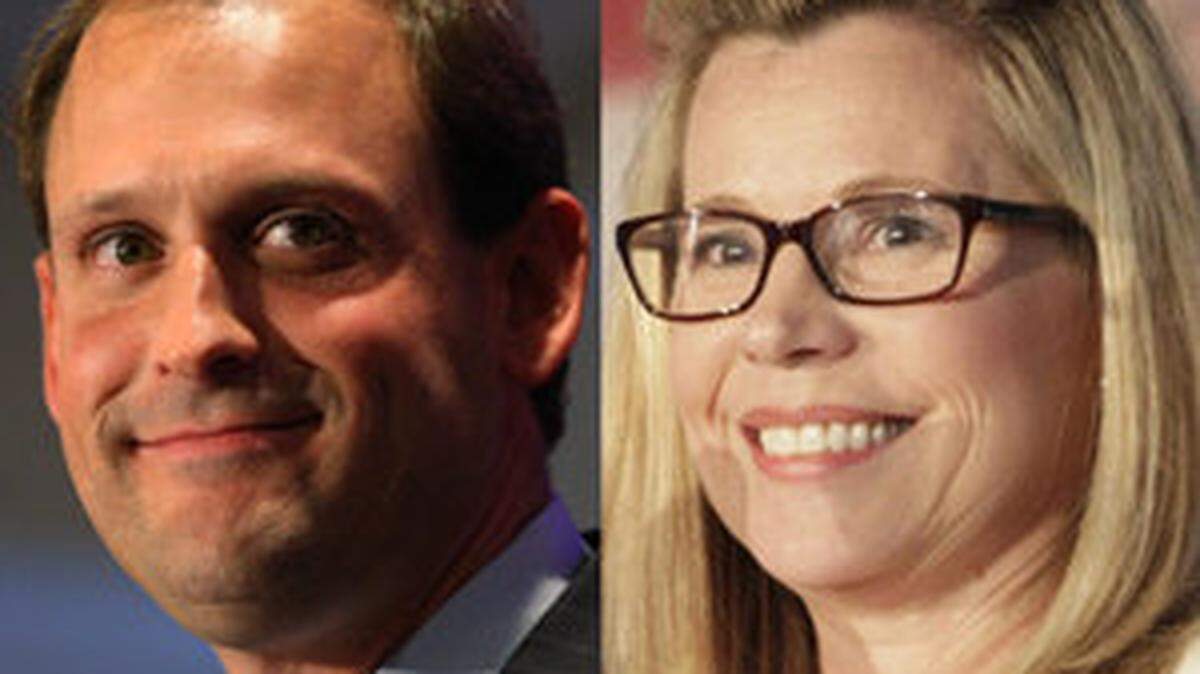
Congress must act to get more Kentuckians into good jobs because the state hasn't recovered from the last recession.
That much is agreed between U.S. Rep. Andy Barr, R-Lexington, and Elisabeth Jensen, his Democratic challenger in the Nov. 4 election.
That's also where their agreement appears to end.
Jensen unveiled a jobs plan this month that calls for aggressive government action: a higher minimum wage; more federal spending on public infrastructure, such as roads, schools and high-speed Internet; more federal subsidies for child care, worker training and college scholarships; mandated equal pay for women; and a new role for post offices as community lender, to replace high-interest payday loan stores.
Government is the necessary counter-balance to self-interested corporations, Jensen said in an interview last week. If nobody else is pumping money into the economy, then government should, even if it means larger deficits for the near future, she said.
"Kentucky workers need a raise," said Jensen, 49, a former Walt Disney Co. executive who runs a Lexington educational nonprofit. "The first responsibility of business — and I say this as a businesswoman — is to make money. Not to create good jobs for Americans, necessarily, or to share the wealth, but to make money for themselves. There needs to be a voice for the worker."
Barr, 41, finishing his first term in Congress, says government should get out of the way. Barr favors less government involvement in most aspects of the economy. He opposes deficit spending, raising the minimum wage and several recently enacted measures, such as the Dodd-Frank Law, a package of banking reforms, and the Affordable Care Act, a mandate through which more than 521,000 Kentuckians have obtained health insurance.
Give people the freedom to act and prosperity will follow, Barr says in campaign materials. (The Barr campaign last week said the congressman would not respond to Jensen's jobs plan.)
"This is done by allowing job creators to keep more of what they earn and by removing unnecessary, costly government overreach that creates additional costs and burdens that stifle job creation," Barr wrote in a campaign essay he titled The First Step to Creating Jobs. "It is time that we focus on restoring our conservative economic values and be a help, not a hindrance, to job creators throughout this nation who want the government out of the way so that they can focus on putting Americans back to work."
Poverty wages
With Jensen's jobs plan, she and Barr offer Central Kentucky's 6th Congressional District a stark choice in a season of campaign hype: Should government attempt to prime the economy with stimulus spending or looser regulations?
For Jensen, a political rookie with far less campaign money than Barr, it remains to be seen whether her plan will resonate with voters, although polls consistently show that a majority of Kentucky voters favor a higher minimum wage.
Jensen announced her plan Sept. 11 to an audience of about 200 at the Rotary Club of Lexington. After a polite round of applause, several people asked skeptically about her proposal to raise the national minimum wage from $7.25 to $10.10 an hour and then index it so that it rises with inflation. One man asked if her higher wage was aimed only at national retail chains or if small, locally owned stores also would be affected.
"Well, I'm not going to pick a fight with any big companies. But the reality is, it is very hard, if not impossible, for an individual to raise a family working on minimum wage," Jensen told one questioner.
It also is hard to raise a family if you raise wages on small businesses and they go out of business, the man replied.
The minimum wage has been controversial since it was established at 25 cents an hour by the Fair Labor Standards Act of 1938, which also banned most forms of child labor. Business leaders at the time warned the law would ruin the economy. It "constitutes a step in the direction of communism, bolshevism, fascism and Nazism," said the National Association of Manufacturers.
The Barr campaign last week pointed to a Feb. 18 report from the Congressional Budget Office that predicted a $10.10 minimum wage "would reduce total employment by about 500,000 workers, or 0.3 percent," while boosting the pay of most "low-wage workers ... and some of those families would see their income rise above the federal poverty threshold."
Jensen responded by noting that U.S. Labor Department data shows stronger job growth in the 13 states that raised their minimum wages at the start of this year, compared to states that did nothing.
"I think it's really basic economics," Jensen said. "When people are making more money, they're spending more money. And for low-wage workers, this isn't going into a bank account, this is being spent on car repairs, on food, on clothes for their kids. This is money that goes directly back into their community, and that fuels more growth."
One way or another, the raise would affect many Kentuckians. A $10.10 minimum wage would help one in four Kentucky workers currently earning less, 88 percent of whom are at least 20 years old and 54 percent of whom work full-time, according to the Kentucky Center for Economic Policy in Berea, which supports the proposed increase. Nearly half of Kentucky's fast-food employees are poor enough to qualify for public assistance, like food stamps and Medicaid, according to the center.
However, increasing the minimum wage "is barking up the wrong tree," said John Garen, a University of Kentucky economist and policy scholar at the Bluegrass Institute for Public Policy Solutions, a free-market think tank that opposes the proposed increase. If the government wants to help the poorest households, it would make more sense to increase their public assistance than to interfere with private-sector wage decisions, Garen said.
"From the point of view of employers, it's almost like you're imposing a tax on hiring unskilled, low-wage workers, which is the last thing we want to do," Garen said.
Public works
Jensen said she doesn't have a dollar figure in mind for the ambitious federal spending she wants on infrastructure. President Barack Obama's stimulus program that mostly ran from 2009 to 2012 cost an estimated $831 billion.
In the short run, Jensen said, a renewed surge in spending to build or improve roads, bridges, railways, schools, broadband data networks and other public projects would increase the $17 trillion federal debt. But it makes no sense for Congress to cut budgets during a sluggish economy, she said. It would help, she added, if Congress closed tax "loopholes that allow billionaires and corporations to avoid paying their fair share."
"Our first priority has to be getting people working again and getting better wages for them," Jensen said. "The income disparity right now is as bad as it's ever been. Trickle-down economics isn't working. The rich are just getting richer."
There is plenty of work that needs to be done in Kentucky. The American Society of Civil Engineers has compiled a daunting list of construction needs for the state, from $1 billion for public schools to $5 billion for drinking water sources. Thirty-four percent of the state's major roads are in poor or mediocre condition, the group says. Nine percent of its bridges are "structurally deficient."
Jensen's proposal finds support in a UK economist whose research she cites in her campaign materials: James Ziliak, director of the Center for Poverty Research. Sometimes government must prime the economy's pump, and data shows that strategy can succeed, Ziliak said last week. The federal Works Progress Administration in the 1930s spent $11 billion (about $182 billion in today's dollars) to hire eight million jobless Americans who built hundreds of projects, some of which are still in use today.
"Nobody likes to have deficits, but it's a larger crime against the country to let physically able people go without work because there are no jobs available for them," Ziliak said. "Where the market fails to produce jobs for whatever reason, the government can step in and employ people, at least in the short term."
The Barr campaign said the congressman also supports infrastructure improvements, but with different funding: corporate tax breaks.
Barr is cosponsor of the Partnership to Build America Act, which has sat in the House Ways and Means Committee since May 2013. The bill would establish $50 billion in American Infrastructure Bonds to "finance the rebuilding of our country's transportation, energy, communications, water and education infrastructure," the bill's sponsors say. The 50-year bonds would pay a fixed 1-percent interest rate.
The bonds would be bought by American-based multinational corporations. In exchange, the corporations could minimize the U.S. taxes owed on offshore profits they brought into the country. The plan could involve up to $300 billion in "repatriated" corporate assets at a cost to the U.S. Treasury of up to $105 billion, according to an analysis by the liberal Economic Policy Institute in Washington.
In May, political scientist Norm Ornstein of the conservative American Enterprise Institute praised the bill in The Atlantic magazine and criticized a "dysfunctional" Congress for ignoring it.
"Suffice to say that the process would be a win-win," Ornstein wrote. "Companies would likely end up paying low tax rates on the repatriated profits and have a substantial amount of the money to reinvest, while also providing a bundle of capital for infrastructure investments, which in turn would be leveraged by the fund into as much as $750 billion in loans or guarantees for infrastructure projects."
This story was originally published September 21, 2014 at 8:55 PM with the headline "Andy Barr and Elisabeth Jensen offer vastly different prescriptions for Kentucky's job woes."