
As Jesse Crenshaw leaves Kentucky legislature, he looks back on trailblazing life, career
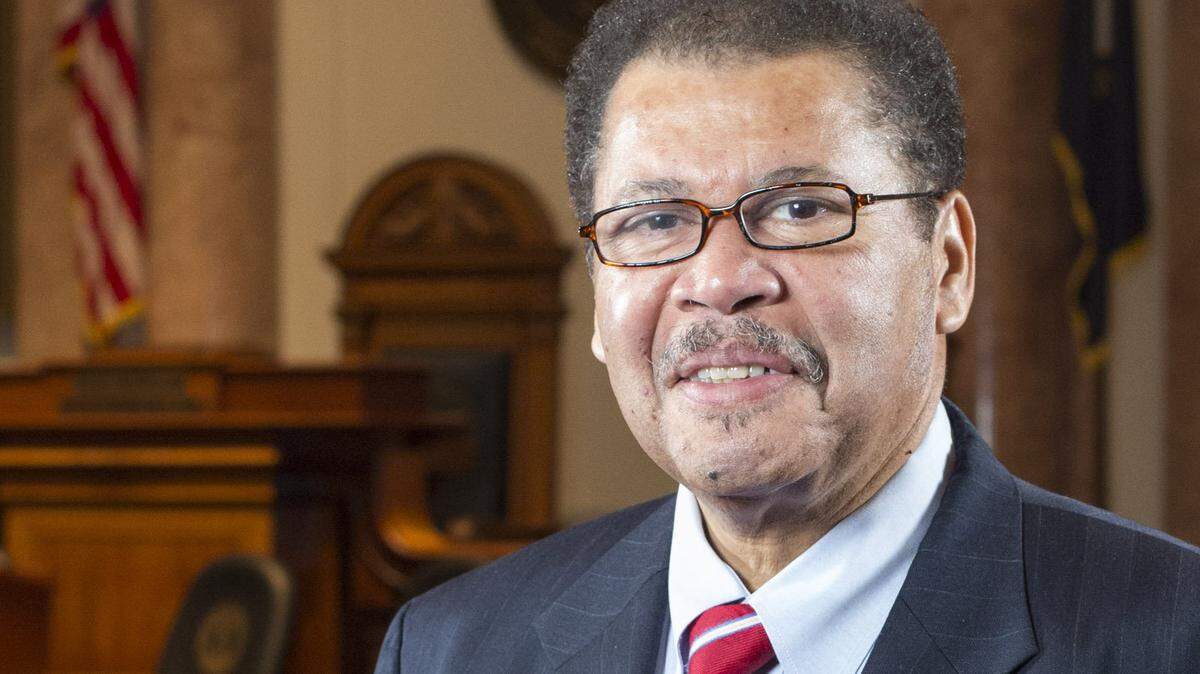
FRANKFORT — From his office in room 332D of the Capitol Annex, state Rep. Jesse Crenshaw could look out the window and see what he calls "a breathtaking view" of the Kentucky Capitol.
He says the beauty of the Capitol, with all its dignity, is one of the many things, along with his colleagues and legislative staff, he will miss as he retires from the Kentucky General Assembly.
When 2014 drew to a close, Crenshaw, 68, wrapped up 22 years as the state representative of the 77th House District in north Lexington.
When Crenshaw joined the House in January 1993, he was the first black from Fayette County to be elected to that lawmaking body.
His district is considered a "minority" district. Based on the 2010 Census, 36 percent of the people in the 77th District are black and 15 percent are Hispanic. It has 17,824 registered Democrats and 6,421 Republicans.
In the state House, Crenshaw has been instrumental in the passage of many bills to benefit not only his constituents, but all Kentuckians.
He has amassed a record to be proud of, a record not shabby at all for a person who was born and reared on a farm in Metcalfe County and survived and thrived through this nation's era of segregation.
House Speaker Greg Stumbo, D-Prestonsburg, had only praise for Crenshaw.
"I could spend a whole day talking about the good things Jesse Crenshaw has done for his district and the state. He is a remarkable person, and I will miss him greatly," Stumbo said.
Crenshaw, one of the more quiet state legislators, recently talked about his life while seated at his desk in the House chamber.
"For the first time in my life, I will be more of an outsider looking in," he said of his retirement.
"As a former university teacher, I was directly involved in the lives of young people. As a legislator, I was involved in trying to help people. Now, I am going to gradually return to practicing law at my office at 121 Constitution Street in downtown Lexington, but it is going to be different for me.
"I have mixed emotions about leaving this part of my life."
Crenshaw, born Sept. 23, 1946, was the first of four sons of O.C. Crenshaw and his wife, Magdalene Brewer Crenshaw.
"After they divorced, she married a Bailey, and most people back home knew her as Magdalene Bailey," he said of his mother.
Crenshaw's father died in 1996. His mother died in 1998. Both saw him become a lawyer and a state representative.
Crenshaw's father worked for years in Detroit in the automotive industry. He tried farming in Metcalfe County for a short time, but he did not like it.
Crenshaw's mother was an elementary school teacher who impressed upon her children the value of a good education.
Crenshaw was reared by his grandparents, Jessie F. and Elva Crenshaw, from the time he was about 8. They owned and operated 168 acres near the Metcalfe-Barren County line in Knob Lick.
Life on the farm for Crenshaw involved hard work. The family milked about 11 cows twice a day and raised a variety of vegetables and fruits: "At 16, I planted and harvested six acres of watermelons and cantaloupes."
The farm products were sold to Houchens and other grocery stores in Glasgow, Cave City and Horse Cave. On weekends, the family sold watermelons and cantaloupes at the farm.
Crenshaw said his grandfather, who had only a second-grade education, was one of the smartest men he has ever known.
Crenshaw spent grades one through eight at Old Blue Spring, a one-room, segregated black school. His strict teacher for his first six years was Wyoming G. President, his aunt.
Crenshaw traveled 20 miles by bus to and from Ralph Bunche High School in Glasgow, another segregated black school. Its principal was Luska Twyman, who was Kentucky's first black mayor when he became mayor of Glasgow in 1968.
Crenshaw graduated in 1963 as valedictorian in a class of 23.
As a youth in Glasgow, Crenshaw remembered going to the movies at Plaza Theatre. "Blacks had to watch movies from the balcony," he said.
He lived for a year in Glasgow with his mother when he was 16 to recuperate from a car accident.
Crenshaw did not immediately go to college. He intended to enroll in fall 1963; however, his grandfather was sick. His grandfather died in September 1963, and he continued to live and work on the farm until September 1964.
Kentucky State University in Frankfort was Crenshaw's choice for college. His mother and aunt had gone there. He graduated from there in 1968 with a major in history and political science.
Crenshaw said he had known since he was 15 that he wanted to be a lawyer.
"My grandfather had always taught me you should be your own boss," he said. "I thought I could do that by being a doctor or a lawyer. I cannot stand the sight of blood, so I chose being a lawyer."
His studies at the University of Kentucky's law school were interrupted by a stint in the U.S. Army from 1969 to 1971, including a tour of duty in Vietnam.
Crenshaw was admitted to practice law in 1974.
He said his law professors were outstanding. A memorable lesson, he said, came from professor Eugene Mooney.
"He taught us that the most important part of the decision is deciding who gets to decide. I have applied that in my political and legislative life."
The three most "analytical" people in his life, he said, were his grandfather, "who could barely sign his name;" Dr. Henry Ellis Cheaney, his history professor and adviser at Kentucky State; and statesman Edward F. Prichard Jr.
After working for the state labor department, teaching criminal justice at Kentucky State and serving as the first black assistant U.S. attorney for the Eastern Judicial District of Kentucky, Crenshaw started practicing law in Lexington.
He expanded his activities by working in various Democratic Party campaigns and joining the local NAACP chapter in 1979.
In 1992, Crenshaw was vice chairman of Bill Clinton's successful presidential campaign in Kentucky.
Also that year, Crenshaw was elected to the state House.
His Republican opponent, Shirley Cunningham, spent about $56,000 on his total campaign expenditures, while Crenshaw spent only about $20,000.
"We won with 61 percent of the vote," Crenshaw said.
As a state legislator, Crenshaw made a name for himself as chairman of the budget subcommittee on justice and judiciary. The panel covers state police, police training, juvenile justice, corrections and the court system.
He said he is proud that he voted for a state budget that included $129 million for a new Eastern State Hospital in his district and transformed its former site to Bluegrass Community and Technical College's Newtown campus.
He also notes his work for Community Ventures to try to start more businesses and helping persuade UK to locate the Polk-Dalton health clinic on Elm Tree Lane in his district.
"And I drive by the Robert F. Stephens Courthouses in downtown Lexington and think how good it is that I had something to do with getting them, helping to obtain $63 million in state aid for them."
Roads, education programs, sewer service and renovation of Rupp Arena are other projects that Crenshaw supported.
His longtime colleague, state Rep. Ruth Ann Palumbo, D-Lexington, said Crenshaw always presented his bills on their merits.
"He's been an outstanding legislator," she said. "His patience is a virtue."
House budget chairman Rick Rand, D-Bedford, said, "There is no finer person and citizen legislator than Jesse. His work on our committee has been invaluable and will be hard to replace."
Crenshaw's biggest legislative disappointment has been an inability to pass a law restoring voting rights to most felons who have completed their sentences.
"That will happen some day," he said. "I hope I live to see it."
In his last few days as a state lawmaker, Crenshaw was busy preparing legislative citations and wrapping up his committee assignments.
Before he left, he planned to take one last look out of that office window.
He wanted to gaze on the grand building where a man who used to farm in Metcalfe County has tried these last 22 years to make laws to benefit his fellow Kentuckians.
This story was originally published December 31, 2014 at 8:23 PM.