
Bluegrass Poll: Hal Heiner has early advantage in GOP race for Kentucky governor
Former Louisville councilman Hal Heiner has the early advantage in what looks to be a competitive three-way race for the Republican gubernatorial nomination in Kentucky, according to a new Bluegrass Poll.
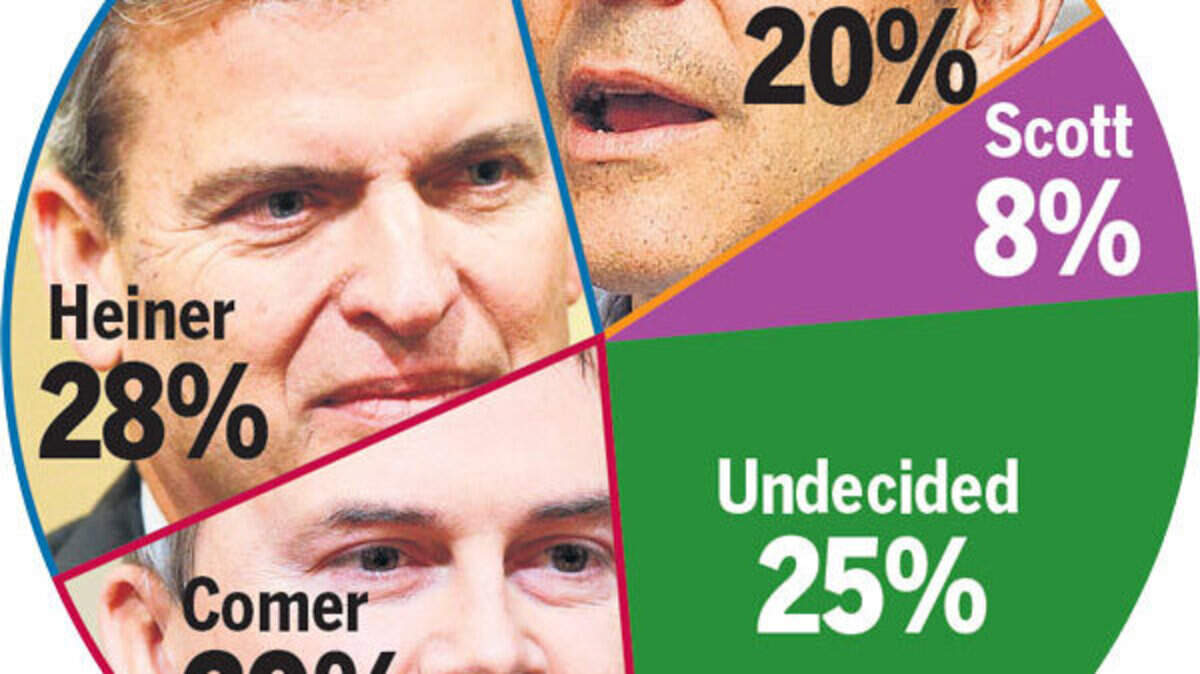
With more than two months to go before the May 19 primary election, the poll shows Heiner garnering support from 28 percent of likely Republican voters. Tied in second place at 20 percent are Louisville businessman Matt Bevin, who lost handily to U.S. Senate Majority Leader Mitch McConnell in last year's U.S. Senate primary, and James Comer, the state's commissioner of agriculture. Recently retired Supreme Court Justice Will T. Scott brings up the rear with 8 percent.
The race remains fluid, with one in four Republicans saying they haven't yet made up their mind about who to support.
"I haven't heard much about anybody," said poll respondent Dessa Dean of Owensboro, who agreed to a follow-up interview with the Herald-Leader.
Stephen Voss, a political science professor at the University of Kentucky, cautioned that the first Bluegrass Poll of 2015 comes "before most voters are paying attention to the gubernatorial race."
"Voters are still fatigued from the Senate race last year, and the campaign organizations have not kicked into full gear, so many people can only offer a rough guess of how they're leaning at this point," Voss said. "What's interesting about an early poll like this one is the way it lays out the advantages each candidate brings to the contest as well as the challenges each candidate faces."
The poll of 529 likely Republican voters, conducted by SurveyUSA on behalf of the Herald-Leader and WKYT-TV in Lexington and The Courier-Journal and WHAS-TV in Louisville, has a margin of error of plus or minus 4.4 percentage points. That means the pollster is 95 percent confident that Heiner's support from likely GOP voters ranges from just under 24 percent to just above 32 percent. Support for Comer and Bevin would range from slightly under 16 percent to slightly above 24 percent.
Heiner has been in the race the longest, having announced his candidacy in early 2014, and has vastly outspent his Republican rivals on television advertising and staffing after giving about $5 million of his own money to the campaign last year.
Heiner had spent almost $1.2 million as of the last financial reporting deadline at the end of 2014, which was well before Heiner dramatically stepped up his spending on advertising and staffing.
In comparison, Comer had spent about $200,000 at the end of 2014 and only began running limited television advertising in late February. It's unclear how much money Bevin, who entered the race in January, has to spend, but he raised more than $5 million in last year's U.S. Senate race, including more than $1.5 million of his own money.
Heiner's strength comes from overwhelming support in the Louisville area, where he ran and lost a Louisville mayoral bid in 2010.
In the Louisville region, Heiner enjoys support from 48 percent of likely GOP voters, giving him a 25-point advantage over Bevin and a 38-point lead over Comer, who is from Tompkinsville.
In Western Kentucky, Comer has the support of 38 percent of likely Republican voters, giving him a 16-point edge over Bevin and a 23-point lead over Heiner.
In north-central Kentucky, which includes the Lexington area and much of Northern Kentucky, Heiner's support from 23 percent of likely voters is four points more than Bevin and seven points more than Comer. One in three voters in the region remain undecided.
Eastern Kentucky is the only region where Scott, who is from Pikeville, garnered double-digit support, at 14 percent. Heiner got 28 percent in the region, putting him 13 points ahead of Bevin and 12 points up on Comer. Twenty-nine percent were undecided.
Jack Bruner, a poll respondent from London, said he met Heiner while he was having coffee recently and said he likes that Heiner is a businessman "who knows how to make a living."
"That was my first contact with him, but he impressed me," said Bruner, who agreed to a follow-up interview with the Herald-Leader.
Broadly speaking, Voss said each of the candidates is performing as expected in the various regions of the state, with the possible exception of Heiner's lead in Eastern Kentucky.
Comer has had a tense relationship with some Eastern Kentucky Republicans, such as U.S. Rep. Hal Rogers, over his efforts to legalize hemp and a speech he gave in Somerset in the fall of 2013 in which Comer said he could not be controlled by "party bosses."
Scott's entrance into the race also seems to have carved up Eastern Kentucky support that might have otherwise gone to Bevin or Comer.
Bevin, meanwhile, is running second in each region of the state, presumably thanks in large part to his high name identification after last year's U.S. Senate race.
"The numbers at this stage mostly represent a combination of name recognition and regional ties," Voss said.
Former Louisville councilman Hal Heiner has the early advantage in what looks to be a competitive three-way race for the Republican gubernatorial nomination in Kentucky, according to a new Bluegrass Poll.
With more than two months to go before the May 19 primary election, the poll shows Heiner garnering support from 28 percent of likely Republican voters. Tied in second place at 20 percent are Louisville businessman Matt Bevin, who lost handily to U.S. Senate Majority Leader Mitch McConnell in last year's Senate primary, and James Comer, state commissioner of agriculture. Recently retired Supreme Court Justice Will T. Scott brings up the rear with 7 percent.
The race remains fluid, with one in four Republicans saying they haven't made up their minds about whom to support.
"I haven't heard much about anybody," said poll respondent Dessa Dean of Owensboro, who agreed to a follow-up interview with the Herald-Leader.
Stephen Voss, a political science professor at the University of Kentucky, cautioned that the first Bluegrass Poll of 2015 comes "before most voters are paying attention to the gubernatorial race."
"Voters are still fatigued from the Senate race last year, and the campaign organizations have not kicked into full gear, so many people can only offer a rough guess of how they're leaning at this point," Voss said. "What's interesting about an early poll like this one is the way it lays out the advantages each candidate brings to the contest as well as the challenges each candidate faces."
The poll of 529 likely Republican voters, conducted by SurveyUSA on behalf of the Herald-Leader and WKYT-TV in Lexington and The Courier-Journal and WHAS-TV in Louisville, has a margin of error of plus or minus 4.4 percentage points. That means the pollster is 95 percent confident Heiner's support from likely GOP voters ranges from just less than 24 percent to slightly more than 32 percent. Support for Comer and Bevin would range from slightly less than 16 percent to just more than 24 percent.
Heiner has been in the race the longest, having announced his candidacy in early 2014, and has vastly outspent his Republican rivals on television advertising and staffing after giving about $5 million of his own money to the campaign last year.
He had spent almost $1.2 million as of the last financial reporting deadline at the end of 2014, which was well before Heiner dramatically stepped up his spending on advertising and staffing.
In comparison, Comer had spent about $200,000 at the end of 2014 and began running limited television advertising only in late February. It's unclear how much money Bevin, who entered the race in January, has to spend, but he raised more than $5 million in last year's U.S. Senate race, including more than $1.5 million of his own money.
Heiner's strength comes from overwhelming support in the Louisville area, where lost a bid for mayor of Louisville in 2010.
In the Louisville region, Heiner enjoys support from 48 percent of likely GOP voters, giving him a 25-point advantage over Bevin and a 38-point lead over Comer, who is from Tompkinsville.
In Western Kentucky, Comer has the support of 38 percent of likely Republican voters, giving him a 16-point edge over Bevin and a 23-point lead over Heiner.
In north-central Kentucky, which includes the Lexington area and much of Northern Kentucky, Heiner's support from 23 percent of likely voters is four points more than Bevin and seven points more than Comer. One in three voters in the region remains undecided.
Eastern Kentucky is the only region where Scott, who is from Pikeville, garnered double-digit support, at 14 percent. Heiner got 28 percent, putting him 13 points ahead of Bevin and 12 points up on Comer. Twenty-nine percent were undecided.
Jack Bruner, a poll respondent from London, said he met Heiner while having coffee recently and liked that Heiner is a businessman "who knows how to make a living."
"That was my first contact with him, but he impressed me," said Bruner, who agreed to a follow-up interview with the Herald-Leader.
Broadly speaking, Voss said, each of the candidates is performing as expected in the various regions of the state, with the possible exception of Heiner's lead in Eastern Kentucky.
Comer has had a tense relationship with some Eastern Kentucky Republicans, such as U.S. Rep. Hal Rogers, over his efforts to legalize hemp and a speech he gave in Somerset in fall 2013, in which Comer said he could not be controlled by "party bosses."
Scott's entrance into the race also seems to have carved up Eastern Kentucky support that otherwise might have gone to Bevin or Comer.
Bevin, meanwhile, is running second in each region of the state, presumably thanks in large part to his high name recognition after last year's U.S. Senate race.
"The numbers at this stage mostly represent a combination of name recognition and regional ties," Voss said.
This story was originally published March 10, 2015 at 6:00 PM with the headline "Bluegrass Poll: Hal Heiner has early advantage in GOP race for Kentucky governor."