
In low-turnout election, Republican candidates in Kentucky see young voters as secret weapon
RICHMOND — Caitlin Brock spoke briefly with Republican gubernatorial candidate Hal Heiner before apologizing and leaving suddenly.
"I have an exam, so I have to go," she told Heiner.
Brock, head of the College Republicans at Eastern Kentucky University, was instrumental in organizing last week's Politics on the Plaza at the school, bringing three of the Republican candidates for governor together on an overcast spring day.
She might have had to run to take an anatomy exam, but Heiner and the rest of the Republican field are hoping young voters like Brock will turn out for them in the May 19 primary, possibly making the difference in a four-way race where turnout could be less than 15 percent.
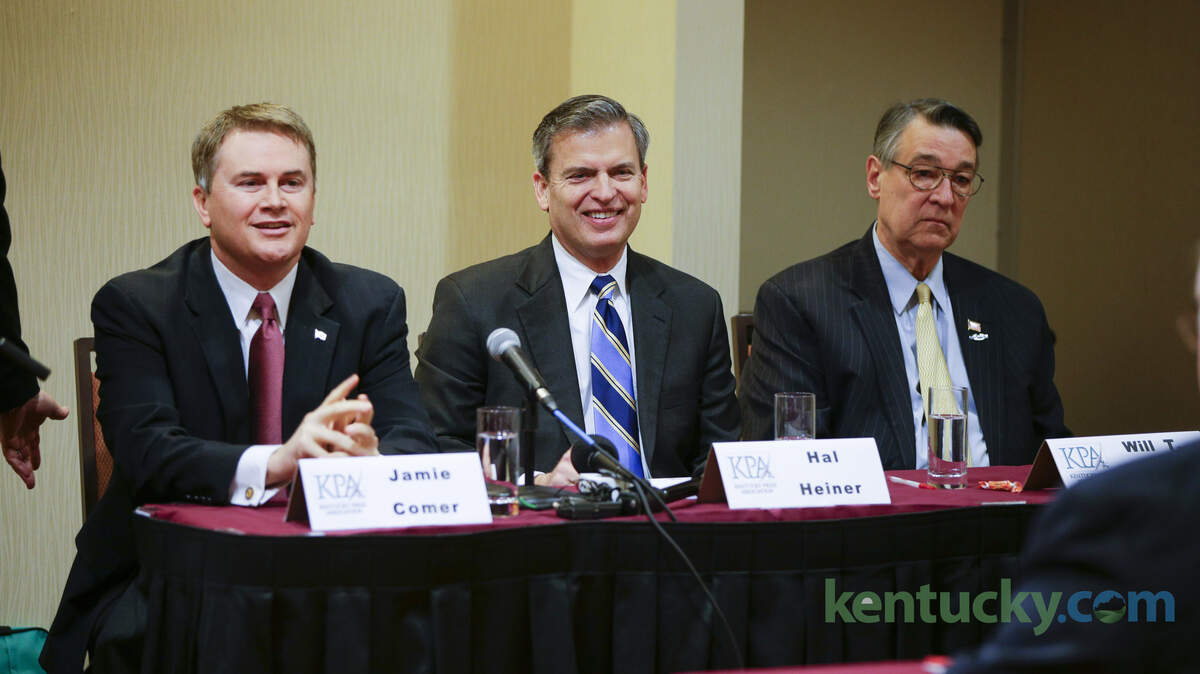
So there they were — Heiner, Commissioner of Agriculture James Comer and Louisville businessman Matt Bevin — mugging for smartphone pictures while the students mingled and ate pizza.
Bevin's running mate, Jenean Hampton, tried her hand at "bear pong" next to a table set up by the Young Americans for Liberty group. She tried to bounce a rubber ball in buckets with labels like "Balance the budget" and "Repeal Obamacare" while a student played defense, swatting the ball away with a cutout of President Barack Obama's head.
Nearby, state Rep. Ryan Quarles, a candidate for commissioner of agriculture, sipped a Red Bull while state Rep. Jonathan Shell, the youngest member of the state legislature, slipped on some free plastic College Republicans sunglasses, hoping to hide his bloodshot eyes after a long last night of the General Assembly in Frankfort.
While so much has been made in recent years about the importance of millennial voters who were crucial to getting Obama elected, the trend hasn't really materialized in Kentucky.
The state's Republican candidates are hoping to change that.
According to the Center for Information and Research on Civic Learning and Engagement, more than 10 million millennials — voters ages 18 to 29 — turned out to vote in last year's midterms nationwide, and they largely voted for Democrats.
Now, Comer and others are betting heavily that they can attract young voters to the GOP in hopes that will put them over the top in May.
At 42, Comer is the youngest candidate in the field, and regardless of the audience, he almost always mentions what he thinks is the "terrible" job the Republican Party has done courting young voters.
"The Republican Party has not done a good job trying to attract and inspire the next generation of leaders," Comer told a group of more than 100 young professionals at a recent campaign event at Lexington's Jefferson Davis Inn.
To try to win over those young voters, Comer is talking about "reversing the brain drain," making the state a hub for technology that attracts young entrepreneurs, easing access to credit, and lessening the burden of student loans.
"We want to inspire young professionals to get involved in this campaign," Comer told the crowd. "We want the young professionals and our county youth chairs to be integral parts of this campaign."
At the event at EKU, Comer had the largest crowd, a group of about 20 college students who call themselves Colonels for Comer. There are similar groups at most of the state's other schools, including Racers for Comer at Murray State University and Eagles for Comer at Morehead State University.
Comer said he has a youth chair in almost every county and a group of 125 young professionals from around the state.
"In all honesty, we have a movement among the 18-to-35 crowd," Comer said later, even as he acknowledged that the vast majority of voters in May probably will be much older.
But the candidates aren't just using issues like student loans and college costs to draw young voters, they are utilizing technology and social media to speak the language of a new generation.
In Richmond, Comer posed for pictures with students, then asked them to post the snapshots on social media.
He's also drawing some familiar names to his youth movement, including former Miss Kentucky Jessica Casebolt and John Y. Brown IV, a Bellarmine University junior whose grandfather was governor and a Democrat. Brown said he was supporting Comer after shadowing him at the Department of Agriculture.
"I think that he has a message that can really appeal to young voters," Brown said.
For Heiner's campaign, the hope is that the former Louisville councilman's message of being a Frankfort outsider will appeal to a generation that might feel disconnected or forgotten by state government.
"Younger voters are tired of Frankfort insiders who are more focused on themselves than helping Kentucky's next generation of leaders," said campaign spokesman Doug Alexander. "These voters are drawn to a conservative outsider like Hal Heiner who has a record of attracting over 4,000 jobs to Kentucky."
Alexander said the campaign "has invested heavily in our digital outreach with the goal of reaching younger people."
"That has resulted in us connecting with close to 7,000 young people on Facebook with whom we communicate with daily and found them to be the best social sharers we have," Alexander said. "We have also worked to bring on young people on Twitter, which skews significantly younger."
Bevin regularly holds Youth for Bevinevents, but campaign manager Ben Hartman did not respond to requests for comment about how Bevin is trying to reach young voters or how many are responding to the effort.
Brandon Love, treasurer of EKU's College Republicans, said he voted for Bevin in his U.S. Senate primary against incumbent Mitch McConnell last year and plans to vote for Bevin again.
"Overall, I just think he's the better candidate," Love said. "I voted for him (in 2014). I think that's where his name came up for me."
As spring flirts with college campuses and the May 19 primary inches nearer, the candidates and the students realize they have an uphill battle in trying to excite and move young voters to the polls.
Nolan Pettit, an EKU freshman from Webster County, is the head of Colonels for Comer, and he conceded that his age group was not a reliable voting bloc.
"That's what I'm trying to get past," Pettit said. "He's a candidate that really cares about the youth here in Kentucky and really has a plan for us. Hopefully if I can get the student base to see that, they'll want to come out and vote too."
This story was originally published March 29, 2015 at 6:02 PM with the headline "In low-turnout election, Republican candidates in Kentucky see young voters as secret weapon."