
Gubernatorial profile: Will T. Scott says his 'lunchpail ticket' can't be corralled by wealthy
Editor's note: This is the first of four profiles of Kentucky's Republican candidates for governor.
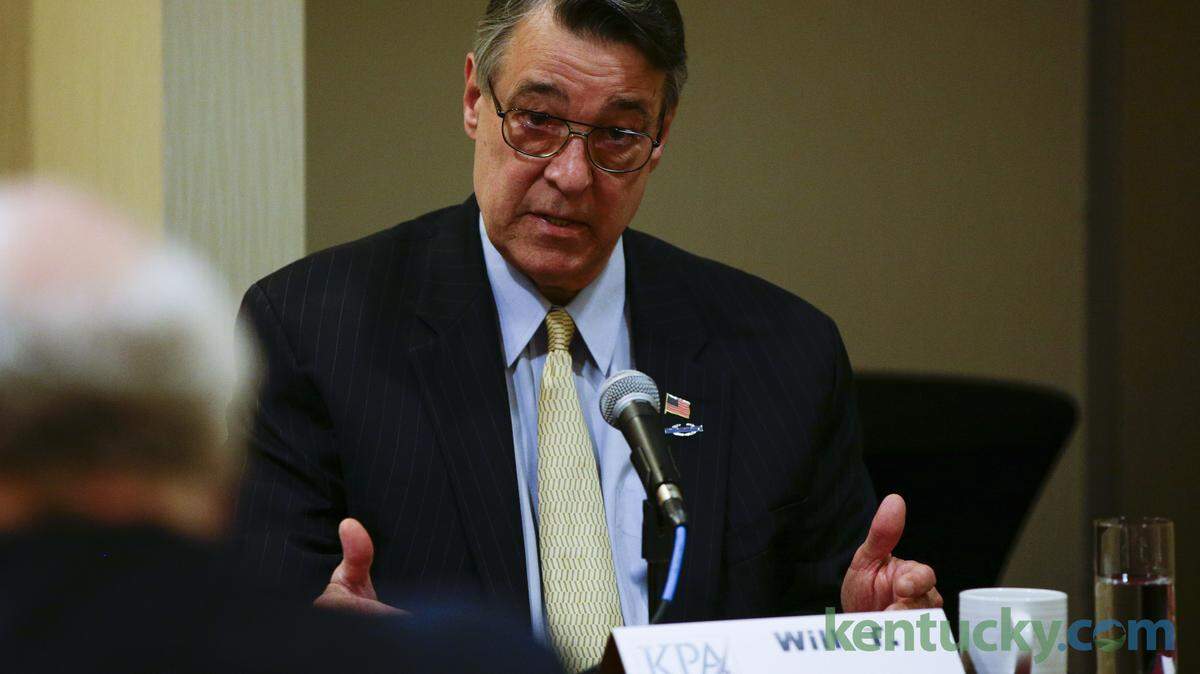
LOUISVILLE — Polls show former Kentucky Supreme Court Justice Will T. Scott running a distant last in the four-way primary to become the Republican nominee for governor on May 19.
But he's not worried.
"It's playing out exactly how I planned it to play out ... I'm going through the smoke and the rubble and I'll walk across the finish line first," said the Vietnam War veteran, tax lawyer, litigator, and former circuit judge. "And they'll be wounded and staggering around with swords in their hands and everything."
Scott, 67, known to most as Will T., was referring to the previous hour in front of the Louisville Forum, where he'd watched his three better-funded and higher polling opponents — Louisville businessmen Hal Heiner and Matt Bevin, and Agriculture Commissioner Jamie Comer — fret and fuss at each other over negative advertising from a political action committee that supports Heiner.
"I'm going to stay out of this fight," Scott told the crowd, drawing a big laugh.
Instead, Scott urged people to vote for him and his running mate for lieutenant governor, former Menifee Sheriff Rodney Coffey, saying they are the "lunch-pail ticket," the only down-to-earth candidates who will fight for the little guy.
"If the working people really want solutions, they should look at us," he told the crowd. "No wealthy people can put corrals around us because we don't take well to bit and bridle."
His Pike County twang stands out next to the newscaster accents of big city businessmen like Heiner and Bevin, and he's largely running his own campaign, unlike the larger, statewide networks of his opponents. He says he's raised about $100,000 so far, while the other candidates flaunt substantially larger war chests. (Scott is not required to report his primary campaign donations to the Kentucky Registry of Election Finance until Wednesday.)
Scott is less interested in modern campaign analytics than in having some fun: In his 1995 race for Attorney General against Ben Chandler, Scott hired a man to parade around Chandler's events in a chicken suit to goad him into a debate. Most of his campaigns, including this one, have featured the former paratrooper jumping out of an airplane. He's also driven a mule team from Pineville to Barbourville, walked across his Supreme Court district, traveled in a bass boat down the Ohio River, and last week, got a pie thrown in his face for a literacy group.
His campaign website displays pictures of his three sons and grandchildren, plus several photos of his three bird dogs, with whom he shares his Miller's Creek cabin after four divorces.
"It's fun to run against someone like that who makes the campaign more fun," said Chandler. "He's very attractive in that he doesn't take himself too seriously."
Neither, it seems, do most political pundits. But even Scott's worst enemies would tell his opponents not to rule him out just yet.
"He's a very, very talented, charismatic campaigner and he's very effective and closes very fast," said Prestonsburg attorney Ned Pillersdorf, whose wife, Janet Stumbo, lost two bitter, name-calling Supreme Court races to Scott, despite polls that showed her ahead.
Many have wondered why Scott would give up his spot on the Supreme Court, along with its job security and general gravitas, in order to run what is expected to be a losing campaign for governor. Some observers ask if Scott is helping out Heiner or Bevin by hurting Comer's chances in Eastern Kentucky, where Scott's name recognition is highest.
But Scott dismisses these theories with one of his frequent waves of the hand.
"I'm 67," Scott responded. "I've got a lot of good years left as long as my parachutes work ... and I have answers and I'm telling you it's my obligation on this earth to make it better. Until the people say I'm free, and when I'm free then it's time in Alaska, down in Florida, the Smokies, me and the dogs will take off."
'An intellectual giant'
Scott grew up in Pike County, descended from the McCoys of Hatfield and McCoy fame, and less well-known but earlier settlers, including the Weddingtons, who owned much of the property that became Pikeville. He attended Eastern Kentucky University before leaving to serve in Vietnam with the U.S. Army.
Scott returned to the University of Pikeville, then received his law degree and a master's in tax law from the University of Miami.
He came home in 1975 and worked at the Pikeville National Bank, then spent his early legal career as both a public defender and an assistant commonwealth's attorney.
In 1983, Scott ran for Pike Circuit Court judge, where he claims to have halved the backlog of cases. He started making headlines, too, in an infamous case of a farmer who sued Bethlehem Steel for illegally taking coal from his property. The dispute started in 1964; in 1987, Scott ruled against the company, citing "callous and reckless disregard for the property rights of the defendants."
He ordered Bethlehem to pay $17 million in damages. After numerous appeals and hearings in front of the Kentucky Supreme Court, Scott's decision was upheld and Bethlehem's eventual payout was more than $40 million.
In 1988, Scott stepped down to run an unsuccessful campaign for Congress against incumbent U.S. Rep. Carl Perkins, and in 1995, he lost the Attorney General race to Chandler. Back in private practice in Pikeville, he waited until 2004 to run against Supreme Court Justice Janet Stumbo, the first woman elected to the court.
Scott and Stumbo played rough; his ads accused her of being soft on crime and using her maiden name because it was a powerful one in the region. She called him out for wearing judge's robes in an ad even though he no longer was a judge.
Ashland businessman and Democratic activist Marcus Woodward said those campaigns made Scott infamous among Democrats and women of both parties.
"He's used some campaign tactics that are less than honorable," Woodward said.
But when Scott got to the Supreme Court in 2004, he surprised some people with numerous opinions that displayed the sharp intellect that lurks under his folksy exterior, said fellow Justice Dan Venters.
"He kind of keeps that hidden, but he's an intellectual giant, and he's firm and well reasoned in his convictions," said Venters, who is not endorsing anyone in the race. "He's not dogmatic or ideological; he listened to different viewpoints with an open mind."
Scott helped develop a system for helping veterans returning from the Middle East negotiate the court system.
"They were suffering from PTSD (post traumatic stress disorder), and we didn't know it and they didn't know it," Scott said.
Scott's most famous decision also took aim at powerful coal interests. In 2011, in a 4-3 vote, he wrote the opinion that found coal miners with black lung had been wrongly forced to undergo much more rigorous screenings than other workers to prove their ailments and get benefits.
"It was a decision whose time had come," Scott said. "It was unfair treatment to the extent it crossed constitutional boundaries."
That's why Scott says he does not benefit from the coal industry's still powerful influence in statewide political races.
"We don't have people throwing money at us and that's because I don't wear a bit and a bridle well," he said. "I come out to see what's right and wrong and try to correct it."
Ethics questioned
Issues of right and wrong, however, have dogged Scott throughout the years. He made headlines in 2008 when officials decided to build a new courthouse in downtown Pikeville, which required the Administrative Office of the Courts to buy several buildings belonging to Scott and his family. Scott said there was no conflict of interest because he didn't want to sell the buildings.
Later that year, Scott became embroiled in an employment controversy involving his son, Andrew. At the time, Andrew Scott was an AOC employee, who was promoted despite a pending felony drug charge in Virginia. Andrew Scott was sued by another AOC employee who said she was fired to make room for the younger Scott. (Her lawyer was Ned Pillersdorf).
The AOC refused to answer other questions about the promotion — including whether Andrew Scott had notified the AOC of the drug charge, whether he was subjected to any disciplinary proceedings or if Scott's familial ties helped him get the promotion.
Will T. Scott denied any involvement in the decision. Andrew Scott later resigned from the AOC and is now mayor of Coal Run in Pike County. In a plea agreement, he pleaded guilty to a Class 2 misdemeanor.
During his 2012 re-election campaign, Will T. Scott put Eric C. Conn on his campaign committee. At the time, Conn was a multi-millionaire attorney facing federal investigations for allegedly rigging medical records in disability cases. Then Scott received $10,000 in $1,000 money orders from 10 of Conn's employees, which Scott returned because he said they seemed suspicious. In 2013, Conn pleaded guilty to a misdemeanor, but served no time in prison and kept his law license. Scott was never accused of wrongdoing because he returned the donations, state officials said.
Marcus Woodward said Scott's ethical issues are well known in Eastern Kentucky, but it's not clear if either his problems or his achievements mean much in the wider state.
"He's pretty well-known in Eastern Kentucky, but I just don't think his influence is as far-flung as perhaps his perception of it is," Woodward said.
Saving drug addicts
Scott has many typical Republican stances: he wants to lower the corporate tax rate, make government smaller, and allow charter schools to compete with public schools. He opposes gay marriage.
He has less traditional views on other issues, such as using expanded gambling to solve the state's $21 billion unfunded pension liability. He would put casinos at five racetracks around the state and capture what he says are millions of dollars going to other states.
He also wants to reinvigorate Eastern Kentucky's flagging coal industry with cleaner power plants that use coal in conjunction with gas and biofuels.
Having suffered through the drug addiction of one of his sons, Scott wants to solve Kentucky's widespread drug addiction problem by lessening the number of addicts in prison with more drug treatment.
"We are not winning our War on Drugs, and we're going to kill a lot more of our children if we don't do something," he said. "Kentucky can't be safe until we save them."
To that end, he would turn some prison facilities into de facto treatment programs. Upon completion, the former addict would be released under the supervision of a probation officer and a judge.
'I'll win in November'
Scott has been married four times and has three sons from his first marriage. His fourth marriage was to Dea Riley, his campaign manager for both of his Supreme Court runs. She later ran on the gubernatorial ticket with the late Gatewood Galbraith.
Scott's third wife, Tracey Damron, said Kentucky could not do better than to elect her former husband.
"He does have the will and desire and fortitude to do what needs to be done," she said. "He's a leader, but he's very humble. He's book smart and street smart. He has it all and he's proven that in his service to all of us."
Being governor has "been on Scott's bucket list as far back as I can remember," said Rep. Leslie Combs, D-Pikeville, who calls herself a good friend of Scott although she will be supporting Democratic candidate Jack Conway. "If he were given that opportunity, I think he would do a wonderful job."
Scott said he believes people from both sides of the political aisle will support him in the general election because "I have the solutions to Kentucky's problems. I believe they will elect me on May 19 and when they do, I'll win in November."
This story was originally published April 18, 2015 at 9:00 PM with the headline "Gubernatorial profile: Will T. Scott says his 'lunchpail ticket' can't be corralled by wealthy."