
Proposed regulations would let companies erect digital billboards, cut trees along Kentucky highways
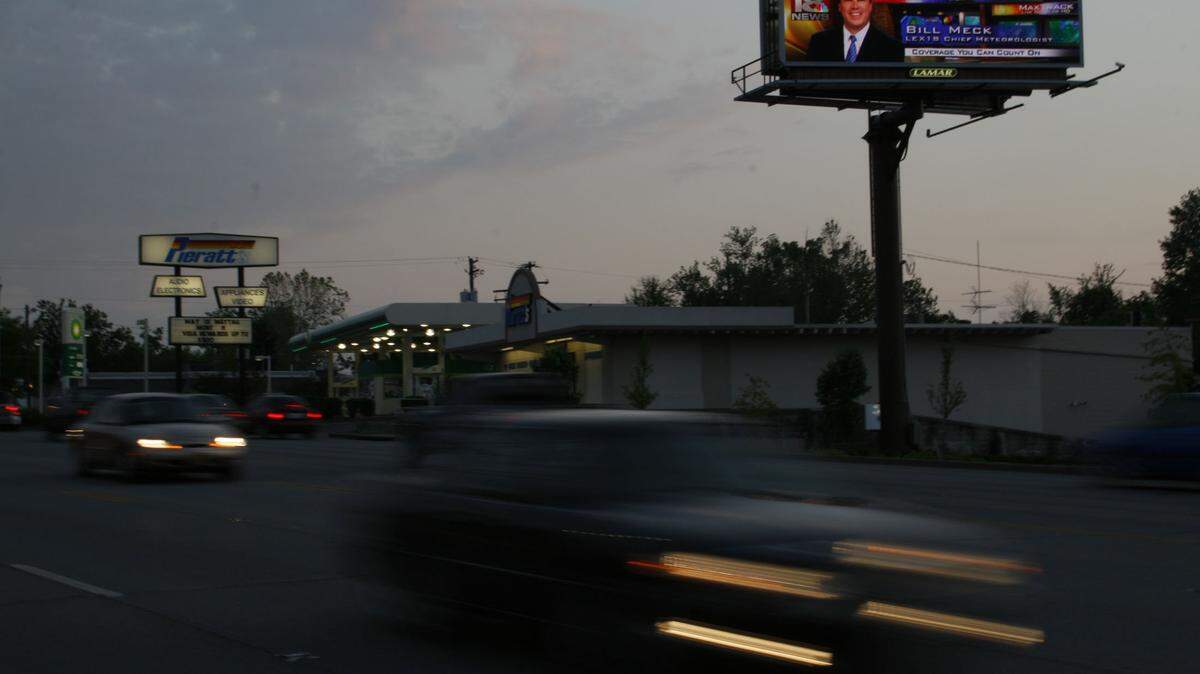
Environmental groups and billboard industry representatives wrangled in Frankfort on Friday over proposed new regulations that would allow digital LED billboards throughout the state and let billboard owners cut trees on public rights of way that block visibility of their outdoor advertisements.
Environmental groups, including Scenic Kentucky and the Sierra Club, argued in a public hearing that the proposed rules could lead to an explosion of light-polluting billboards, environmental destruction and property devaluation.
Lobbyist for the outdoor advertising industry countered that the regulations would actually decrease the number of billboards in the state, and that vegetation would be removed in an environmentally responsible manner.
The regulations were presented by Kentucky Transportation Cabinet officials Friday as a compromise proposal after about 18 months of meetings between the industry, environmentalists and state officials. However, the environmental groups made clear Friday that they aren't happy with the proposed rules.
The billboard industry has long pushed state lawmakers to create a new law that would allow them to cut vegetation on public rights of way that obstruct the view of billboards located on private property, but the General Assembly has repeatedly rebuffed the idea.
The industry now hopes to bypass lawmakers by asking the Transportation Cabinet to create regulations that rely on the authority of existing laws to accomplish the same outcome.
Transportation Cabinet spokesman Chuck Wolfe said existing state billboard regulations are outdated and difficult to enforce, noting that they don't specifically address LED billboards that have already begun popping up in some locations.
In addition, he said federal officials have been pressuring the cabinet to improve weak enforcement of billboard regulations. Without change, the federal government could take away 10 percent of federal highway funds, Wolfe said.
"If you rely on legislation, there's no guarantee that it's going to be passed anyway, or that it's going to be passed in a way that's agreeable to everyone involved," Wolfe said. "There was give and take on all sides, but the cabinet's position is that we have, at the end of the day, a new set of regulations that are practical and enforceable and treat everyone fairly."
The regulations could take effect as early as October after being reviewed by the legislature's Administrative Regulation Review Subcommittee and the Interim Joint Committee on Transportation.
If approved, the regulations would allow billboard companies to take down four traditional billboards to create one new LED billboard, or the companies could take down three static billboards to convert one static billboard into an LED billboard, which has an electronic screen that cycles through advertisements.
Industry lobbyist Leigh Ann Thacker said this swapping policy would decrease the number of billboards in the state.
"The idea that it's a proliferation of boards is completely unfounded," Thacker said. "It doesn't expand new opportunities for new locations."
The environmental groups argued that LED billboards will create light pollution that affects nearby residents, causes dangerous distractions for drivers and tarnishes the aesthetics of Kentucky's highways.
"Time and again, they have proven to be a nuisance and dangerous," said Paul Bergmann, executive director of Scenic Kentucky, which works to lessen the environmental and visual impact of cell phone towers, billboards and road expansions.
Digital billboards are illegal in parts of Arizona because of light pollution.
A study in Traffic Injury Prevention, a journal that covers crash prevention and injury control, found that digital billboards hold the gaze of drivers for longer than traditional "static" billboards whether during night or day, but there were no data in the study to suggest that it was enough to cause a safety hazard.
Thacker said the lights in LED billboards would emit about the same amount of light as a street lamp.
Environmentalists also took issue with a change that would allow billboard companies to trim trees and other plants that obstruct the view of their billboards.
Under the proposed rules, before applying for a permit from the state highway department the companies must hire a certified arborist to accompany them to the scene of the billboard and must discuss with the U.S. Department of Fish and Wildlife which types of plants will be affected by the trimming.
Ruth Bamberger, a member of the Cumberland chapter of the Sierra Club, said she worried that certain endangered plants, along with the habitat for bees and butterflies, could be damaged by billboard companies.
Bamberger said the bee and monarch butterfly populations have dropped dramatically in recent years. If billboard companies made a point to replant certain types of plants, they could reduce any collateral damage to these struggling populations, she said.
"I would hope the billboard industry and transportation cabinet would take into consideration the type of plants that would bring these populations back," said Bamberger, who advocated using milkweed to attract bees.
Thacker said the industry would work with arborists, the U.S. Department of Fish and Wildlife and environmental groups to make sure the correct trees, flowers and shrubs are protected and replanted.
"If milkweed is a good suggestion, we'll certainly take that into consideration," Thacker said. "We really do want to partner not only with the cabinet, but with Scenic Kentucky and the Sierra Club to make sure we are doing this in a thoughtful manner."
This story was originally published May 22, 2015 at 7:02 PM with the headline "Proposed regulations would let companies erect digital billboards, cut trees along Kentucky highways."