
Emotional moments follow ruling in Kentucky's same-sex marriage case
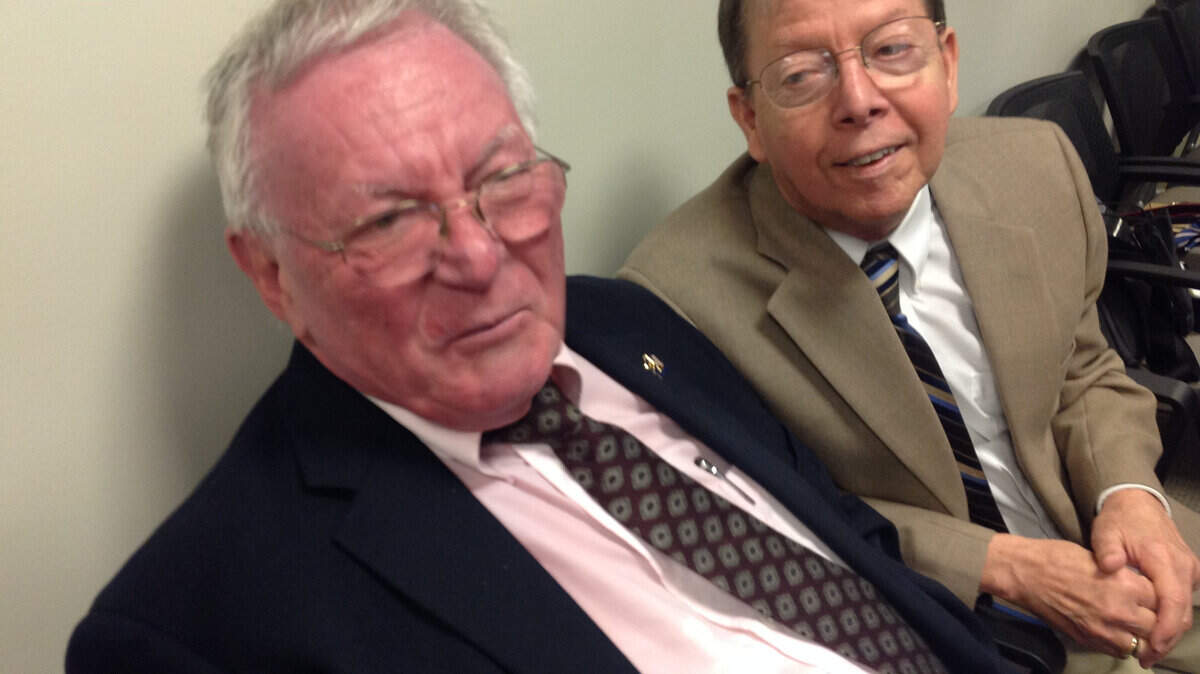
LOUISVILLE — Luke Barlowe and Jim Meade of Bardstown met 48 years ago and married in 2009 in Iowa. But, as Barlowe said 90 minutes after the Supreme Court declared their marriage legal in Kentucky, the two men had never held hands in public here.
Just then, Meade gingerly put his hand atop Barlowe's. The move left Barlowe speechless for a few moments, then he said, "Watch this," and the two men kissed.
It was an emotional moment at a jubilant gathering of the lawyers and plaintiffs who helped take the fight for gay marriage to the U.S. Supreme Court and emerged victorious Friday.
Plaintiffs Timothy Love and Larry Ysunza said they have lived together for 35 years and plan to marry in October.
"We're going to see the end of a lot of engagements in Kentucky," Love said.
Later Friday, backers of same-sex marriage celebrated at rallies organized by the Kentucky Fairness Coalition in Lexington, Louisville and Bowling Green.
Michael Harrington and fiance Matthew Frederick, who were engaged in July, were among the first of about 200 to gather in Lexington's Courthouse Plaza for the 5:30 p.m. rally.
Harrington waved a large pride flag throughout the event, where Lexington Fairness Chairman Josh Mers roused the crowd before introducing a number of speakers, including state Sen. Reginald Thomas, D-Lexington, and Fayette Family Court Judge Lucinda Masterton.
Plaintiffs Barlowe and Meade also attended, with Barlowe giving an emotional speech and then requesting a hug from Scott Shive and Marc Roland, the first same-sex couple to marry in Lexington Friday.
In a statement earlier in the day, Lexington Mayor Jim Gray, one of Kentucky's few openly gay politicians, said the court's decision "means a lot to me personally."
"Today's Supreme Court decision affirms our shared values of equality, freedom and dignity," Gray said. "That is the American way; a way we can all celebrate."
Attorneys Dan Cannon and Laura Landenwich said the ruling ends "a very long journey."
"Our clients are not second-class citizens," Landenwich said. "They are loving people, and this shows (that) the court — at least five of them, and that's all that matters — are on the right side of history."
Landenwich said she was sorry that U.S. District Judge John Heyburn of Louisville, who struck down Kentucky's ban on same-sex marriage, did not live to see his ruling affirmed by the high court. Heyburn died April 29. (EDITOR'S NOTE: Heyburn's date of death was incorrect when originally published. It was corrected June 27, 2015.)
U.S. Congressman John Yarmuth also remembered Heyburn in his statement.
"His courageous decision was an important step to reaching this place and this time, and his legacy will forever be intertwined with a more fair and more equal America," Yarmuth said.
Chris Hartman, director of the Fairness Coalition, said he was mindful of the many gay couples "who never got to see this day."
Hartman said that only eight Kentucky communities have adopted fairness ordinances to ban discrimination in housing and public employment.
"There's still much work left to be done," he said.
Not everyone was pleased with the ruling.
Paul Chitwood, executive director of the Kentucky Baptist Convention, said he wasn't surprised.
"Given the tenor of the court and the culture, frankly, I would have been shocked by any other outcome," he said. "Moving forward, one of the most pressing questions now regards religious liberty. Does the ruling threaten this foundational principle of American law and life? ... Appealing to the First Amendment, biblically faithful Baptists in Kentucky will continue to preach and teach God's truth on the sanctity of marriage between one man and one woman, as well the sinfulness of the homosexual lifestyle."
Politicians reacted along party lines.
Matt Bevin, the Republican candidate for governor, said he disagreed with the majority opinion.
"When the definition of marriage was put on the ballot 10 years ago, 74 percent of Kentuckians made it clear that they supported traditional marriage," he said in a statement. "Since that time, however, activist judges have chosen to ignore the will of the people, and to ignore the Constitutional principle of state's rights."
The Democratic candidate, current Attorney General Jack Conway, defended his decision last year not to fight Heyburn's decision to strike down Kentucky's ban.
"I agreed with his legal analysis and used the discretion given to me by statute to inform Gov. Beshear and the citizens of the commonwealth that I would not waste the scarce resources of this office pursuing a costly appeal that would not be successful," Conway said in a statement Friday. "The ruling does not tell a minister or congregation what they must do, but it does make clear that the government cannot pick and choose when it comes to issuing marriage licenses and the benefits they confer. It is time to move forward because the good-paying jobs are going to states that are inclusive."
Beshear hired private lawyers in the appeal.
The decision opens the door for many Kentuckians who wish to get married, but it also pleases same-sex couples who chose to be wed in other states.
University of Kentucky law professor Allison Connelly called Friday the second-happiest day of her life.
"The first-happiest day was when I married my spouse," said Connelly, a University of Kentucky law professor whose wedding was held in San Francisco in 2008. "We are over the moon."
For Lujza Nehrebeczky Hayes, the decision brought relief.
A Hungarian immigrant, Hayes has been with spouse Joy Hayes for 11 years. After the Supreme Court struck down the federal Defense of Marriage Act, they got married in Connecticut. Now their marriage will be recognized in Kentucky, and she can begin the road to citizenship.
"I am overwhelmed with relief because this has been a particularly hard road for us," said Lujza Hayes, who had just received a congratulatory phone call from her mother in Hungary.
The Hayes have long wanted to start a family, Lujza Hayes said, but in Kentucky, there's no second-parent adoption of a partner's biological child.
"Hopefully this will now change," she said.
Joan Callahan and Jennifer Crossen have been together since 1988 and got married in 2013. Callahan said her first call Friday morning was from their daughter-in-law, who has an eight-month-old son.
"She said, 'If my son grows up to be gay, I want him to be able to get married,'" Callahan said.
This story was originally published June 26, 2015 at 2:47 PM with the headline "Emotional moments follow ruling in Kentucky's same-sex marriage case."