
McConnell’s civil rights record sets him apart
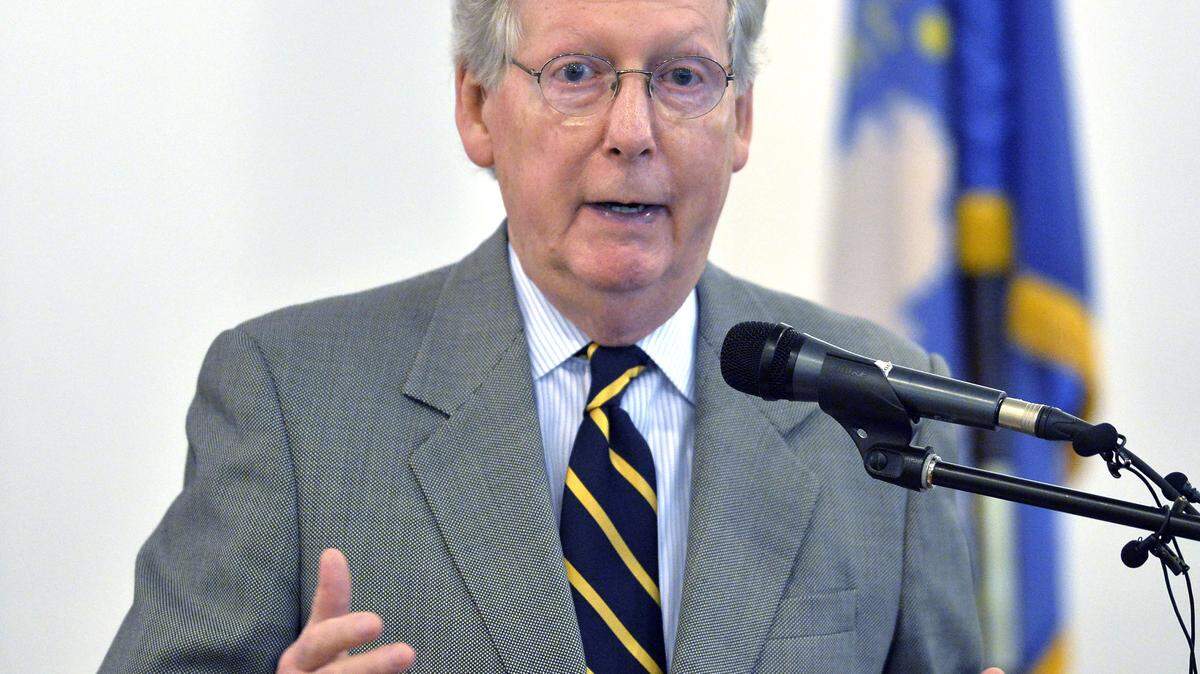
WASHINGTON — Last spring, Marc H. Morial, the president of the National Urban League, found himself in a place he has come to know well over the years, across a desk from Sen. Mitch Mc-Connell, the majority leader, talking about public policy.
Morial’s question this time was pointed: What was going on with the confirmation vote for Loretta E. Lynch, President Barack Obama’s nominee for attorney general, which Mc-Connell had been dragging out for months over an unrelated imbroglio with Democrats.
“He said, ‘I believe she will be confirmed,’” Morial recalled. But what McConnell did not tell him — or anybody else for that matter— was that it would happen with his vote.
While McConnell’s aye in favor of Lynch may have startled many of his Republican colleagues, it was consistent with his nuanced, sometimes surprising, sometimes contentious record on civil rights that has placed him apart from some Republican colleagues.
In recent years, McConnell’s longstanding commitment to civil rights legislation has come into conflict with his party’s push for state-imposed limits on early voting, voter identification requirements and other measures that Democrats say are intended to disenfranchise minorities.
Eyes will now turn to Mc-Connell, an early voice calling for the removal of the Confederate battle flag from the South Carolina Capitol, after a major skirmish in the House last week over the use of the flag on federal land.
“One thing I am not in favor of erasing is our history,” he said, referring to the removal of statues, not the House debate on the flag. “The Civil War was a part of our history and there were actually good people on both sides of that war.”
McConnell’s interest in race issues was inspired by his upbringing in Kentucky by parents who opposed segregation. It was fermented on the campus of the University of Louisville, where he encouraged students to march with the Rev. Dr. Martin Luther King Jr. It was reinforced by his internship in the office of Sen. John Sherman Cooper, a Kentucky Republican who helped break the Southern-led filibuster of the Civil Rights Act of 1964.
It also surfaced during his first term in the Senate, when McConnell’s vote helped Congress override President Ronald Reagan’s veto of a measure imposing sanctions on South Africa during apartheid, and has persisted through his years in the U.S. Capitol, most recently last month, when McConnell stood before reporters and said that a statue of Jefferson Davis, the president of the Confederacy, should be removed from Kentucky’s Capitol.
McConnell’s strong feelings about racial equality began with his parents, whom he often refers to as “very enlightened Southerners” who were involved in the National Urban League.
“I was born in North Alabama, and when I was a little kid, I remember segregated movie theaters, segregated drinking fountains, segregated schools,” he said. “We had a day off for Robert E. Lee’s birthday, along with Lincoln’s. The Civil War was omnipresent.” During college, he served as an intern in Washington and attended King’s “I Have a Dream” speech in 1963 — “You could see a massive throng of humanity down to the memorial” — and wrote a college editorial excoriating opponents of civil rights. He worked as an intern for Cooper, opening mail, much of which was from constituents unhappy with the senator’s support for the Civil Rights Act.
McConnell, 73, recalled, as he often does, asking Cooper how he could handle the overwhelming pressure. His boss told him, “There are times when you are supposed to lead, and other times to reflect the views of your state, and I think it is time to lead,” he said. “That was pretty inspirational to a young guy just going to law school.”
In 1986, McConnell was among 31 Senate Republicans who voted to override President Ronald Reagan’s veto of legislation imposing stiff economic sanctions on South Africa. At the time, he said of Reagan: “I think he is wrong. We have waited long enough for him to come on board.” In 2002, McConnell was one of the principal authors, with Sen. Christopher J. Dodd, D-Conn., of the Help America Vote Act, which helped modernize state voting systems after the debacle of the 2000 presidential election.
But in 2007, in keeping with his party’s move to the right on voting rights, Mc-Connell proposed an amendment to a Senate immigration bill that would have amended that same act to require that all voters show photo identification.
Civil rights groups are now pressing McConnell to support a new wave of legislation that would curb racial profiling practices by law enforcement officials and that would restore voting rights provisions stripped away by the Supreme Court in 2013. That ruling allowed nine states, mostly in the South, to change their election laws without advance federal approval, known as preclearance.
McConnell has shown little support for measures intended to strengthen that law, noting more than once that “America is very different from what it was in the 1960s.” There is legislation in the House and the Senate that would reinstate federal supervision of elections in states where there has been a history of voter discrimination. Many Republicans have criticized these efforts as unfairly singling out states and as failing to address voter fraud.
The NAACP gives Mc-Connell poor grades on its congressional report card, largely because he has not supported Obama’s health care law and programs to aid the poor, but also because he has not voiced support for the voting rights and profiling measures.
Civil rights leadership requires “a continuation” of progress toward equal treatment, said Hilary O. Shelton, a senior vice president at the NAACP.“If you look at the Racial Profiling Act,” Shelton added, referring to the 2013 law, “we are not seeing leadership coming from him, but if you asked anyone at the King Center, they would say Dr. King would have wanted a racial profiling act.”
Morial of the National Urban League said, “He is not committed to it, but I also have not heard him say he is opposed.” “He knows how deeply we feel,” he said. “He is a straight shooter. He is not going to duck or dodge. He is not going to sit in his office and tell me he is going to do something and not do it.”
This story was originally published July 12, 2015 at 6:34 AM with the headline "McConnell’s civil rights record sets him apart."