
Bluegrass Poll: Less than half of Kentucky Democrats approve of Obama's handling of foreign policy
A majority of Kentucky voters continues to view the economy as the top issue facing the United States, but a growing number say foreign policy is the nation's most serious concern, according to the latest Bluegrass Poll.
Fifty-four percent of respondents said the economy is their top issue — down slightly from 56 percent in late July — but the percentage of voters who chose foreign policy as their biggest concern has doubled after a summer when the Islamic State in Iraq and Syria, also known as ISIS, entered the consciousness of Americans with graphic beheadings of American journalists and a terror campaign across the Middle East.
In the latest Bluegrass Poll of 730 registered Kentucky voters, 9 percent said foreign policy is the most important issue facing the U.S., up from 4 percent when the same question was asked in late July.
The Bluegrass Poll was conducted Sept. 29 to Oct. 2 by SurveyUSA for the Herald-Leader and WKYT-TV in Lexington and the Courier-Journal and WHAS-TV in Louisville. It has a margin of error of plus or minus 3.7 percentage points.
Three out of every four Kentucky voters approve of President Barack Obama's decision to use American airstrikes to fight ISIS, but a majority of the state's voters disapproves of how Obama has handled foreign policy.
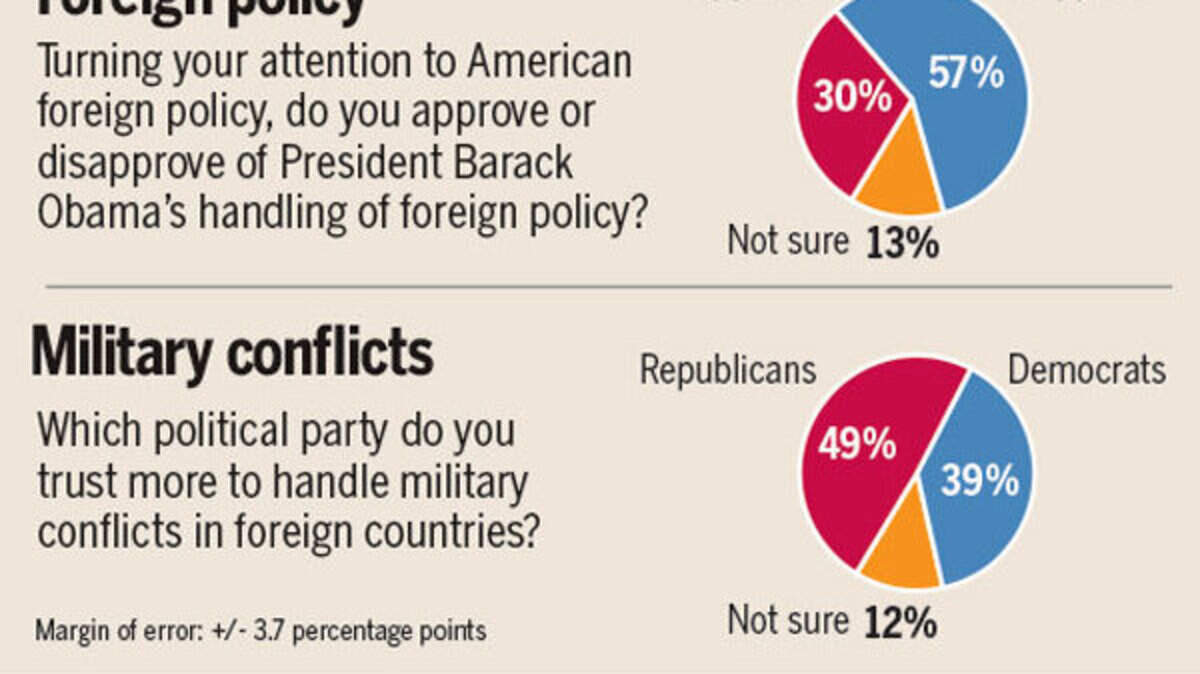
Thirty percent of respondents approve of Obama's handling of foreign policy and 57 percent disapprove, numbers that closely track Obama's overall favorable rating of 29 percent in Kentucky. Fewer than half of Kentucky Democrats, 49 percent, said they approve of Obama's handling of foreign policy.
Retired Louisville school teacher Jane Nast, a poll respondent who agreed to a follow-up interview with the Herald-Leader, said she especially is concerned with how Obama has dealt with the Islamic State.
"I support his airstrikes in Iraq and Syria, but it was ludicrous for him to say no American troops on the ground," Nast said. "Why did he broadcast his strategy? I'm afraid that the only real way to make a difference in fighting those crazies is ground troops."
Overall, Kentuckians trust Republicans more than Democrats to "handle military conflicts in foreign countries" by a 10-point margin, 49 percent to 39 percent, with 12 percent answering "not sure."
Men chose Republicans over Democrats by an 18-point margin, but the Republican advantage shrunk to 2 percent among women.
The only portion of the state that trusts Democrats more than Republicans to handle military conflicts is the Louisville region, where 48 percent chose Democrats and 41 percent chose Republicans. In north-central Kentucky, which includes the Lexington area and most of Northern Kentucky, 48 percent chose Republicans and 40 percent chose Democrats. More than half of voters picked Republicans in Eastern and Western Kentucky.
The United States and an international coalition initiated airstrikes against the Islamic State in both Iraq and Syria on Sept. 22, a move that is supported by 76 percent of Kentucky voters. Thirteen percent oppose the decision and 11 percent aren't sure.
Kentuckians are more closely divided on other possible actions to fight ISIS, with a small plurality supporting an effort to arm and train Syrian rebels and a slightly larger plurality opposing the use of American ground forces.
Forty percent said they support using American resources to arm and train the rebels, while 37 percent said they were opposed and 23 percent were not sure. Democrats were more likely to support the action than Republicans, 44 percent to 38 percent, as were men than women, 45 percent to 36 percent.
Congress voted in mid-September to give Obama the authority to arm and train Syrian rebels. Kentucky's two Republican U.S. Senators split on the issue. U.S. Senate Minority Leader Mitch McConnell voted in favor of the measure, while U.S. Sen. Rand Paul voted against it.
The campaign of Democratic U.S. Senate candidate Alison Lundergan Grimes, who is challenging McConnell in the Nov. 4 election, told the Associated Press last month that she would have voted against the measure if it had been a standalone bill, but because it was attached to a funding measure, she would have voted for it.
According to the Associated Press, Grimes' campaign said "she supports strong action to hunt down terrorists but 'would only vote for arming and training Syrians if there is compelling evidence that they are trustworthy and effective.'"
When asked about using ground troops to fight ISIS, 37 percent of respondents said they approved of the idea and 46 percent opposed it. Seventeen percent were not sure.
Republicans and Democrats were sharply divided on using ground troops, with half of Republicans supporting the idea and 38 percent opposing it. Among Democrats, 29 percent support using ground troops and 52 percent oppose it.
Poll respondent Dwayne Hammack, a disabled coal miner in Hopkins County, said Obama should be applauded for not sending ground troops to fight the Islamic State.
"We've got the air power to do the job. Let's use it," he said.
Ron Marlow, a former mayor of Campbellsburg in Henry County, said he isn't sure air power will solve the problem.
"I support the airstrikes, but we may have to go in ourselves despite what Obama said," Marlow said. "I think it would have been better to get the Muslims of Saudi Arabia and Iraq to go after the Islamic State terrorists."
On the importance of issues other than foreign policy, the opinions of Kentucky voters have remained largely unchanged since July.
After jobs and the economy, health care ranked as the second-most cited issue of concern at 10 percent, up one point from two months ago. Immigration dropped one point to 9 percent, followed by taxes and spending at 8 percent, which also was down one point from July.
"Most of the time, voters asked to name their top policy priorities will answer something related to the economy, whether that's economic growth or jobs or taxes or inflation," said Stephen Voss, a political science professor at the University of Kentucky. "Usually it takes a big event to distract voters from economic concerns, and we've had two in quick succession: the crisis in the Middle East and the crush of Central Americans at the U.S. border."
In general, anything that removes voters' focus from pocketbook issues can be problematic for Democrats, Voss said.
"These events happening outside our borders are stacking the deck in favor of the GOP," Voss said. "Conservatives tend to be the ones focused on border issues and international issues, and they're especially unimpressed with President Obama's policies in those domains."
Still, Voss said, voters' interest in foreign policy and immigration might wane in the coming month, particularly if the beheadings cease and the migration wave ebbs.
"We would expect some bounce back to the Democrats if voter attention drifts back and they start looking around in their empty pocketbooks again," he said.
This story was originally published October 7, 2014 at 5:00 PM with the headline "Bluegrass Poll: Less than half of Kentucky Democrats approve of Obama's handling of foreign policy."